bolt Quick Answer (As of 2026)
A 100 watt LED bulb is not simply the LED equivalent of an old 100W incandescent bulb. That is one of the most common misunderstandings in modern lighting.
A 100 watt LED bulb is not simply the LED equivalent of an old 100W incandescent bulb. That is one of the most common misunderstandings in modern lighting.
When people search for a 100 watt bulb, they may be asking for one of two completely different things. They might want a bulb that consumes 100 watts of electricity, or they may want an LED bulb that produces the same amount of light as a traditional 100W incandescent bulb.
Those are not the same thing.
A traditional 100W incandescent bulb consumes 100 watts to produce roughly 1,500–1,700 lumens of light. A modern 100 watt LED light can produce dramatically more light—potentially 10,000 lumens or more—while consuming the same electrical power.
This difference is at the heart of LED efficiency.
For homeowners, businesses, warehouses, factories, commercial buildings, and outdoor applications, understanding the distinction between actual wattage, equivalent wattage, and lumen output can prevent costly purchasing mistakes.
This guide compares 100W LEDs with traditional incandescent, halogen, CFL, and metal-halide lighting. We'll examine brightness, energy consumption, heat generation, lifespan, operating costs, and the practical situations where a genuine 100W LED makes sense.
What Does "100 Watt LED" Actually Mean?
The phrase 100 watt LED normally means an LED lighting product that consumes approximately 100 watts of electrical power.
That is very different from saying
- "100W equivalent LED."
A 100W-equivalent LED is designed to replace the light output of a traditional 100W incandescent bulb while using far less electricity.
Here's the key difference
- Product Description
- Approx. Power Consumption
- Typical Light Output
- 100W Incandescent
- 100W
- 1,500–1,700 lumens
- 100W Halogen
- ~100W
- 1,600–2,000 lumens
- 100W-equivalent LED
- ~12W–18W
- ~1,500–2,000 lumens
- Actual 100W LED
- 100W
- ~10,000–15,000+ lumens*
*Actual output varies significantly by product efficiency, driver design, LED technology, thermal management, and optical losses.
This is why the label needs to be read carefully.
A 100W-equivalent LED is a household replacement for a traditional 100W bulb.
A genuine 100W LED light is a high-output lighting product typically intended for commercial, industrial, floodlighting, high-bay, or other demanding applications.
100W LED vs. 100W Incandescent: Brightness Comparison
The first thing to understand is that wattage and brightness are different measurements.
Watts measure electrical power.
Lumens measure visible light output.
A traditional incandescent bulb converts only a small portion of its electrical energy into visible light. Much of the energy becomes heat.
An LED is significantly more efficient at converting electricity into useful light.
Traditional 100W Incandescent
- A typical 100W incandescent bulb produces around
- 1,500–1,700 lumens
That is enough for general residential lighting.
Genuine 100W LED
- A modern high-quality 100W LED light may produce
- 10,000–15,000+ lumens
depending on the LED chips, driver efficiency, thermal design, and optical system.
In other words, a true 100W LED can produce several times the light output of a 100W incandescent bulb.
This makes it unsuitable as a direct one-for-one replacement in many ordinary household fixtures.
A 100W LED can be excessively bright in a small bedroom or living room.
It is better suited to applications where high-output illumination is required.
Why Is a 100W LED So Much Brighter?
The answer is luminous efficacy.
Luminous efficacy describes how efficiently a lighting system converts electrical power into visible light.
It is typically expressed as
- Lumens per watt (lm/W)
- Consider this simplified comparison
- Incandescent
- 100W × 16 lm/W = 1,600 lumens
- LED
- 100W × 120 lm/W = 12,000 lumens
The LED system produces significantly more light from the same electrical input.
The actual efficiency of a complete LED lamp will depend on
- LED chip efficiency
- Driver losses
- Thermal conditions
- Optical losses
- Diffuser efficiency
- Operating temperature
The LED itself may have a higher theoretical efficacy than the final lamp achieves.
This is why professional buyers should compare delivered lumens, not just LED chip specifications.
100W-Equivalent LED vs. Actual 100W LED
This distinction deserves special attention.
100W-Equivalent LED
A 100W-equivalent LED typically consumes around 12W–18W.
It produces approximately 1,500–2,000 lumens.
It is designed to replace a conventional 100W household bulb.
Typical applications include
- Living rooms
- Bedrooms
- Kitchens
- Offices
- Table lamps
- Ceiling fixtures
- Actual 100W LED
A true 100W LED consumes approximately 100W.
It may produce 10,000 lumens or more.
Typical applications include
- LED floodlights
- High-bay lighting
- Warehouses
- Workshops
- Industrial facilities
- Large outdoor areas
- Sports and recreational spaces
The two products may both be described as "100 watt LED" in casual conversations, but they serve very different purposes.
Always verify whether "100W" refers to actual power consumption or incandescent equivalent.
Energy Efficiency: 100W LED vs. Traditional 100W Bulb
This is where LEDs offer one of their biggest advantages.
Suppose you replace a 100W incandescent bulb with a 15W LED that provides a comparable amount of light.
The energy saving is
- 100W − 15W = 85W
That's an 85% reduction in electrical power consumption.
Now imagine the bulb operates for 5 hours every day.
Incandescent
- 100W × 5 hours = 500Wh/day
- LED
- 15W × 5 hours = 75Wh/day
- Daily saving
- 425Wh
- Annual saving
- 425 kWh × 365 = approximately 155 kWh per year
For a single bulb, that's meaningful.
For 100 bulbs operating in a commercial building, the savings become substantial.
This is one reason businesses increasingly replace traditional lighting with LEDs.
What About a Genuine 100W LED?
A true 100W LED does not save energy compared with a 100W incandescent if both consume exactly 100W.
The difference is that the 100W LED produces far more light.
Think of it this way
- 100W Incandescent
- 100W consumption
- ~1,600 lumens
- Significant heat
- Short lifespan
- 100W LED
- 100W consumption
- Potentially 10,000–15,000+ lumens
- Much higher efficacy
- Lower heat generation per lumen
- Much longer service life
- The LED's advantage is therefore not simply "100W LED uses less electricity."
- The more accurate statement is
A 100W LED produces dramatically more light per watt than a traditional 100W incandescent bulb.
If you need 12,000 lumens of illumination, the LED can deliver that output using approximately 100W, whereas achieving the same output with incandescent technology would require a much larger electrical load.
LED vs. Incandescent: Heat Generation
One of the most noticeable differences is heat.
Incandescent bulbs are essentially small electric heaters that happen to produce light.
A large percentage of the energy consumed becomes infrared radiation and heat.
A 100W incandescent bulb can become extremely hot during operation.
This creates several problems
- Higher cooling loads
- Risk of burns
- Heat buildup in enclosed fixtures
- Increased air-conditioning demand
- Potential damage to nearby materials
LEDs also produce heat, but they are much more efficient at producing visible light.
However, this does not mean that a 100W LED is completely cool.
A genuine 100W LED still generates substantial heat and requires proper thermal management.
The heat must be transferred away from the LED junction through
- LED chip → PCB → thermal interface → heat sink → surrounding environment
- A poorly designed 100W LED may suffer from
- Reduced lumen output
- Color shift
- Driver failure
- Shortened lifespan
This is why thermal engineering becomes increasingly important as LED wattage increases.
The Importance of Heat Dissipation in a 100W LED Light
For high-power LED products, heat management is not optional.
A reliable 100 watt LED light should have an appropriately designed thermal system.
Depending on the product, this may include
- Aluminum heat sinks
- Fin structures
- Thermally conductive housing
- Thermal interface materials
- Efficient internal airflow
- Separate driver compartments
The design should match the application.
For example, a 100W floodlight installed outdoors may have better natural airflow than a 100W LED enclosed in a poorly ventilated industrial fixture.
Pro Tip
When buying a high-power LED, don't judge the product solely by its lumen rating.
Ask
- How is the heat being removed?
A product that claims extremely high lumen output but has an undersized thermal system may not maintain its rated performance over the long term.
Lifespan: 100W LED vs. Traditional Bulbs
Traditional incandescent bulbs typically have a relatively short operating life.
A common incandescent bulb may last approximately
- 1,000 hours
- A quality LED product may have a rated life of
- 25,000–50,000+ hours
depending on design and operating conditions.
The difference is substantial.
If a bulb operates 5 hours per day
- 1,000-hour incandescent
- Approximately 200 days of operation
- 25,000-hour LED
- Approximately 13.7 years of theoretical operation
- Of course, real-world LED lifespan depends on
- Ambient temperature
- Driver quality
- Electrical stability
- Operating hours
- Thermal management
- Product quality
The "50,000 hours" printed on packaging should therefore be interpreted as a rated lifetime under specified conditions, not an unconditional guarantee that every component will operate perfectly for 50,000 hours.
In many cases, LED products continue operating but gradually lose light output over time.
This is known as lumen depreciation.
100W LED vs. Halogen
Halogen lamps are more efficient than traditional incandescent bulbs but still significantly less efficient than modern LEDs.
A 100W halogen lamp may produce roughly 1,600–2,000 lumens.
A 100W LED can potentially produce several times that amount.
LED advantages include
- Lower energy consumption for equivalent brightness
- Longer lifespan
- Lower operating temperature
- Better efficiency
- Reduced maintenance
Halogen lamps may still be preferred in specific applications where their distinctive light quality or compatibility is important, but for general energy-efficient lighting, LEDs have a substantial advantage.
100W LED vs. CFL
Compact fluorescent lamps (CFLs) were widely adopted as an energy-efficient alternative to incandescent lighting before LEDs became mainstream.
A CFL can provide similar light output to a traditional 100W incandescent while consuming significantly less electricity.
However, LEDs offer several advantages
- Instant-on operation
- Longer service life
- Better dimming options
- No mercury content
- Improved durability
- Better directional control
- More compact designs
Modern LED technology has largely replaced CFLs in many applications.
100W LED vs. Metal Halide
The comparison becomes especially interesting in commercial and industrial lighting.
A 100W LED system may replace a higher-wattage metal-halide fixture, depending on the application and required light levels.
Metal-halide systems often have
- Higher energy consumption
- Longer warm-up times
- Longer restart times after power interruption
- More maintenance requirements
- LED systems offer
- Instant-on operation
- Better controllability
- Longer service life
- Reduced maintenance
- High directional efficiency
However, replacement should be based on actual lumen output and lighting distribution, not a simple watt-for-watt substitution.
A 100W LED may replace a much higher-wattage traditional fixture because of improved optical control.
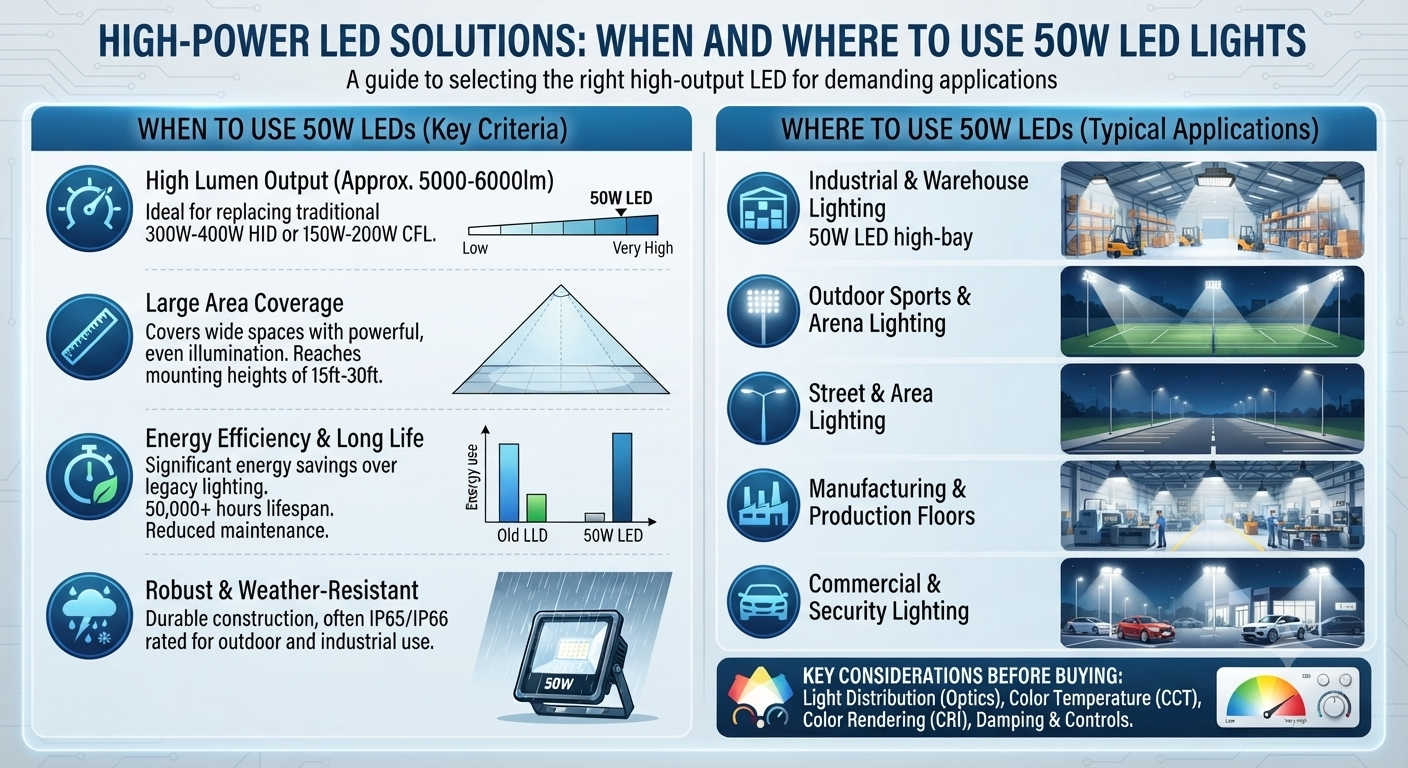
Where Should You Use a 100W LED Light?
A genuine 100W LED is generally a high-output lighting solution.
Common applications include
- Warehouses
High ceilings and large floor areas require substantial light output.
Workshops
Mechanical and manufacturing environments often benefit from high-output illumination.
Industrial Facilities
A 100W LED can provide efficient general lighting in large spaces.
Outdoor Floodlighting
Large yards, building facades, parking areas, and security zones may require high lumen output.
Commercial Buildings
Large retail, storage, and operational spaces can benefit from high-efficiency LED lighting.
Agricultural Facilities
Barns, sheds, and other large structures may require powerful lighting, depending on the application.
The exact suitability depends on mounting height, beam angle, required lux level, and the number of fixtures.
How Bright Is a 100W LED?
This depends on the product's luminous efficacy.
Consider three examples
- 100W LED Efficiency
- Approximate Output
- 80 lm/W
- 8,000 lumens
- 100 lm/W
- 10,000 lumens
- 120 lm/W
- 12,000 lumens
- 150 lm/W
- 15,000 lumens
These figures are simplified calculations.
The actual delivered lumens may be lower because of driver losses, optical losses, temperature, and other factors.
For professional purchasing, always ask for the rated lumens of the complete fixture, not just the theoretical LED chip efficacy.
Beam Angle Changes How Bright a 100W LED Feels
A 100W LED producing 12,000 lumens can be designed with different beam angles.
A wide beam spreads light across a larger area.
A narrow beam concentrates light into a smaller area.
The result?
Two 100W LED floodlights with identical wattage and lumen output can produce very different illumination levels on the ground.
For example
- Wide beam: Large area, lower intensity per square meter
- Narrow beam: Smaller area, higher intensity
- Medium beam: Balance between coverage and intensity
- This is why lighting design should consider
- Lumens + Beam Angle + Mounting Height + Spacing
Wattage alone cannot determine the quality of the installation.
How Much Does a 100W LED Cost to Run?
The operating cost depends on your electricity tariff.
The calculation is straightforward
- Power consumption (kW) × Operating hours × Electricity rate = Energy cost
- A 100W LED consumes
- 1 kW per hour
- If it operates for 10 hours
- 1 × 10 = 1 kWh
- If electricity costs $0.15 per kWh
- 1 × $0.15 = $0.15
The same calculation can be adapted to your local electricity tariff.
For businesses, the savings become more significant when comparing a 100W LED with traditional lighting that requires substantially more power to achieve the same useful illumination.
Don't Confuse Rated Wattage With Maximum Wattage
- When purchasing a 100 watt bulb, check whether the product is
- Rated at 100W
- Maximum 100W
- 100W equivalent
- 100W input
- 100W LED chip power
These descriptions can mean very different things.
A reputable manufacturer should clearly state the actual power consumption of the finished product.
For commercial and industrial applications, ask for
- Input power
- Rated voltage
- Power factor
- Lumen output
- Lumens per watt
- Operating temperature
- Surge protection
- Warranty
- Beam angle
This information provides a much clearer picture of what you're actually buying.
Is a 100W LED Always Better Than a Lower-Wattage LED?
No.
The right wattage depends on the application.
If you need 1,500 lumens for a bedroom, a 100W LED would be excessive.
If you need 12,000 lumens to illuminate a warehouse, a 10W bulb would obviously be inadequate.
The goal is not maximum wattage.
The goal is the correct amount of useful light with the lowest practical energy consumption.
For this reason, professional lighting design often begins with the required lux level and target lumens, then determines fixture quantity and wattage.
Practical Buying Checklist for a 100W LED
- Before purchasing a 100W LED light, check
- Electrical Specifications
- Actual power consumption
- Input voltage
- Frequency
- Power factor
- Driver efficiency
- Lighting Performance
- Total lumens
- Lumens per watt
- Color temperature
- CRI
- Beam angle
- Reliability
- Rated lifetime
- Lumen maintenance
- Operating temperature
- Surge protection
- Thermal design
- Physical Construction
- Housing material
- Heat sink design
- IP rating for outdoor use
- Mounting system
- Lens/diffuser quality
- Commercial Considerations
- Warranty
- Certifications
- Manufacturer reputation
- Replacement availability
- Total cost of ownership
- Frequently Asked Questions
- Is a 100W LED brighter than a 100W incandescent bulb?
Yes, if both are actual 100W products. A high-quality 100W LED can produce approximately 10,000–15,000+ lumens, while a traditional 100W incandescent bulb typically produces around 1,500–1,700 lumens. The LED is therefore dramatically more efficient at converting electricity into useful light.
What LED replaces a traditional 100W bulb?
A 100W-equivalent LED producing approximately 1,500–2,000 lumens can generally replace a traditional 100W incandescent bulb. Depending on efficiency, the LED may consume approximately 12W–18W rather than 100W.
How many lumens does a 100W LED produce?
The answer depends on the product's efficiency. At 100 lm/W, a 100W LED produces approximately 10,000 lumens. At 120 lm/W, it produces approximately 12,000 lumens. Always check the manufacturer's rated lumen output for the complete fixture.
Does a 100W LED use less electricity than a 100W bulb?
If both products actually consume 100W, they use approximately the same amount of electricity. The advantage of the LED is that it produces far more light from that electricity. A 100W-equivalent LED, however, uses much less electricity because it only consumes around 12W–18W while producing similar light output to a 100W incandescent bulb.
Final Takeaway: Compare Lumens, Not Just Watts
The phrase 100 watt LED can be confusing because it may refer to either a genuine 100W high-output LED or a 100W-equivalent household replacement.
The difference is substantial.
A traditional 100W incandescent bulb produces roughly 1,500–1,700 lumens and wastes much of its energy as heat. A 100W LED can potentially produce 10,000–15,000+ lumens, making it suitable for high-output commercial, industrial, and outdoor applications.
For ordinary household replacement, you probably want a 100W-equivalent LED, not a genuine 100W LED.
For industrial and commercial applications, a true 100 watt LED light can deliver exceptionally high lumen output while reducing energy consumption compared with older high-intensity lighting technologies.
The smartest way to choose is to work backward from the lighting requirement
Determine the required lux → calculate the required lumens → select the right beam angle → choose the appropriate LED wattage → verify efficiency and thermal performance.
That approach ensures you're buying the right amount of light—not simply the biggest number printed on the package.