bolt Quick Answer (As of 2026)
A 50W LED light sits in an interesting middle ground in modern lighting. It is powerful enough for applications that demand substantially more illumination than a standard household bulb, yet compact and energy-efficient enough for many residentia...
A 50W LED light sits in an interesting middle ground in modern lighting. It is powerful enough for applications that demand substantially more illumination than a standard household bulb, yet compact and energy-efficient enough for many residential, commercial, and outdoor installations.
But choosing a 50 watt LED should never be based on wattage alone.
A 50W fixture can produce very different amounts of usable light depending on its LED chip efficiency, driver quality, optics, beam angle, color temperature, and thermal design. A well-engineered 50 watt LED light may deliver excellent illumination for years, while a poorly designed product can suffer from excessive heat, lumen depreciation, flicker, or premature driver failure.
So where does a 50W LED actually make sense?
Common applications include outdoor floodlights, security lighting, parking areas, building facades, workshops, warehouses, commercial spaces, gardens, pathways, and large rooms. It can also be an excellent replacement for older, much higher-wattage halogen or incandescent floodlights.
This guide explains how much light a 50W LED typically produces, where it works best, how to choose the right beam angle and color temperature, and what to check before buying one.
What Is a 50W LED Light?
A 50W LED light is a lighting fixture or lamp designed to consume approximately 50 watts of electrical power during normal operation.
Unlike traditional incandescent or halogen lamps, the wattage doesn't directly tell you how bright the fixture will be.
The actual light output is measured in lumens.
For example, two 50W LED fixtures could have different outputs
- Product
- Power Consumption
- Light Output
- Approx. Efficacy
- Basic 50W LED
- 50W
- 4,000 lm
- 80 lm/W
- Standard 50W LED
- 50W
- 5,000 lm
- 100 lm/W
- High-Efficiency 50W LED
- 50W
- 6,000 lm
- 120 lm/W
- Premium 50W LED
- 50W
- 7,000 lm
- 140 lm/W
These figures are illustrative; actual performance varies by product.
The key lesson is straightforward
A 50W rating tells you how much electrical power the product uses. It does not tell you exactly how much useful light it produces.
Always check the lumen rating and, ideally, the fixture's lumens-per-watt (lm/W) specification.
How Bright Is a 50 Watt LED?
The answer depends on the efficiency of the complete lighting system.
A modern 50W LED fixture might produce approximately 4,000–7,000 lumens, depending on the LED technology, driver, optical system, and thermal design.
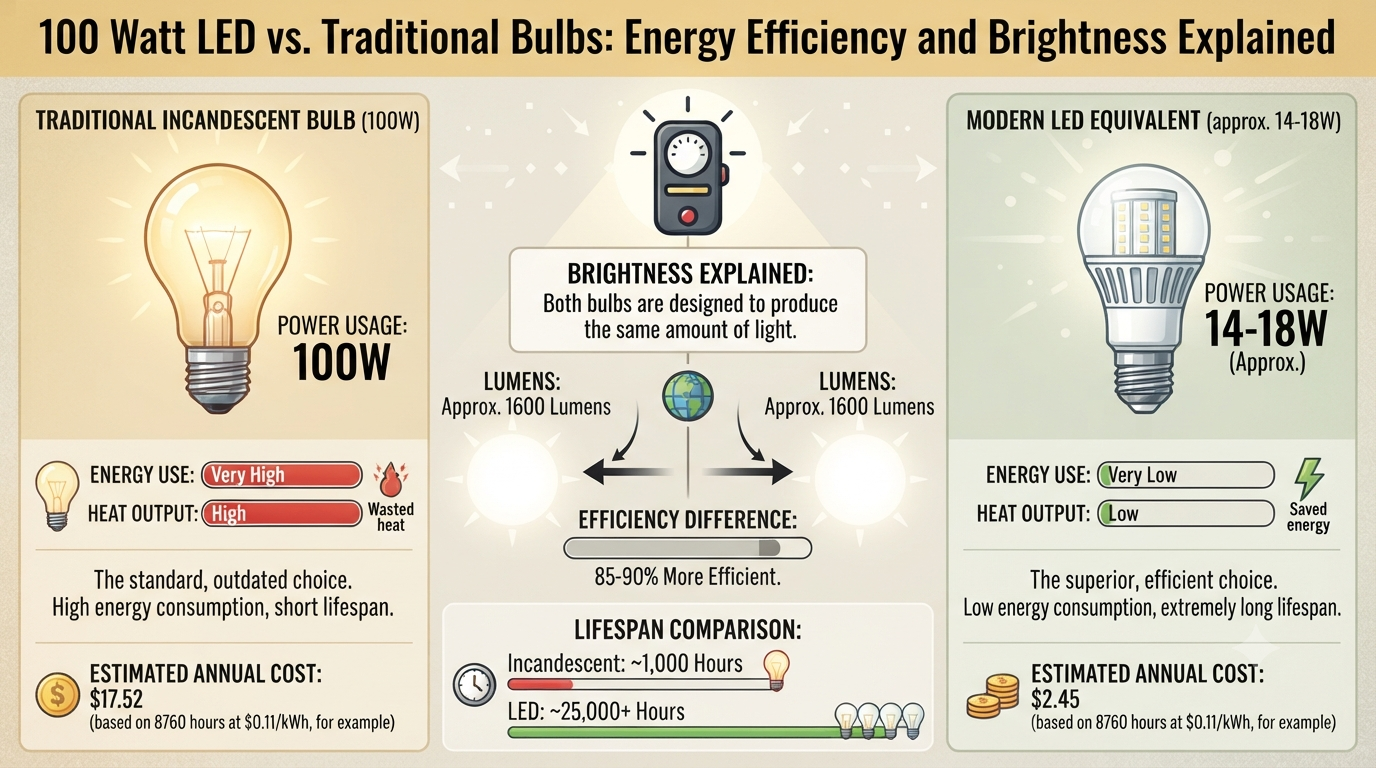
For comparison, a traditional 500W halogen floodlight could produce a similar or even lower amount of useful illumination while consuming roughly ten times as much electrical power.
This is one reason high-power LEDs have become popular for outdoor and commercial lighting.
However, brightness isn't determined by lumens alone.
A 5,000-lumen fixture with a 120-degree beam angle spreads light over a broad area.
A 5,000-lumen fixture with a 30-degree beam angle concentrates light into a much narrower zone.
The total light output is similar, but the visual effect is completely different.
50W LED vs. Traditional 50W Bulb
A common misconception is that a 50W LED is equivalent to a traditional 50W incandescent bulb.
It isn't.
A 50W incandescent bulb produces relatively little light compared with a modern 50W LED.
The LED is dramatically more efficient at converting electricity into visible light.
The comparison is better understood like this
- Lighting Technology
- Typical Power
- General Light Output
- Incandescent
- 50W
- Low
- Halogen
- 50W
- Moderate
- CFL
- 50W
- High
- LED
- 50W
- Very high
The exact lumen values vary significantly between products, but the efficiency difference is substantial.
This makes a 50 watt LED particularly attractive when replacing older high-power lighting.
When Should You Use a 50W LED Light?
A 50W LED is generally appropriate when you need moderate-to-high light output over a defined area.
Typical applications include
- Outdoor security lighting
- Driveways
- Gardens
- Parking areas
- Building entrances
- Commercial storefronts
- Workshops
- Garages
- Warehouses
- Small sports or recreational areas
- Construction sites
- Industrial workspaces
The correct application depends on the fixture's optical characteristics.
A 50W floodlight may be excellent for illuminating a driveway.
The same fixture may be unsuitable for a high-mast parking lot where a much higher mounting height and wider coverage are required.
The wattage alone doesn't determine suitability.
50W LED Floodlights for Outdoor Security
One of the most common applications for a 50 watt LED light is outdoor security illumination.
A well-positioned floodlight can illuminate
- Driveways
- Gates
- Entrances
- Perimeter walls
- Backyards
- Parking spaces
- Loading zones
For security applications, the goal isn't simply maximum brightness.
You need sufficient illumination across the target area without creating excessive glare or dark zones.
A broad beam may be useful for general area coverage.
A narrower beam can be better when illuminating a distant gate, wall, or entrance.
Pro Tip
Don't automatically mount a 50W floodlight as high as possible.
Mounting height, beam angle, and aiming direction work together.
A poorly aimed floodlight can waste light by shining above the target area while producing glare for pedestrians and drivers.
Aim the fixture toward the area that actually needs illumination.
50W LED Lights for Driveways and Parking Areas
A 50W LED can be a practical choice for small and medium-sized outdoor spaces.
For a driveway, you might use
- One wide-angle floodlight
- Two fixtures from opposite sides
- A wall-mounted fixture near the entrance
The best arrangement depends on the geometry of the space.
For parking areas, consider
- Mounting height
- Number of parking spaces
- Required illuminance
- Uniformity
- Glare
- Pole or wall position
A single 50W LED may be adequate for a small private parking area but insufficient for a large commercial car park.
Professional projects should be designed according to the required lux levels and uniformity, rather than simply selecting fixtures by wattage.
50W LED Lights for Workshops and Garages
Workshops require more than general ambient illumination.
People may need to
- Read measurements
- Operate machinery
- Inspect components
- Repair equipment
- Work with small parts
A 50W LED can provide strong general lighting in a garage or workshop, particularly when mounted at an appropriate height.
However, consider adding dedicated task lighting.
For example
- 50W LED overhead fixture + localized task light
This is often better than trying to make one extremely bright fixture illuminate everything.
A high-output ceiling light provides general visibility.
Task lighting delivers focused illumination exactly where detailed work takes place.
50W LED Lights in Warehouses and Industrial Spaces
A 50W LED may be suitable for certain low- or medium-height industrial applications.
However, warehouse lighting requires careful planning.
Consider
- Ceiling height
- Rack arrangement
- Aisle width
- Required lux level
- Beam angle
- Mounting position
- Glare
- Uniformity
A 50W fixture with a narrow beam may work well for a specific aisle configuration.
A wide-beam fixture may provide better general coverage.
For high-bay warehouses with tall ceilings, dedicated high-bay LED fixtures are usually more appropriate than standard 50W floodlights.
The right question is
- How much useful light reaches the working surface?
- Not
- How many watts does the fixture consume?
- 50W LED for Building Facades and Architectural Lighting
High-power LED technology is also useful for exterior architectural applications.
A 50W LED floodlight can highlight
- Building walls
- Columns
- Signage
- Landscape features
- Trees
- Architectural details
Here, beam angle becomes especially important.
A narrow beam can emphasize a specific architectural element.
A wide beam can wash an entire wall with light.
Color temperature also influences the appearance.
Warm white can create a softer, more welcoming effect.
Neutral or cool white can produce a cleaner, more contemporary appearance.
Choosing the Right Beam Angle
Beam angle is critical when selecting a 50W LED.
Narrow Beam
- Best for
- Accent lighting
- Long-distance illumination
- Architectural highlights
- Specific targets
- Medium Beam
- Suitable for
- General outdoor lighting
- Entrances
- Driveways
- Commercial areas
- Wide Beam
- Useful for
- Large open areas
- Wall washing
- General security lighting
- Broad coverage
Imagine shining a flashlight.
A narrow beam concentrates light into a small area.
A wide beam spreads it across a larger area.
The same principle applies to LED floodlights.
Why Lumens Aren't Enough
Suppose you have two 50W LED floodlights.
Both produce
- 5,000 lumens
But one has a 30° beam angle.
The other has a 120° beam angle.
The 30° model concentrates the light.
The 120° model spreads it widely.
If you're illuminating a distant gate, the narrow-beam product may provide higher light intensity at the target.
If you're illuminating a broad backyard, the wide-angle fixture may be more practical.
This is why professional lighting design considers
- Lumens
- Beam angle
- Mounting height
- Target area
- Light intensity
- Uniformity
- Color Temperature: Warm White vs. Daylight
A 50W LED is available in different color temperatures.
2700K–3000K: Warm White
- Suitable for
- Residential gardens
- Hospitality
- Decorative architecture
- Relaxed environments
- 4000K: Neutral White
- Useful for
- Commercial spaces
- Workshops
- General outdoor lighting
- Entrances
- 5000K–6500K: Cool White / Daylight
- Often selected for
- Security lighting
- Industrial areas
- Utility spaces
- High-visibility applications
Cooler color temperatures can appear visually brighter, but that doesn't necessarily mean the fixture produces more lumens.
The lumen rating remains the objective measure of light output.
50W LED and Energy Efficiency
The biggest advantage of a high-quality 50W LED is its ability to produce substantial illumination with relatively low energy consumption.
Consider a simple comparison.
Suppose a traditional floodlight consumes
- 500W
- A replacement LED consumes
- 50W
- The power reduction is
- 500W − 50W = 450W
That's a 90% reduction in rated power consumption.
If the light operates for 8 hours per day
- 450W × 8 hours = 3,600Wh
- or
- 6kWh saved per day
- Over 30 days
- 6 × 30 = 108kWh saved per month
Your actual financial savings depend on your electricity tariff.
This is where high-power LED lighting can deliver meaningful operating-cost reductions, particularly in applications where lights run for many hours each day.
The Importance of LED Driver Quality
A 50W LED fixture isn't just an LED chip.
It also requires a driver or power supply.
The driver controls the electrical power delivered to the LED.
A quality driver contributes to
- Stable operation
- Better efficiency
- Lower flicker
- Improved power factor
- Longer service life
- A poor driver can cause
- Flickering
- Buzzing
- Premature failure
- Excessive electrical losses
When purchasing a 50W LED light, don't focus only on the LED chip brand.
The driver is equally important.
For commercial or industrial projects, ask for driver specifications and warranty information.
Thermal Management in 50 Watt LED Lights
At 50W, thermal design becomes increasingly important.
LEDs generate heat.
Although they are far more efficient than incandescent lamps, a portion of the electrical energy still becomes heat.
That heat must be transferred away from the LED junction.
A properly designed 50W fixture may use
- Aluminum heat sinks
- Die-cast aluminum housings
- Thermal interface materials
- Ventilation channels
- Efficient thermal paths
- Poor heat dissipation can lead to
- Reduced lumen output
- Faster lumen depreciation
- Driver stress
- Shortened lifespan
- Pro Tip
When evaluating a 50W LED, look at the housing.
A substantial aluminum body is often necessary for effective thermal management, particularly in outdoor fixtures exposed to high ambient temperatures.
Don't judge quality solely by how bright the fixture looks when first switched on.
Long-term thermal performance matters just as much.
IP Rating: Choosing a 50W LED for Outdoor Use
Outdoor fixtures are exposed to weather.
Rain, dust, humidity, and temperature changes can all affect performance.
The IP rating indicates the degree of protection provided by the enclosure against solid particles and water ingress.
For outdoor installations, choose a product with an appropriate IP rating for the environment.
A fixture under a protected roof may face very different conditions from one exposed directly to:
Heavy rain
- Wind-driven dust
- Sprinklers
- Coastal humidity
Don't assume every 50W LED floodlight is suitable for every outdoor location.
Check the manufacturer's specifications.
50W LED Floodlight With Motion Sensor
For security applications, a motion sensor can make a 50W LED even more useful.
Instead of operating continuously, the fixture activates when movement is detected.
This can reduce energy consumption while providing strong illumination when needed.
Common applications include
- Residential entrances
- Driveways
- Garages
- Warehouses
- Side passages
- Security perimeters
However, sensor placement matters.
A poorly positioned sensor may trigger unnecessarily due to
- Passing vehicles
- Animals
- Tree movement
- Environmental changes
For reliable security lighting, configure the detection zone and activation time carefully.
Fixed vs. Adjustable 50W LED Lights
Some fixtures have fixed optics.
Others allow you to adjust the light direction.
Adjustable floodlights can be useful when
- The target area changes
- The mounting position is fixed
- You need precise aiming
- One fixture serves multiple purposes
For security lighting, adjustability can help direct light exactly where it's required.
For architectural lighting, it can make installation easier because the beam can be aimed at a wall or feature.
50W LED vs. 30W and 100W LED Lights
The correct wattage depends on the application.
Feature
- 30W LED
- 50W LED
- 100W LED
- General Output
- Moderate
- High
- Very High
- Typical Use
- Small areas
- Medium areas
- Large areas
- Energy Consumption
- Lower
- Moderate
- Higher
- Outdoor Floodlighting
- Small coverage
- Small-to-medium coverage
- Medium-to-large coverage
- Ideal Application
- Entrances, paths
- Driveways, security, workshops
- Large yards, parking, commercial spaces
This is a general comparison.
Actual performance depends on the lumen output and optical design.
A highly efficient 30W fixture may outperform an inefficient 50W product.
Likewise, a 100W LED may be excessive for a small residential driveway.
Use the lowest power that delivers the required illumination—not simply the highest wattage available.
How Many 50W LED Lights Do You Need?
There's no universal answer.
The number of fixtures depends on
- Area size
- Mounting height
- Required lux
- Beam angle
- Fixture lumen output
- Desired uniformity
For example, two strategically positioned 50W floodlights may provide better coverage than one 100W fixture.
Why?
Because multiple fixtures can reduce shadows and improve uniformity.
However, adding more fixtures increases
- Installation costs
- Wiring requirements
- Maintenance points
- Total equipment cost
Professional projects should ideally use lighting calculations or photometric simulations.
For simple residential applications, a practical trial installation can also help determine whether the coverage is adequate.
Common Mistakes When Buying a 50W LED
- Mistake 1: Assuming Every 50W LED Is Equally Bright
Check lumens.
Mistake 2: Ignoring Beam Angle
A narrow beam and wide beam produce very different results.
Mistake 3: Buying Based Only on Price
Cheap products may use lower-quality drivers and thermal components.
Mistake 4: Ignoring IP Rating
Outdoor fixtures need appropriate environmental protection.
Mistake 5: Overlooking Heat Dissipation
Thermal design strongly affects long-term reliability.
Mistake 6: Installing One Extremely Bright Fixture Instead of Multiple Smaller Fixtures
One fixture may create harsh shadows and uneven illumination.
Mistake 7: Choosing the Wrong Color Temperature
The light may be technically bright but visually uncomfortable.
50W LED Buying Checklist
- Before purchasing a 50 watt LED light, check
- Lumens
- How much actual light does it produce?
- Efficacy
Calculate or verify lumens per watt.
Beam Angle
- Will the fixture cover the required area?
- Color Temperature
Choose warm, neutral, or cool white according to the application.
CRI
Check color rendering if accurate color perception matters.
Driver
Look for reliable, high-quality power electronics.
Thermal Design
Check the housing and heat dissipation.
IP Rating
Ensure the product is suitable for its environment.
Warranty
A strong warranty can indicate manufacturer confidence.
Mounting
Confirm that the bracket and mounting system suit the installation location.
Dimming or Sensors
If required, verify compatibility before purchase.
Frequently Asked Questions
- How bright is a 50W LED light?
A typical 50W LED fixture may produce approximately 4,000–7,000 lumens, depending on its efficiency and design. The actual brightness you experience also depends on beam angle, mounting height, and light distribution.
Is a 50 watt LED good for outdoor security lighting?
Yes. A 50W LED floodlight can be an excellent choice for driveways, entrances, gardens, gates, and small-to-medium security areas. Select the beam angle and IP rating based on the specific installation environment.
How much electricity does a 50W LED use?
A 50W LED consumes approximately 0.05 kilowatt-hours (kWh) for every hour it operates, assuming its actual power consumption is 50W. Operating it for 10 hours would consume approximately 0.5 kWh. Actual consumption may vary slightly depending on the driver's efficiency and the fixture's operating conditions.
Is a 50W LED better than a 100W LED?
Not necessarily. A 50W LED uses less energy, but a 100W LED can produce more light and cover a larger area. The correct choice depends on the required lumen output, mounting height, beam angle, and coverage area.
Final Takeaway: Use 50W LED Lights Where High Output Meets Practical Efficiency
A 50W LED light is a versatile solution for applications that need more illumination than ordinary household bulbs but don't require the output of large industrial floodlights or high-bay fixtures.
It can work exceptionally well for
Security lighting. Driveways. Gardens. Entrances. Workshops. Garages. Small parking areas. Building facades. Commercial spaces.
But don't choose a 50 watt LED simply because "50W" sounds powerful.
Look at the complete lighting system.
Check lumens. Calculate efficacy. Select the right beam angle. Consider mounting height. Evaluate driver quality. Verify thermal management. Check the IP rating.
The best 50W LED is not necessarily the one with the highest advertised brightness or the lowest price.
It's the one that delivers the right amount of useful light, across the required area, with reliable thermal and electrical performance and reasonable long-term operating costs.
For many residential and commercial applications, that combination makes the 50W LED light a highly practical step between low-power general lighting and larger high-output LED systems.