bolt Quick Answer (As of 2026)
Traditional LED lighting already changed the way we illuminate our homes and businesses. Compared with incandescent and halogen bulbs, LEDs use less electricity, last much longer, and offer a wider range of color temperatures.
Traditional LED lighting already changed the way we illuminate our homes and businesses. Compared with incandescent and halogen bulbs, LEDs use less electricity, last much longer, and offer a wider range of color temperatures.
Now there's another step forward: smart LED lights.
Instead of simply switching a light on or off, smart lighting allows you to control brightness, color temperature, schedules, scenes, and sometimes even full RGB colors from a smartphone, remote control, voice assistant, or automated home system.
You can turn the lights on before arriving home. Dim the living room without leaving the sofa. Set bedroom lights to gradually brighten in the morning. Program outdoor lights to switch on automatically at sunset. Or create a lighting scene that changes several fixtures at once.
But are these features genuinely useful, or are smart bulbs simply ordinary LEDs with a more complicated control system?
The answer depends on how you use your lighting.
For some households, smart lighting is a worthwhile upgrade that adds convenience, energy management, and greater control. For others, a high-quality conventional LED bulb with a reliable wall switch is all that's needed.
This guide explains how smart LED lights work, what features actually matter, how smart light bulbs compare with conventional LEDs, where products such as Hue light bulbs fit into the market, and whether smart lighting is worth the additional investment.
Smart LED Lights vs. Traditional LED Bulbs
- Feature
- Traditional LED Bulb
- Smart LED Light
- On/Off Control
- Wall switch
- App, voice, switch, automation
- Dimming
- Requires compatible dimmer
- Often built in
- Scheduling
- Usually unavailable
- Yes
- Remote Control
- No
- Yes
- Color Temperature
- Usually fixed
- Fixed or adjustable
- RGB Colors
- Rare
- Available on some models
- Smart Home Integration
- Limited
- Common
- Energy Monitoring
- Usually unavailable
- Available on some systems
- Installation
- Simple
- Simple to moderate
- Cost
- Lower
- Higher
- Best For
- Basic lighting
- Connected and automated homes
The key distinction is control.
A conventional LED bulb provides efficient illumination.
A smart LED light adds a digital control layer on top of that lighting.
What Are Smart LED Lights?
Smart LED lights are LED lighting products that can be controlled electronically through a wireless or connected system.
Depending on the product, control may be available through
- Smartphone apps
- Wi-Fi
- Bluetooth
- Zigbee
- Matter
- Smart home hubs
- Voice assistants
- Wireless switches
- Motion sensors
- Automation platforms
Some smart bulbs connect directly to your home Wi-Fi network.
Others communicate through a dedicated hub or bridge.
Some newer ecosystems use standards designed to improve interoperability between different smart-home products.
The exact technology matters because it affects
- Setup
- Reliability
- Network requirements
- Response time
- Compatibility
- Scalability
If you're installing one or two smart bulbs, almost any mainstream system may work well.
If you're planning an entire smart home, ecosystem compatibility becomes much more important.
How Do Smart Light Bulbs Work?
A smart bulb contains the same basic LED lighting technology found in conventional LED lamps, but it also includes electronic control circuitry.
A typical smart bulb may contain
- LED chips
- LED driver
- Microcontroller
- Wireless communication hardware
- Power-management electronics
When you send a command from your smartphone, the control system communicates with the bulb.
The bulb then adjusts its output.
For example
- "Set brightness to 50%."
The internal electronics regulate the LED output accordingly.
For color-changing products, multiple LED channels may be combined to create different colors or white-light temperatures.
This is why smart bulbs tend to be more expensive than basic LED bulbs.
You're paying for both the lighting hardware and the electronic control system.
The Biggest Benefit: Convenience
- The strongest argument for smart lighting is simple
You gain more control over your lights.
Imagine you're already in bed and realize the downstairs lights are still on.
With smart lighting, you may be able to switch them off from your phone.
Or you're arriving home late.
You can turn the entrance lights on remotely before you reach the door.
This may sound like a small improvement.
Over time, however, these small conveniences can become surprisingly useful.
Smart lighting becomes especially valuable when controlling multiple fixtures.
Instead of walking around the house switching individual lights, you can activate a predefined scene with one command.
Smart Lighting Automation
Automation is where smart LED lights become significantly more interesting.
You can create rules based on
- Time
- Sunrise
- Sunset
- Motion
- Occupancy
- Location
- Other smart-home events
- For example
- Morning
Bedroom lights gradually increase in brightness.
Evening
Living-room lights automatically switch to a warm, low-intensity setting.
Night
Hallway lights operate at reduced brightness.
Vacation
Lights turn on and off at different times to make the property appear occupied.
This is more sophisticated than simply controlling a bulb from a phone.
The lighting becomes part of the home's overall automation system.
Smart Light Bulbs and Energy Savings
One of the most common questions is whether smart lighting actually saves energy.
The answer is
Potentially, but not automatically.
Smart bulbs are still LED products, so they already benefit from LED energy efficiency.
The additional energy savings come from better control.
For example, automation can prevent lights from being left on unnecessarily.
You might program
- Lights off after midnight
- Outdoor lights off at sunrise
- Hallway lights to operate at 20% brightness overnight
- Motion-triggered lighting only when someone is present
These controls can reduce unnecessary energy consumption.
However, a smart bulb that is constantly left at full brightness doesn't magically consume less electricity than a comparable conventional LED.
Smart technology provides the opportunity for better energy management.
Your habits and automation settings determine how much you actually save.
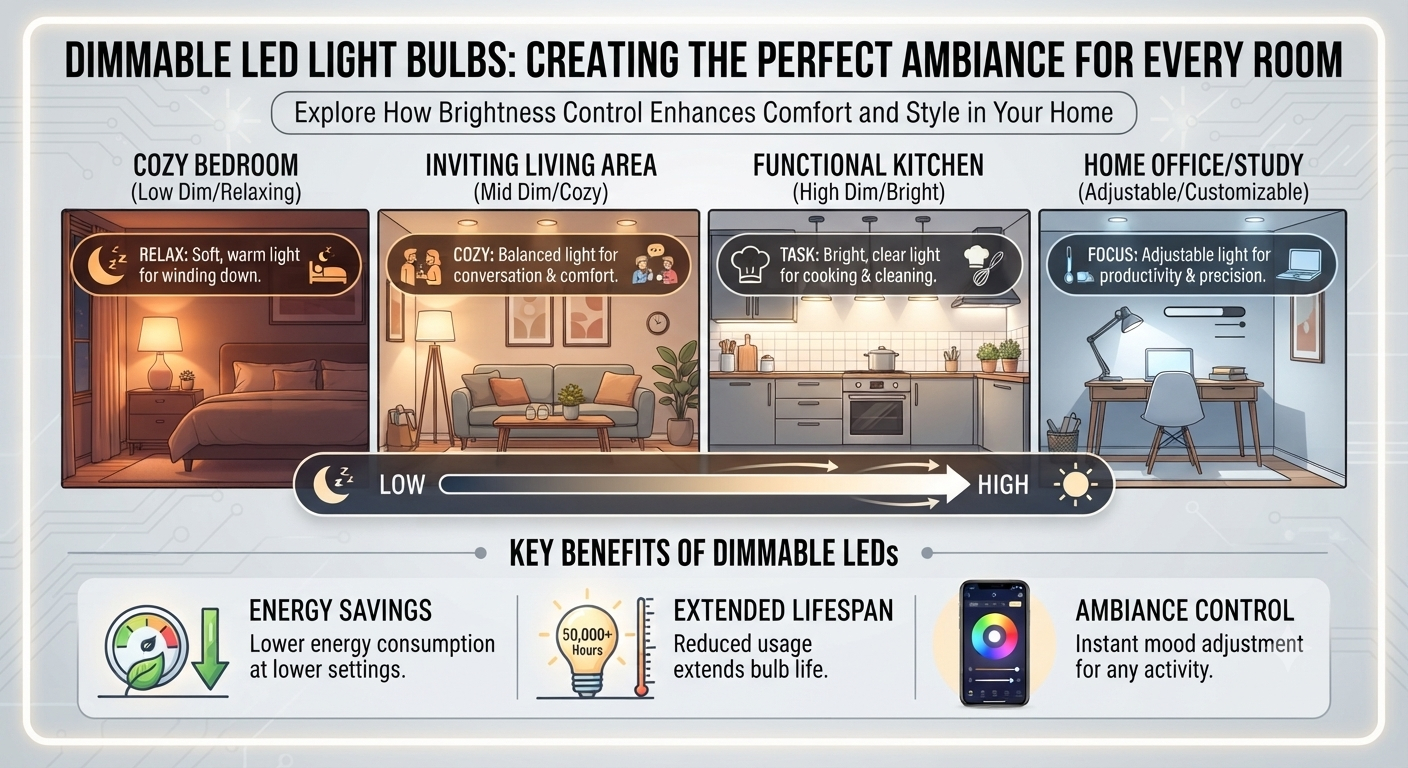
Dimming Without a Traditional Dimmer
One advantage of many smart light bulbs is built-in electronic dimming.
A conventional LED bulb may require
- A compatible dimmer switch
- A dimmable LED bulb
- Correct electrical compatibility
A smart bulb can often be dimmed directly through its app or control system.
This can simplify installation.
However, there is an important consideration.
A smart bulb generally needs continuous electrical power to remain connected to the network.
If someone turns off the wall switch, the bulb loses power and becomes unavailable.
This is one reason smart lighting systems often work best with
- Smart switches
- Wireless buttons
- Scene controllers
rather than relying exclusively on conventional wall switches.
Color Temperature: A More Useful Smart Feature Than RGB
Many people associate smart bulbs with millions of colors.
That's certainly a feature of some products.
But for everyday residential lighting, adjustable white color temperature may be more useful.
For example
- 2700K: Warm, relaxing evening light
- 3000K: Comfortable warm white
- 4000K: Neutral, functional illumination
- 5000K+: Cool daylight appearance
A tunable-white smart bulb allows you to change the atmosphere throughout the day.
You might use cooler white light during working hours and warmer light in the evening.
This approach can be more practical than changing your entire room to blue, green, or purple.
RGB Smart LED Lights
RGB smart lighting uses red, green, and blue LED channels to create different colors.
Some products also add a dedicated white LED channel to improve white-light quality.
RGB lighting can be useful for
- Entertainment rooms
- Gaming setups
- Parties
- Decorative lighting
- Accent walls
- Media rooms
However, RGB lighting isn't necessarily the best choice for general illumination.
If you need high-quality white light for
- Reading
- Cooking
- Working
- Dressing
a dedicated white-light channel or tunable-white system may provide better results.
Pro Tip
Choose RGB because you genuinely want color-changing effects.
Don't choose it simply because "more colors" sounds better.
For everyday lighting, good white-light quality is often more valuable.
Where Do Hue Light Bulbs Fit In?
Hue light bulbs are associated with the Philips Hue smart lighting ecosystem, one of the best-known names in consumer smart lighting.
The ecosystem has historically offered products ranging from
- Standard smart bulbs
- Tunable-white lighting
- Color-changing lamps
- Light strips
- Outdoor fixtures
- Smart switches
- Motion sensors
The appeal of a mature ecosystem is that you aren't necessarily buying just one smart bulb.
You're building a lighting platform.
This can allow you to coordinate multiple rooms and create scenes across several fixtures.
For example, one command might
- Dim the living room
- Turn on the hallway
- Change the color temperature
- Activate an accent light
The downside is that premium ecosystems can cost significantly more than basic smart bulbs.
Whether the investment is worthwhile depends on how much you value ecosystem integration, reliability, product variety, and advanced control.
Smart Bulbs vs. Smart Switches
This is an important decision.
You can make a room "smart" in two major ways.
Smart Bulbs
The intelligence is inside the bulb.
Advantages
- Easy installation
- Color changing
- Adjustable color temperature
- Individual bulb control
- Easy retrofit
- Disadvantages
- Wall switch can cut power
- Multiple bulbs can become expensive
- Bulbs need replacement eventually
- Smart Switches
The intelligence is built into the wall switch.
Advantages
- Works with conventional bulbs
- Physical wall control remains available
- Ideal for multiple ceiling lights
- Often better for whole-room lighting
- Disadvantages
- Installation can be more complex
- Electrical compatibility matters
- Some systems require a neutral wire
For a single table lamp, a smart bulb makes sense.
For a ceiling fixture with six ordinary bulbs, a smart switch may be more practical.
Do Smart LED Lights Need Wi-Fi?
Not always.
Different systems use different communication technologies.
Wi-Fi
- Advantages
- Direct network connection
- No dedicated hub in some systems
- Convenient remote access
- Disadvantages
- Adds devices to your Wi-Fi network
- Can be less scalable in very large installations
- Bluetooth
- Advantages
- Simple
- Low setup complexity
- Useful for nearby control
- Disadvantages
- Limited range
- Less suitable for whole-home automation
- Zigbee or Similar Mesh Technologies
- Advantages
- Designed for connected devices
- Can scale across multiple devices
- Mesh networking can improve coverage
- Disadvantages
- May require a hub or compatible controller
- Matter
Matter is designed to improve interoperability across supported smart-home ecosystems.
The important takeaway is to check compatibility before buying.
Don't assume that every smart bulb works with every smart-home platform.
Smart Lighting and Voice Control
Voice control can make smart lighting particularly convenient.
Depending on the ecosystem, you may be able to say
- "Turn off the bedroom lights."
- "Dim the living room to 30%."
- "Set the kitchen lights to cool white."
- "Turn on the outdoor lights."
This is useful when your hands are occupied.
It can also improve accessibility for people who have difficulty reaching conventional switches.
However, voice control shouldn't be the only control method.
A good lighting system should ideally provide a physical or manual alternative.
Technology occasionally fails.
Wi-Fi goes down.
Apps stop responding.
Batteries run out.
The best smart-home systems still provide practical fallback options.
Smart Lighting for Security
Smart LED lights can support home security, but they should not be considered a replacement for a complete security system.
Useful features include
- Scheduled lighting
- Motion activation
- Remote control
- Vacation routines
- Integration with security sensors
For example, outdoor smart lights can activate when motion is detected.
Indoor lights can be scheduled to create the appearance that someone is home.
You can also remotely turn on lights if you receive an alert from a security camera.
However, dedicated security lighting may still be more appropriate for high-output applications.
Smart bulbs are not automatically suitable for outdoor use.
Always check
- IP rating
- Temperature rating
- Outdoor certification
- Installation requirements
- Smart LED Lights and Lifespan
The LED component itself can have a long operating life.
But a smart bulb contains more electronics than a basic LED bulb.
It includes
- Wireless components
- Microcontrollers
- Power electronics
- LED drivers
Any of these components can potentially fail.
This means that the practical lifespan of a smart bulb may be limited by the electronics rather than the LED chips.
When purchasing premium smart lighting, consider
- Warranty
- Manufacturer reputation
- Firmware support
- Replacement availability
- Ecosystem longevity
A smart bulb is both a lighting product and an electronic device.
That distinction matters.
Are Smart Bulbs More Expensive?
Usually, yes.
A basic LED bulb is inexpensive because its primary job is simple
Convert electrical power into light.
A smart bulb has additional hardware and software.
You're paying for
- Wireless connectivity
- Digital controls
- Dimming
- Color adjustment
- Automation
- App support
- Ecosystem compatibility
Premium products may cost considerably more.
The value comes from the features you actually use.
If you only want a light to turn on and off from a wall switch, smart technology may offer little additional value.
If you want automation and whole-home control, the additional cost can be justified.
Are Smart LED Lights Reliable?
Modern smart lighting can be very reliable, but the experience depends heavily on the ecosystem.
Potential problems include
- Wi-Fi connectivity issues
- App failures
- Firmware updates
- Network congestion
- Hub failures
- Compatibility changes
A high-quality smart lighting system should be stable once configured.
However, cheap products from unknown manufacturers may provide a less consistent experience.
When choosing smart lighting, look beyond the bulb's specifications.
Consider the manufacturer and ecosystem.
Ask
- How long has the platform been supported?
- Are firmware updates available?
- Does it work with your preferred smart-home system?
- Can the bulb still be controlled manually?
- What happens if the internet connection fails?
These questions become increasingly important as you install more devices.
Smart Lighting and Privacy
- Connected devices introduce another consideration
Data and privacy.
Depending on the system, smart lighting may communicate with cloud services or smartphone apps.
Before buying, consider
- What data the manufacturer collects
- Whether an account is required
- Whether local control is available
- How much cloud dependency exists
For many users, this isn't a major concern.
For privacy-conscious households and businesses, it may be worth choosing systems that support local control.
Smart LED Lights for Different Rooms
- Bedroom
Smart lighting can be excellent here.
Consider
- Warm white
- Dimming
- Sunrise routines
- Bedside control
A gradual morning light can be more pleasant than an abrupt bright ceiling fixture.
Living Room
This is one of the best applications.
Use scenes for
- Watching television
- Reading
- Entertaining
- Relaxing
Combine smart ceiling lighting with floor lamps and accent lighting.
Kitchen
Smart lighting can be useful, but task lighting remains essential.
Consider
- Bright neutral white general lighting
- Under-cabinet lighting
- Dimming during evening hours
Smart control is an enhancement—not a replacement for proper illumination.
Home Office
Adjustable color temperature can be useful.
Use brighter neutral or cool white light during working hours and warmer light later in the evening.
Always prioritize low glare and good CRI.
Outdoor Areas
- Smart outdoor lighting can provide
- Scheduling
- Motion activation
- Remote control
But make sure the fixture has an appropriate IP rating.
Smart LED Lights: Pros and Cons
- Advantages
- Remote control
- Dimming
- Scheduling
- Automation
- Voice control
- Adjustable color temperature
- RGB color options
- Security integration
- Scene creation
- Better control over operating time
- Disadvantages
- Higher purchase price
- More complex setup
- Dependence on electronics
- Potential network problems
- Compatibility concerns
- Wall-switch limitations
- Firmware and software dependency
- How to Choose the Best Smart Light Bulbs
Before purchasing, consider the following.
Brightness
Check the lumen output.
Don't compare smart bulbs by wattage alone.
Color Temperature
Choose fixed warm white, fixed daylight, or tunable white according to your needs.
CRI
For high-quality residential lighting, consider CRI 80+ and higher where color accuracy matters.
Connectivity
- Check whether the bulb uses
- Wi-Fi
- Bluetooth
- Zigbee
- Matter
- Another protocol
- Ecosystem
Confirm compatibility with your preferred smart-home platform.
Hub Requirements
Some systems require a bridge or hub.
Dimming
Check the available brightness range.
Physical Size
Make sure the bulb fits inside your existing fixture.
Outdoor Rating
For exterior applications, verify the IP rating.
Warranty
Choose products backed by a reliable manufacturer.
A Practical Smart Lighting Setup
You don't need to make your entire home smart on day one.
A practical approach is to start with the rooms where smart control provides the most value.
For example
- Bedroom
- 2 smart bedside lamps
- Living Room
- 1 smart ceiling fixture or smart bulbs
- 2 smart accent lamps
- Entrance
- 1 motion-activated smart outdoor light
- Kitchen
- Smart control for general lighting
This gives you a useful starting point without requiring a large investment.
You can expand the system gradually.
Common Smart Lighting Mistakes
- Buying RGB When You Only Need White Light
Color-changing features may add cost without adding practical value.
Ignoring Ecosystem Compatibility
Not all products work together.
Using Smart Bulbs With Frequently Used Wall Switches
Someone may turn off the physical switch and disconnect the bulb.
Buying Based on Price Alone
Cheap smart bulbs may have weaker software support or lower-quality drivers.
Ignoring Lumens
A smart bulb isn't useful if it doesn't produce enough light.
Forgetting CRI
Color quality still matters.
Putting Indoor Smart Bulbs Outdoors
Always check environmental ratings.
Overcomplicating the System
Start with the features you will actually use.
Frequently Asked Questions
- Are smart LED lights worth the extra money?
They can be worth the additional cost if you value remote control, automation, dimming, scheduling, adjustable color temperature, or smart-home integration. If you only need basic on/off illumination, a conventional LED bulb is usually more economical.
Are smart light bulbs energy efficient?
Yes. Smart bulbs use LED technology and are generally energy efficient. However, the smart features themselves don't automatically guarantee lower energy consumption. The biggest additional savings come from automation, scheduling, dimming, and preventing lights from being left on unnecessarily.
Are Hue light bulbs better than regular smart bulbs?
Hue light bulbs are part of a mature smart-lighting ecosystem with a broad range of products and advanced control options. Whether they are "better" depends on your requirements and budget. If you want a larger, coordinated smart-lighting system, an established ecosystem can be valuable. For basic smart control, less expensive alternatives may be sufficient.
Do smart LED lights work without Wi-Fi?
Some smart LED lights can continue operating through Bluetooth, a local hub, or physical controls if the internet connection is unavailable. The exact behavior depends on the product and ecosystem. Check whether the system supports local control before purchasing if offline operation is important to you.
Final Takeaway: Are Smart LED Lights Worth It?
Smart LED lights are worth it when you want more than basic illumination.
The real advantage isn't that a smart bulb produces better light simply because it is "smart." A high-quality conventional LED can provide excellent brightness, efficiency, color quality, and lifespan.
The difference is control.
Smart lighting gives you the ability to automate when lights operate, adjust brightness, change color temperature, create scenes, and integrate lighting into a wider smart-home environment.
For most people, tunable white and dimming are likely to be more useful on a daily basis than RGB color effects. Remote access and scheduling can also provide genuine convenience, while motion sensors and automation can reduce unnecessary energy use.
When selecting smart light bulbs, look beyond flashy app features. Evaluate lumens, CRI, color temperature, connectivity, ecosystem compatibility, driver quality, warranty, and long-term software support.
And remember that smart lighting works best as part of a thoughtful lighting design. Use ceiling fixtures for ambient illumination, task lighting where detailed work takes place, and accent lights to create visual depth.
The smartest lighting system isn't the one with the most features. It's the one that gives you better control over the light you actually need, exactly when you need it.