bolt Quick Answer (As of 2026)
Lighting can completely change the character of a room without moving a single piece of furniture.
Lighting can completely change the character of a room without moving a single piece of furniture.
The same living room can feel bright and energetic in the afternoon, warm and intimate during dinner, and calm and relaxing at night—all by changing the intensity and character of the light.
That's the advantage of dimmable LED light bulbs.
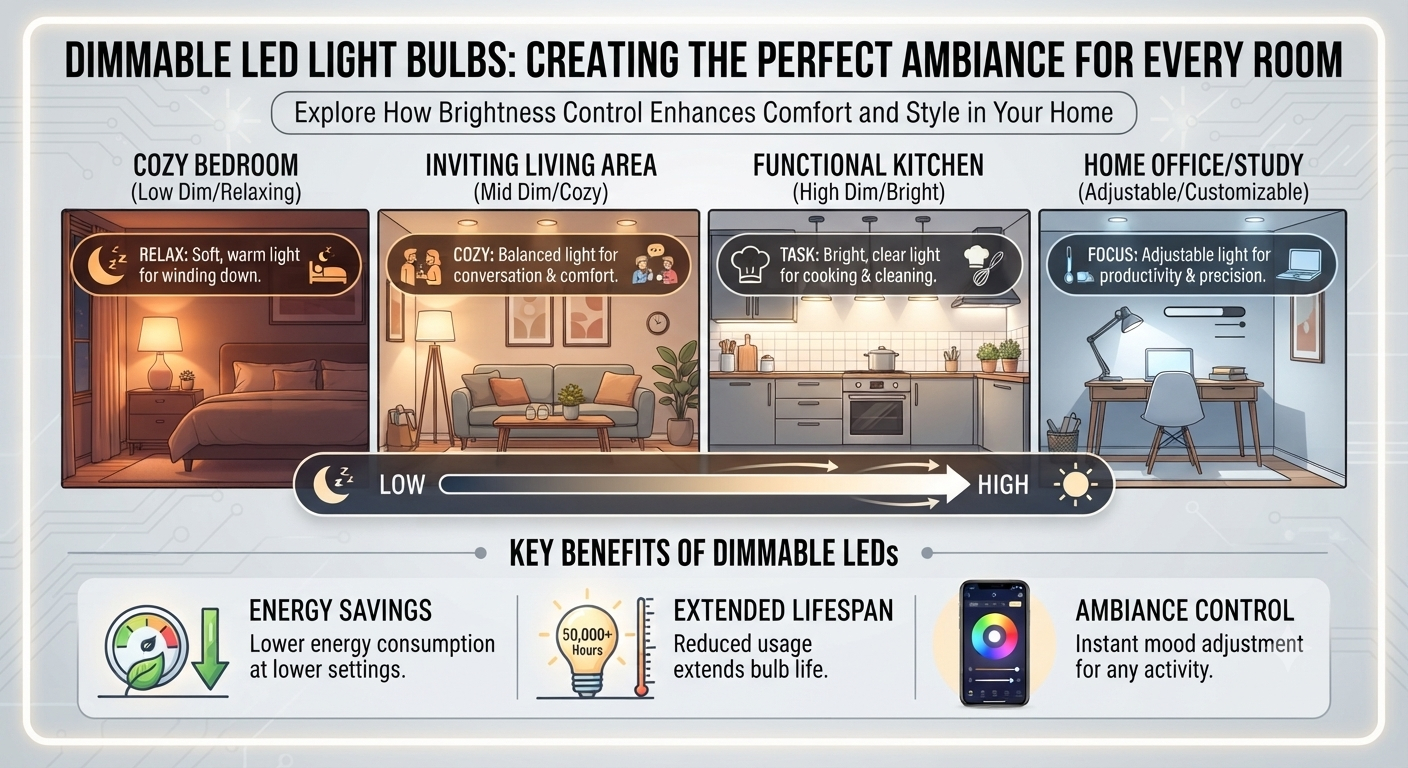
Unlike conventional on/off lighting, dimmable LEDs allow you to adjust brightness to suit the moment. Instead of operating every light at maximum output, you can use only the amount of illumination you actually need. This can improve comfort, reduce glare, create a more attractive interior, and potentially lower energy consumption.
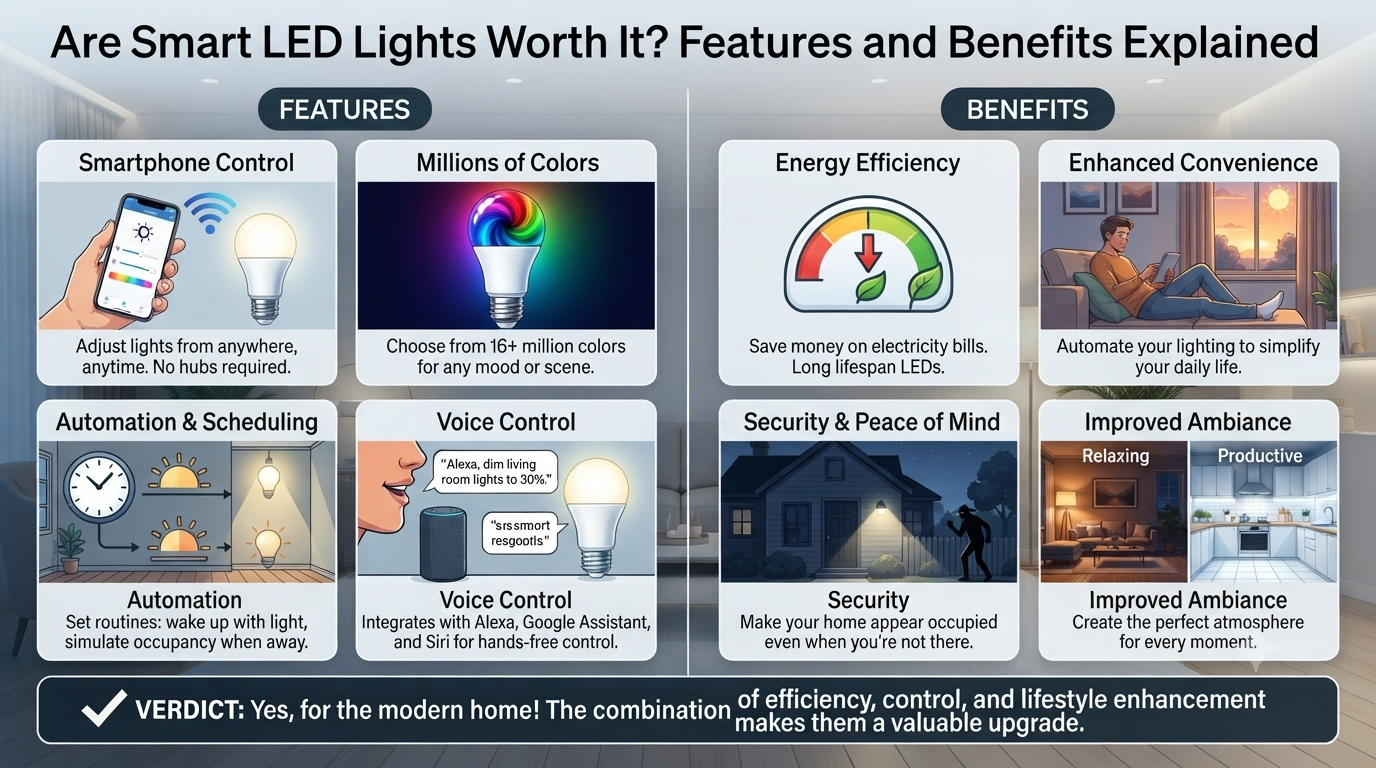
Modern lighting technology has taken this concept even further. Smart lighting systems, including products often associated with Hue light bulbs, can combine dimming with remote control, scheduling, automation, and adjustable color temperature. This creates a lighting environment that can respond to your daily routines rather than simply illuminating a room.
But there is more to choosing a dimmable LED than buying a bulb labeled "dimmable."
The bulb, dimmer, driver, fixture, and electrical system must work together correctly. Poor compatibility can result in flickering, buzzing, limited dimming range, or premature failure.
This guide explains how dimmable LED lighting works, its benefits, compatibility requirements, energy-saving potential, and how to choose the right solution for your home or commercial space.
What Are Dimmable LED Light Bulbs?
A dimmable LED light bulb is designed to operate at different brightness levels rather than simply switching between fully on and fully off.
Depending on the product and control system, you may adjust the light output using
- A wall-mounted dimmer
- Rotary dimmer
- Slider dimmer
- Push-button control
- Remote control
- Smartphone app
- Smart-home automation system
- The fundamental benefit is simple
You control the amount of light instead of accepting one fixed brightness level.
This is particularly useful in rooms that serve multiple purposes.
A dining room might need bright lighting while the table is being prepared but softer lighting during dinner. A bedroom may require stronger light when getting dressed but a much lower level when relaxing.
Dimming allows the same fixture to support both situations.
Why Dimmable LEDs Are Different From Traditional Bulbs
Incandescent lamps are naturally easy to dim.
Their brightness can be reduced by lowering the electrical power supplied to the filament.
LEDs work differently.
An LED requires carefully controlled electrical current, which means the bulb contains a driver that manages the power supplied to the LED components.
The dimming system must communicate with or regulate that driver correctly.
This is why LED dimming compatibility matters so much.
A bulb can be labeled "dimmable," yet still perform poorly if paired with an incompatible dimmer.
The result may include
- Flickering
- Flashing
- Buzzing
- Limited dimming range
- Sudden shutoff
- Uneven brightness
- Failure to turn on at low settings
A high-quality dimmable LED paired with a compatible dimmer should provide smooth, predictable performance.
The Biggest Benefit: Personalized Ambiance
Lighting affects how a space feels.
Bright lighting tends to create a more energetic and functional atmosphere.
Lower lighting levels can make the same room feel
- Relaxed
- Warm
- Intimate
- Comfortable
This makes dimming particularly valuable in living spaces.
Consider a typical evening.
At 5:00 PM, you might use 100% brightness while preparing dinner.
At 7:00 PM, you reduce the lighting to 60% while eating.
At 9:00 PM, you lower it to 30% while watching television.
The fixtures haven't changed.
Only the lighting level has.
That's the practical power of dimmable LEDs.
Dimming Is More Than a Decorative Feature
Many people think of dimming as something used only to create ambiance.
It can also improve functionality.
A bright light is useful when
- Cleaning
- Cooking
- Reading
- Working
- Searching for objects
- A lower level may be better when
- Watching television
- Relaxing
- Entertaining guests
- Dining
- Preparing for sleep
Instead of installing different fixtures for every activity, you can adjust one lighting system to meet different needs.
This can simplify the overall lighting design.
Energy Savings From Dimming
Dimming can reduce energy consumption because the LED system operates at a lower output level.
However, the exact energy savings depend on
- The dimming technology
- Driver efficiency
- Dimmer type
- Operating time
- Brightness level
Reducing brightness doesn't always produce a perfectly proportional reduction in power consumption.
For example, setting a bulb to 50% brightness does not necessarily mean it consumes exactly 50% of its rated wattage.
Still, operating lights below maximum output can reduce energy consumption compared with running them continuously at full power.
The bigger advantage comes when dimming is combined with good lighting controls.
Dimmable LEDs vs. Standard LED Bulbs
- Feature
- Dimmable LED Bulb
- Standard Non-Dimmable LED
- Brightness Adjustment
- Yes
- No
- Wall Dimmer Required
- Usually
- No
- Energy-Saving Potential
- Higher with controlled use
- Fixed output
- Ambiance Control
- Excellent
- Limited
- Installation Complexity
- Moderate
- Simple
- Initial Cost
- Usually higher
- Usually lower
- Flexibility
- High
- Basic
- Best For
- Living rooms, bedrooms, dining rooms
- Utility areas, simple fixtures
If you only need one fixed brightness level, a non-dimmable LED may be perfectly adequate.
If the room serves multiple purposes, dimmability can be worth the additional investment.
Dimmable LED Light Bulbs for Every Room
- Living Room
The living room is one of the best applications for dimmable LEDs.
Use brighter settings for
- Reading
- Cleaning
- Social gatherings
- Lower settings for
- Watching movies
- Relaxing
- Evening conversations
Warm white LEDs around 2700K–3000K are often a popular choice.
Bedroom
Bedrooms generally benefit from softer lighting.
A dimmable LED allows you to maintain sufficient brightness when needed without leaving the room excessively bright at night.
Consider combining
- Dimmable ceiling lights
- Bedside lamps
- Wall sconces
- Accent lighting
Layered lighting gives you greater control than relying on a single ceiling fixture.
Dining Room
Dimmable lighting is particularly effective above dining tables.
You may want bright light while preparing the table.
During dinner, a lower brightness level can create a more intimate environment.
Pendant fixtures and chandeliers are excellent candidates for dimmable LEDs, provided the bulbs and control equipment are compatible.
Kitchen
Kitchens need both functional and atmospheric lighting.
A strong lighting design may combine
- Ceiling downlights
- Under-cabinet LEDs
- Pendant lighting
- Accent fixtures
Dimming allows you to reduce the overall brightness after food preparation is complete.
However, task lighting should remain sufficiently bright when performing detailed work.
Bathroom
Dimmable LEDs can be useful in bathrooms, especially when the same space is used at different times of day.
For example
Morning: Higher brightness for grooming.
Evening: Lower brightness for a softer environment.
Make sure the selected fixture has the appropriate protection for its installation location, especially in areas exposed to moisture.
The Importance of Color Temperature
Dimming controls brightness.
Color temperature controls the appearance of the light.
These are different characteristics.
A fixed 3000K dimmable LED can become brighter or darker, but its light generally remains around 3000K.
Some advanced smart lighting systems allow both brightness and color temperature to change.
This creates an even greater level of control.
For example
Morning: 4000K neutral white at moderate-to-high brightness.
Afternoon: 3500K balanced white.
Evening: 2700K warm white at low brightness.
This type of lighting is often called tunable white.
It should not be confused with ordinary dimming.
Dimmable LEDs vs. Hue Light Bulbs
The phrase Hue light bulbs is commonly associated with smart LED lighting systems that provide wireless control and advanced features.
Traditional dimmable LEDs and smart lighting can both adjust brightness, but the control method is different.
Feature
- Traditional Dimmable LED
- Smart Lighting / Hue-Style System
- Physical Wall Dimmer
- Usually
- Not normally required
- App Control
- No
- Yes
- Remote Control
- Limited
- Yes
- Scheduling
- No
- Yes
- Automation
- Limited
- Advanced
- Color Temperature
- Usually Fixed
- Often Adjustable
- RGB Colors
- No
- Available on selected products
- Internet/Network
- Not required
- Depends on system
- Installation
- Simple electrical setup
- Wireless setup may be required
- Cost
- Lower
- Higher
If you only want to dim your lights, traditional dimmable LEDs are usually the simpler option.
If you want remote control, automation, color adjustment, and integration with a smart home, a smart lighting ecosystem may be more appropriate.
A Critical Difference: Smart Bulbs Need Continuous Power
One common mistake is installing a smart bulb behind a conventional wall dimmer.
This can create problems.
Smart bulbs generally need continuous electrical power to keep their internal electronics active.
If the wall switch cuts power, the bulb disappears from the network.
If a conventional dimmer alters the power supplied to the smart bulb, it may also cause unpredictable behavior.
For smart lighting, use the manufacturer's recommended control method.
For traditional dimmable LEDs, use an appropriate LED-compatible dimmer.
Don't mix the two systems without confirming compatibility.
How LED Dimmers Work
Several dimming technologies are used with LED lighting.
One common approach is phase-cut dimming, where the dimmer modifies the AC waveform supplied to the lamp.
The LED driver's electronics interpret this modified signal and adjust the LED output.
Compatibility between the driver and dimmer is critical.
Some LED bulbs are designed for specific dimmer types, while others are compatible with a broader range.
When buying a dimmable LED, check the manufacturer's compatibility information.
Why Some Dimmable LEDs Flicker
Flicker is one of the most common complaints with poor LED dimming performance.
Potential causes include
- Incompatible dimmer
- Poor-quality LED driver
- Minimum load requirements
- Incorrect wiring
- Low-quality dimmer
- Bulb-to-bulb compatibility differences
If multiple LEDs are connected to one dimmer, the total electrical load can also influence performance.
The solution is often to use a dimmer specifically designed for LED loads.
What Is Minimum Load?
Some older dimmers were designed for higher-power incandescent lamps.
An incandescent bulb might consume 60W.
A modern LED replacement might consume only 8W.
If several low-wattage LEDs are connected to an older dimmer, the total load may be below the dimmer's minimum operating requirement.
This can cause
- Flickering
- Poor dimming
- Dropouts
Modern LED-compatible dimmers are generally better suited to low-wattage loads.
Can All LED Bulbs Be Dimmed?
No.
Some LED bulbs are specifically designed as non-dimmable products.
Never assume that every LED bulb can be connected to a dimmer.
Check the packaging or manufacturer's technical documentation.
Using a non-dimmable LED with a dimmer may cause
- Unstable operation
- Flickering
- Reduced lifespan
- Driver damage
If you want dimming, purchase a bulb explicitly rated for dimmable operation.
Dimming and LED Lifespan
LEDs already offer long service lives compared with many traditional lamps.
Operating them at reduced output can potentially reduce thermal stress in some applications, but actual lifespan depends on the entire product design.
The key factors include
- LED chip quality
- Driver reliability
- Heat dissipation
- Ambient temperature
- Operating conditions
Don't assume that dimming automatically guarantees a longer lifespan.
A high-quality driver and effective thermal management remain essential.
Why Heat Dissipation Matters
LEDs are more energy efficient than incandescent lamps, but they still generate heat.
The LED junction must remain within an appropriate operating temperature range.
A quality bulb may use
- Aluminum heat sinks
- Thermally conductive materials
- Efficient internal layouts
- Poor thermal management can lead to
- Faster lumen depreciation
- Driver failure
- Reduced service life
This is particularly important for higher-power dimmable LEDs installed in enclosed fixtures.
Always check whether the bulb is approved for enclosed fixtures when applicable.
How to Choose the Right Dimmable LED Bulb
- Before purchasing, check these specifications
- Lumens
Determine how much light you need.
Wattage
Compare electrical consumption.
Color Temperature
Choose between warm white, neutral white, or daylight.
CRI
Higher CRI generally provides more accurate color rendering.
Dimming Compatibility
Confirm that the bulb works with your dimmer.
Base Type
Check whether you need E27, B22, GU10, or another fitting.
Voltage
Verify compatibility with your electrical supply.
Enclosure Rating
Check whether the bulb is suitable for enclosed fixtures.
Rated Life
Compare expected operating hours.
Warranty
A longer warranty can indicate greater manufacturer confidence.
Pro Tip: Replace the Dimmer Before Blaming the Bulb
If your existing LED bulb flickers when dimmed, don't immediately assume the bulb is defective.
Check the dimmer.
An old incandescent dimmer may not be suitable for modern LED loads.
Upgrading to an LED-compatible dimmer can dramatically improve performance.
This is often one of the easiest solutions to LED flickering problems.
Pro Tip: Don't Over-Dim Task Lighting
Dimming is useful, but not every activity should be performed under very low light.
For
- Reading
- Cooking
- Detailed work
- Crafting
Maintain sufficient illumination.
Use dimming primarily to adjust the ambient environment, while dedicated task lights provide focused brightness.
This approach gives you both comfort and functionality.
Creating a Layered Dimmable Lighting System
The best lighting designs rarely rely on one fixture.
Consider three layers.
Ambient Lighting
Provides general illumination.
Examples
- Ceiling lights
- Recessed downlights
- LED panels
- Task Lighting
Provides focused illumination.
Examples
- Under-cabinet lights
- Desk lamps
- Reading lamps
- Accent Lighting
Highlights architectural or decorative features.
Examples
- Wall washers
- Display lighting
- Cove lighting
Dimming each layer independently gives you much greater control over the room.
For example, during a dinner party
- Ambient: 40%
- Task: 20%
- Accent: 70%
The result is a balanced environment with visual depth.
The exact percentages are illustrative, but the principle is powerful: different lighting layers should perform different jobs.
Dimmable LED Lighting for Commercial Applications
Dimming isn't limited to homes.
Commercial environments can benefit significantly from adjustable lighting.
Applications include
- Hotels
- Restaurants
- Retail stores
- Offices
- Conference rooms
- Showrooms
A restaurant may use brighter light during cleaning and preparation, then lower the brightness during service.
A retail store can adjust lighting based on merchandising displays.
An office can reduce artificial lighting when daylight is available.
When combined with automated controls, these systems can improve both energy management and occupant experience.
Common Mistakes When Buying Dimmable LED Light Bulbs
- Mistake 1: Assuming Every LED Is Dimmable
Always check the specification.
Mistake 2: Using an Old Dimmer
The dimmer may not be compatible with low-wattage LED loads.
Mistake 3: Ignoring Minimum Load
The total connected wattage can affect dimming performance.
Mistake 4: Mixing Different Bulb Models
Different LED drivers may respond differently to the same dimmer.
Mistake 5: Buying Only for Low Price
Poor-quality drivers can cause flickering and premature failure.
Mistake 6: Installing Smart Bulbs Behind Traditional Dimmers
Smart bulbs generally require a stable power supply and their intended control system.
Mistake 7: Ignoring Fixture Compatibility
Some bulbs are not suitable for enclosed fixtures or high-temperature environments.
Frequently Asked Questions
- Are dimmable LED light bulbs worth it?
Yes, particularly in rooms where lighting needs change throughout the day. Dimmable LEDs provide greater control over brightness, can improve ambiance, reduce glare, and may reduce energy consumption when operated below maximum output. The key is pairing the bulb with a compatible LED dimmer.
Can I use dimmable LED bulbs with any dimmer?
No. The dimmer must be compatible with the specific LED bulb and electrical load. Older dimmers designed primarily for incandescent lamps may cause flickering, buzzing, or poor dimming performance. An LED-rated dimmer is usually the better choice.
Are Hue light bulbs the same as dimmable LED bulbs?
Not exactly. Both can adjust brightness, but traditional dimmable LED bulbs typically use a physical wall dimmer, while smart products associated with Hue-style ecosystems can be controlled through apps, wireless controls, automation, and other smart-home interfaces. Smart bulbs may also offer adjustable color temperature or color effects.
Do dimmable LED bulbs use less electricity?
They can consume less electricity when operated at reduced brightness, although the exact power reduction depends on the bulb and driver design. The greatest savings come when dimming is combined with efficient LEDs and automatic controls that prevent unnecessary operation.
Final Takeaway: Put Your Lighting Under Your Control
The real advantage of dimmable LED light bulbs isn't simply that they can become brighter or darker.
It's the freedom to customize your environment.
You can create bright, functional lighting when you need to work, then lower the intensity when it's time to relax. You can reduce glare, create a more comfortable atmosphere, and potentially reduce electricity consumption by avoiding unnecessary full-power operation.
For simple installations, a quality dimmable LED paired with a compatible LED dimmer is often all you need.
For advanced applications, smart lighting systems and Hue light bulbs can take customization much further, adding remote control, automation, scheduling, and adjustable color temperature.
Whichever route you choose, focus on the complete system.
The bulb, driver, dimmer, fixture, and electrical installation must work together.
Choose the correct lumen output, color temperature, CRI, fitting, and voltage. Confirm dimmer compatibility before installation. For smart bulbs, use the control method recommended by the manufacturer.
When those pieces are correctly matched, dimmable LED lighting becomes more than an energy-efficient replacement for traditional bulbs.
It becomes a flexible lighting platform that lets you decide exactly how your space should look, feel, and function at any moment of the day.