bolt Quick Answer (As of 2026)
If you've ever stood in a lighting aisle holding an LED bulb and wondered whether it will actually fit your existing lamp, you're not alone. Light bulbs may look similar, but their base type, diameter, voltage rating, and electrical specificatio...
If you've ever stood in a lighting aisle holding an LED bulb and wondered whether it will actually fit your existing lamp, you're not alone. Light bulbs may look similar, but their base type, diameter, voltage rating, and electrical specifications can vary significantly.
One of the most widely used screw fittings worldwide is the E27 bulb.
You will find E27 lamps in homes, offices, shops, hotels, restaurants, decorative fixtures, pendant lights, table lamps, and outdoor luminaires. The fitting is popular because it is simple, robust, and compatible with a huge range of modern LED lighting products.
But "E27" only tells you one part of the story.
It identifies the physical screw base. It does not automatically tell you the correct voltage, wattage, brightness, color temperature, dimming capability, or whether the bulb is suitable for outdoor use.
That's where many lighting mistakes begin.
This guide explains exactly what an E27 fitting means, how it compares with other common electrical bulb bases, how to check voltage compatibility, and where E27 electric light bulbs are most useful. We'll also cover LED efficiency, fixture compatibility, dimming, outdoor applications, and the practical checks you should make before buying a replacement lamp.
What Is an E27 Bulb?
An E27 bulb is a light bulb fitted with an Edison screw base measuring approximately 27 millimeters in diameter.
The "E" refers to Edison screw, named after the screw-base system associated with Thomas Edison.
The number 27 refers to the approximate diameter of the screw base in millimeters.
So
- E27 = Edison screw + approximately 27 mm base diameter
- The E27 base is sometimes called a
- Large Edison screw
- ES bulb
- Edison screw bulb
- E27 lamp
The fitting is extremely common in residential and commercial lighting.
It is available in many lamp styles, including
- LED bulbs
- Incandescent bulbs
- Halogen lamps
- CFLs
- Smart bulbs
- Filament LEDs
- High-lumen LED lamps
The important point is that E27 describes the fitting, not the technology inside the bulb.
An E27 LED bulb and an E27 incandescent bulb have the same basic screw fitting, but their energy consumption, heat output, lifespan, and performance can be completely different.
E27 Bulb Specifications at a Glance
- Specification
- Typical E27 Bulb Consideration
- Base Type
- Edison screw
- Approx. Base Diameter
- 27 mm
- Common Technology
- LED
- Typical Applications
- Homes, offices, shops, decorative fixtures
- Voltage
- Depends on product and market
- Dimming
- Depends on bulb
- Smart Features
- Available in some models
- Outdoor Use
- Only when fixture and bulb are appropriately rated
- Brightness
- Determined by lumens, not base type
- Power Consumption
- Determined by wattage and technology
- The table highlights an important distinction
An E27 base does not define the electrical characteristics of the bulb.
You must check those separately.
E27 vs. E14: What's the Difference?
The E27 and E14 are often confused because both use Edison screw connections.
The primary difference is the size of the base.
Feature
- E27
- E14
- Base Diameter
- Approx. 27 mm
- Approx. 14 mm
- Common Name
- Large Edison screw
- Small Edison screw
- Typical Applications
- Main room lighting
- Decorative and smaller fixtures
- Common Bulb Styles
- A-shape, globe, filament, smart
- Candle, small globe, candle-flame
- Typical Fixtures
- Ceiling lights, table lamps, pendants
- Chandeliers, decorative lamps
An E14 bulb will not fit an E27 socket, and an E27 bulb will not fit an E14 socket.
Adapters are available in some situations, but they should only be used when the adapter and fixture are suitable for the application.
Never force a bulb into an incompatible socket.
Does an E27 Bulb Work With Any Voltage?
No.
This is one of the most important points to understand.
The E27 fitting only describes the physical base.
The bulb itself must be rated for the electrical voltage supplied by the fixture.
Depending on the product and market, E27 bulbs may be designed for
- 120V AC
- 220–240V AC
- Other specified voltage ranges
- Some LED bulbs are designed for a broad input range, such as
- 100–240V AC
These products can accommodate a wide range of mains voltages, assuming the manufacturer's specifications allow it.
Other bulbs may have a narrower operating range.
Always check the label or technical datasheet.
Pro Tip
- Before installing an E27 bulb, check three things
- Base compatibility
- Does it physically fit?
- Voltage compatibility
- Does the bulb's rated voltage match the electrical supply?
- Fixture compatibility
- Is the bulb suitable for the fixture, enclosure, temperature, and environment?
A bulb that physically screws into a socket is not necessarily electrically compatible.
Understanding Voltage Compatibility
Suppose you have an E27 fixture connected to a 230V supply.
You should use an E27 bulb rated for the appropriate voltage, such as a product designed for the relevant 220–240V mains range.
Installing a bulb designed only for a substantially lower voltage can cause
- Immediate failure
- Driver damage
- Excessive current
- Safety hazards
Conversely, using a bulb designed for a higher voltage on a lower-voltage supply may result in:
Reduced brightness
- Improper operation
- Failure to start
The correct voltage is therefore just as important as the correct base.
This is especially important when importing electric light bulbs from another country.
The same E27 base may be physically common in multiple markets, while the electrical supply differs.
Why LED E27 Bulbs Are So Popular
The modern E27 bulb has become particularly popular as an LED replacement because the screw fitting allows easy retrofit installation.
You can often replace an older incandescent or CFL bulb without changing the entire fixture.
The benefits include
- Lower energy consumption
- Longer service life
- Lower heat generation
- Instant start
- Wide range of color temperatures
- Dimming options
- Smart-home compatibility
For example, a traditional incandescent bulb might consume 60W to produce roughly 700–800 lumens.
A modern LED E27 bulb may provide similar brightness using approximately 8–10W, depending on its design and efficiency.
The result is substantially lower energy consumption for comparable light output.
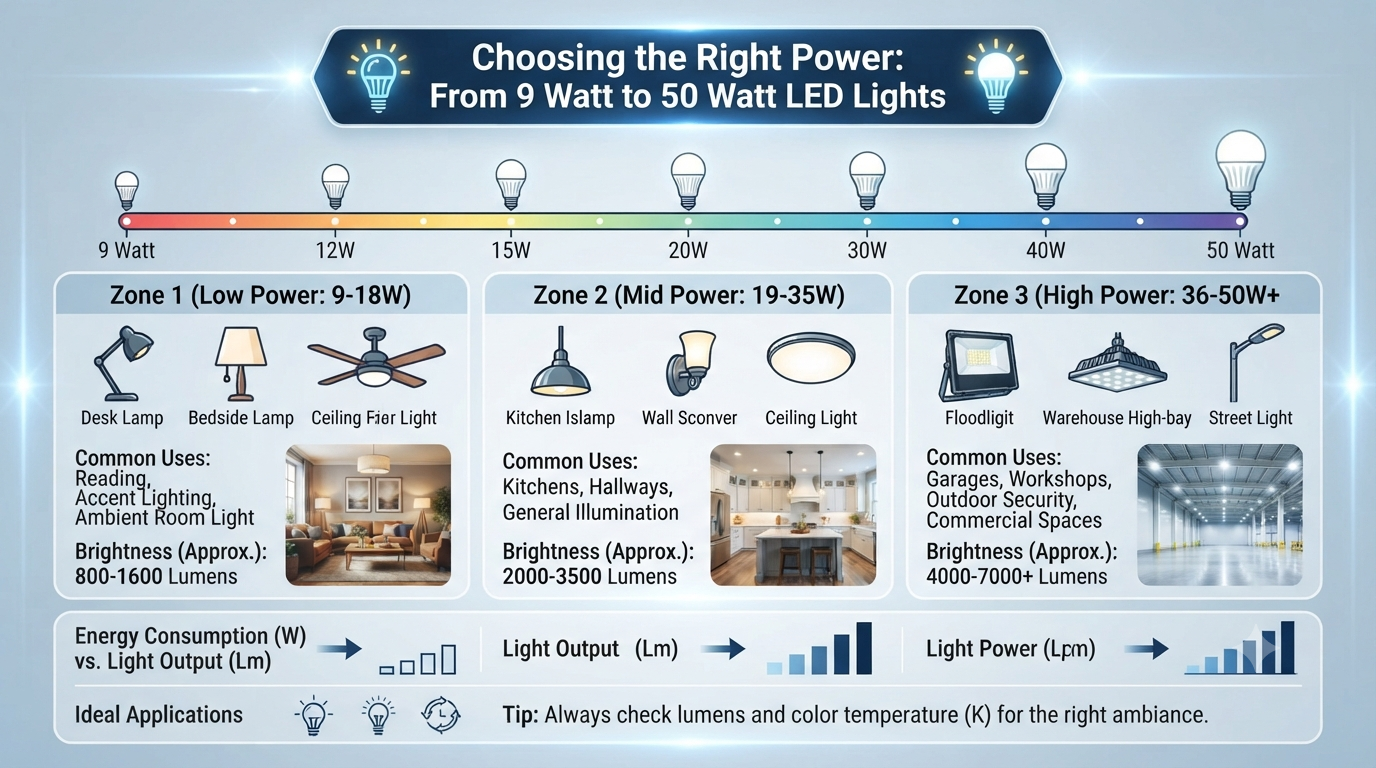
Don't Choose an E27 Bulb by Wattage Alone
- A common mistake is assuming
- More watts = more brightness
That isn't necessarily true with LED lighting.
Wattage measures energy consumption.
Lumens measure light output.
When choosing an LED E27 bulb, look at
- Lumens
- Wattage
- Lumens per watt
- Color temperature
- CRI
- Beam angle
- For example
- Bulb A: 9W, 900 lumens
- Bulb B: 12W, 900 lumens
Both provide similar light output.
But Bulb A consumes less power.
Its efficacy is approximately
- 900 ÷ 9 = 100 lumens per watt
- Bulb B provides
- 900 ÷ 12 = 75 lumens per watt
Therefore, Bulb A is more energy efficient.
This is why modern electric light bulbs should be evaluated by their complete performance rather than wattage alone.
Choosing the Right E27 Bulb Brightness
E27 bulbs are available in a wide range of lumen outputs.
A small decorative lamp might need only a few hundred lumens.
A large room may require several thousand lumens across multiple fixtures.
As a general reference
- Application
- Approximate Lighting Approach
- Bedside lamp
- Low to moderate lumen output
- Table lamp
- Moderate output
- Bedroom ceiling
- Moderate general illumination
- Living room
- Moderate to high, often layered
- Kitchen
- Higher output with dedicated task lighting
- Garage
- Higher output for practical tasks
- Outdoor security
- High output depending on coverage
These are general guidelines rather than fixed requirements.
Room size, ceiling height, wall color, fixture design, and beam angle all affect the final result.
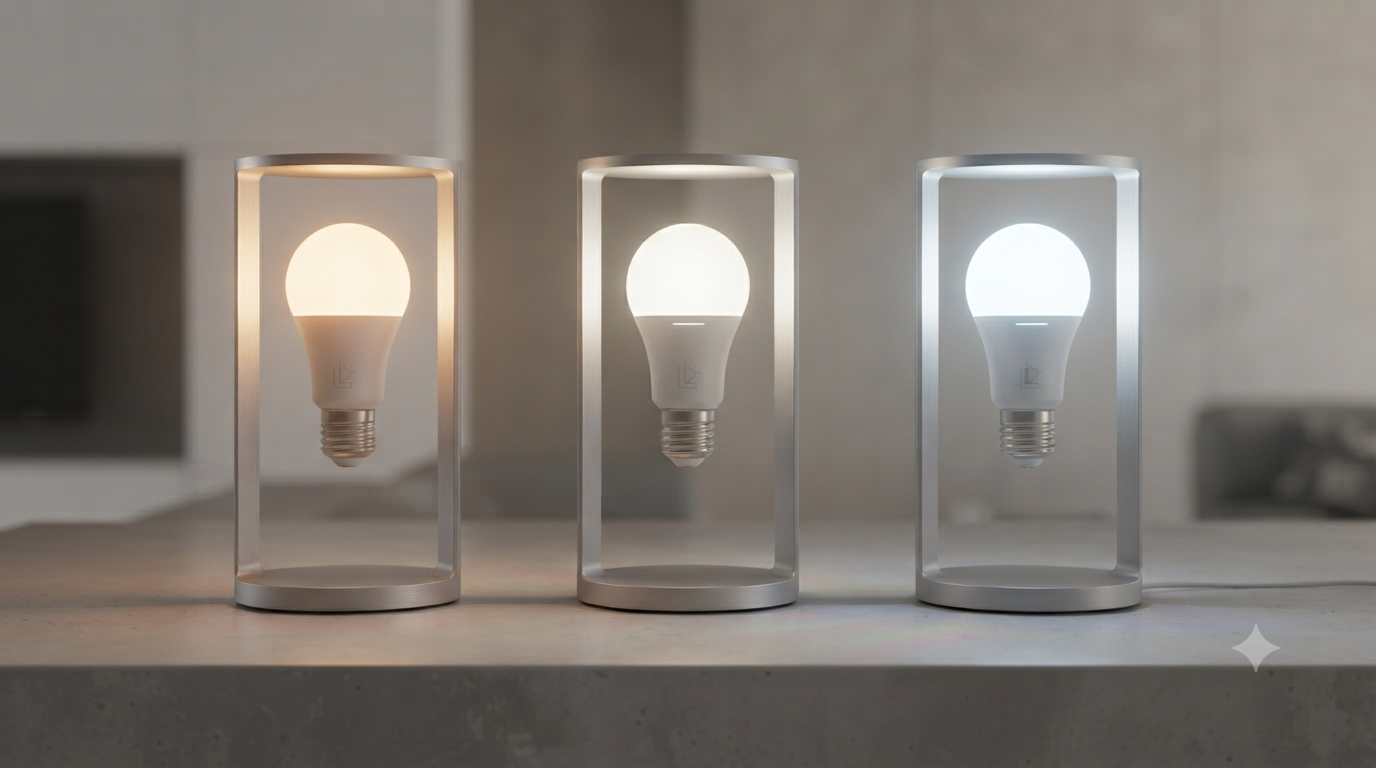
E27 Bulbs and Color Temperature
The E27 fitting doesn't determine the color of the light.
You can find E27 LEDs in various color temperatures.
2700K–3000K: Warm White
- Best for
- Bedrooms
- Living rooms
- Restaurants
- Hospitality
- Relaxing environments
Creates a warm, comfortable atmosphere.
3500K–4000K: Neutral White
- Suitable for
- Kitchens
- Offices
- Bathrooms
- General-purpose spaces
Provides a balanced appearance.
5000K–6500K: Cool White / Daylight
Often used where a crisp, brighter visual appearance is preferred.
Suitable for
- Garages
- Workshops
- Utility spaces
- Some commercial environments
For most residential applications, 2700K–4000K provides a practical range.
What Is CRI and Why Does It Matter?
CRI stands for Color Rendering Index.
It indicates how accurately a light source reveals colors compared with a reference light source.
A higher CRI can make objects and surfaces appear more natural.
This can be particularly valuable in
- Kitchens
- Bathrooms
- Retail displays
- Art spaces
- Dressing areas
A general-purpose LED E27 bulb with CRI 80+ is commonly suitable for many residential applications.
For applications where color accuracy matters, consider a higher-CRI product.
Remember
E27 tells you the base.
CRI tells you about color rendering.
These are completely separate specifications.
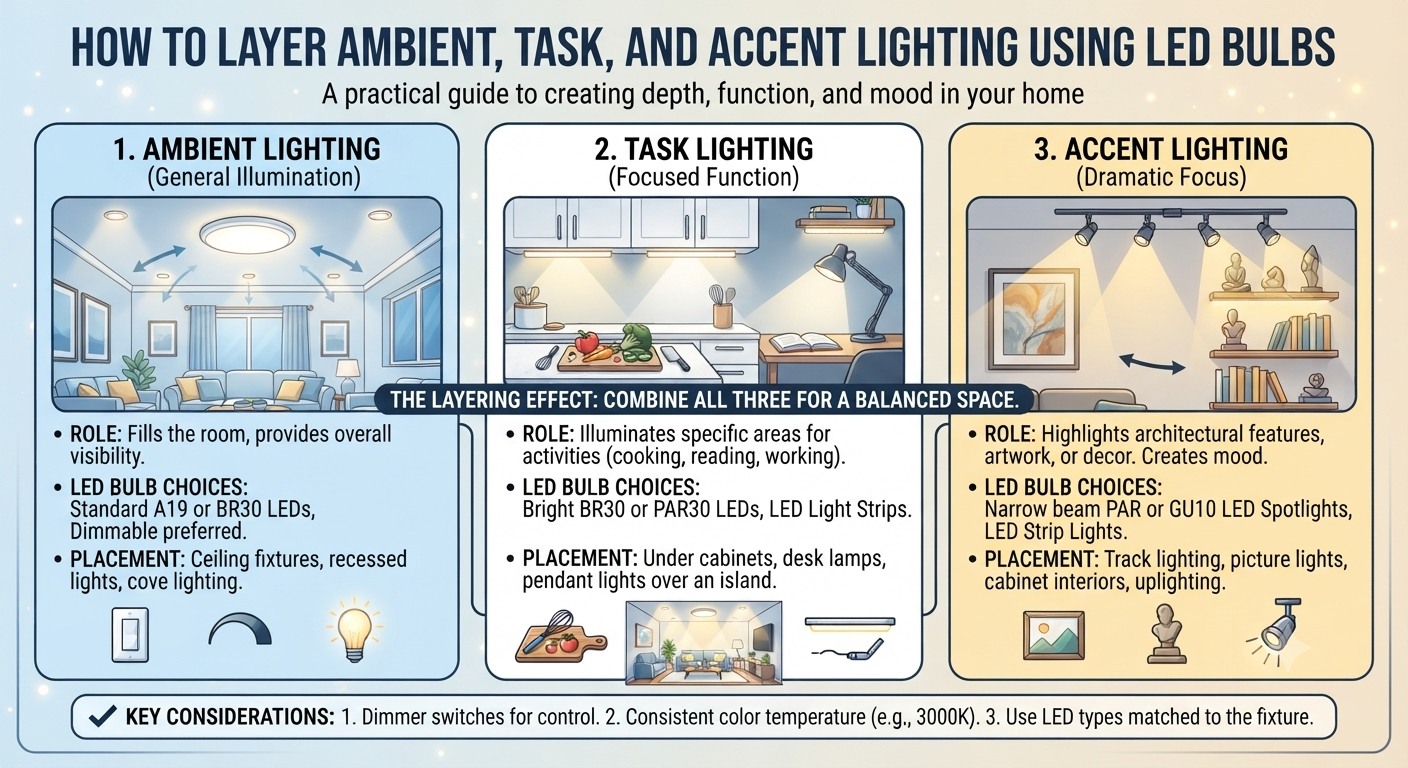
E27 Bulbs for Table and Floor Lamps
One of the most common uses of the E27 bulb is in table and floor lamps.
The large screw base provides compatibility with a wide range of lamp designs.
You can choose from
- Standard LED bulbs
- Filament LEDs
- Globe bulbs
- Decorative bulbs
- Smart bulbs
For exposed-bulb fixtures, decorative filament LEDs can provide a vintage appearance while consuming far less energy than traditional incandescent lamps.
For shaded lamps, a standard A-shape LED may provide more practical light distribution.
Always check the physical dimensions of the bulb.
A large globe bulb may fit the E27 socket but fail to fit inside the lamp shade.
E27 Bulbs for Ceiling Fixtures
E27 ceiling fixtures are widely used in homes and commercial spaces.
They may accommodate
- One bulb
- Multiple bulbs
- Pendant fixtures
- Flush-mount fixtures
- Semi-flush fixtures
When selecting a bulb, consider the fixture's orientation.
A bulb designed for horizontal use may distribute light differently from one installed vertically.
For enclosed ceiling fixtures, check whether the LED bulb is approved for enclosed use.
Heat accumulation inside an unsuitable enclosure can affect LED driver performance and lifespan.
E27 Bulbs for Pendant Lights
Pendant fixtures often use exposed E27 lamps.
This makes the bulb itself part of the visual design.
Popular choices include
- Filament LED bulbs
- Globe LEDs
- Amber glass bulbs
- Vintage-style LEDs
- Smart E27 bulbs
In these applications, appearance matters almost as much as technical performance.
However, don't sacrifice electrical and thermal compatibility for aesthetics.
Check
- Voltage
- Wattage
- Dimming capability
- Fixture rating
- Bulb dimensions
- Dimmable E27 Bulbs
Not every E27 LED bulb is dimmable.
If you want brightness control, look for a product specifically labeled
- Dimmable
You also need a compatible dimmer.
An incompatible combination can cause
- Flickering
- Buzzing
- Poor low-level dimming
- Unstable operation
- Premature driver failure
For the best results, use an LED-compatible dimmer recommended by the bulb manufacturer where possible.
If you're installing multiple E27 bulbs on one dimming circuit, check the dimmer's rated LED load and compatibility requirements.
Smart E27 Bulbs
Smart E27 bulbs combine the traditional Edison screw fitting with modern wireless controls.
Depending on the product, they may offer
- Smartphone control
- Scheduling
- Voice control
- Dimming
- Color temperature adjustment
- RGB color control
- Remote operation
The physical installation remains simple.
You screw the bulb into the E27 socket.
The difference is that control happens electronically through a smart lighting platform.
Important Consideration
Smart bulbs generally need continuous electrical power to remain connected to the network.
If someone switches off the wall switch, the smart bulb loses power and becomes unavailable until the switch is turned on again.
For smart lighting systems, smart switches or automation controls may therefore be preferable to physically cutting power to the bulb.
E27 Bulbs in Outdoor Fixtures
E27 bulbs are also commonly used in exterior fixtures.
Applications include
- Porch lights
- Wall lanterns
- Garden fixtures
- Exterior pendants
- Covered patios
But an E27 bulb isn't automatically suitable for outdoor use.
The fixture and bulb must both be appropriate for the environment.
Consider
- IP rating
- Rain exposure
- Condensation
- Temperature
- Fixture enclosure
- Manufacturer approval
A bulb installed inside a weatherproof fixture may be protected from direct rain.
An exposed E27 bulb hanging outdoors may require a completely different level of environmental protection.
Pro Tip
Never assume that an E27 bulb is outdoor-rated simply because it fits an outdoor fixture.
Check the manufacturer's specifications for both the bulb and the luminaire.
Can You Use an E27 Bulb in an Enclosed Fixture?
It depends on the bulb.
Some LED products are specifically rated for enclosed fixtures.
Others are not.
The issue is heat.
LEDs are efficient, but the driver and electronic components still generate heat. A tightly enclosed fixture can trap that heat and raise the operating temperature.
Excessive heat can contribute to
- Reduced lifespan
- Lower light output
- Driver failure
If your fixture is enclosed, choose a bulb specifically approved for enclosed applications.
E27 Bulbs in Commercial and Industrial Applications
The E27 fitting is primarily associated with general-purpose lamps, but it also appears in various commercial environments.
Examples include
- Retail stores
- Restaurants
- Hotels
- Offices
- Workshops
- Hospitality spaces
- For commercial use, evaluate additional factors such as
- Operating hours
- Energy consumption
- Maintenance costs
- Warranty
- Flicker performance
- Color rendering
- Driver quality
A bulb operating 10–12 hours every day places much greater demands on its driver and thermal design than a bulb used for one hour each evening.
For high-use applications, investing in higher-quality E27 LED products can reduce maintenance and replacement costs.
How to Install an E27 Bulb Safely
Replacing an E27 bulb is generally straightforward, but basic electrical safety still matters.
Step 1: Switch Off the Power
Turn the fixture off before replacing the bulb.
For additional safety, isolate the circuit when appropriate.
Step 2: Allow the Existing Bulb to Cool
Incandescent and halogen bulbs can become extremely hot.
Step 3: Check the Socket
- Inspect for
- Damage
- Corrosion
- Loose components
- Burn marks
- Step 4: Check the Replacement Bulb
- Confirm
- E27 base
- Correct voltage
- Suitable wattage
- Appropriate environment rating
- Step 5: Install the Bulb
Screw it gently into the socket.
Don't overtighten.
Step 6: Restore Power
Turn the fixture on and verify proper operation.
If the bulb flickers, buzzes, or behaves unusually, switch it off and investigate the compatibility.
Common E27 Bulb Mistakes to Avoid
- Mistake 1: Assuming E27 Means 230V
It doesn't.
E27 is a physical fitting specification.
Check voltage separately.
Mistake 2: Choosing Wattage Instead of Lumens
A 10W LED can be brighter than a 12W LED.
Check lumen output.
Mistake 3: Installing an Indoor Bulb Outdoors
Check environmental suitability and IP requirements.
Mistake 4: Using a Non-Dimmable LED on a Dimmer
This can cause flickering and other performance problems.
Mistake 5: Ignoring Fixture Size
A bulb may fit the socket but physically collide with the shade or enclosure.
Mistake 6: Installing an Unsuitable Bulb in an Enclosed Fixture
Heat buildup can reduce service life.
Mistake 7: Mixing Incompatible Smart Lighting Systems
Check wireless protocols and ecosystem compatibility before purchasing smart E27 bulbs.
E27 Bulb Buying Checklist
- Before buying an E27 bulb, check
- ✔ Base
Confirm that the fixture uses an E27 socket.
✔ Voltage
Match the bulb to the electrical supply.
✔ Lumens
Choose the desired brightness.
✔ Wattage
Check actual energy consumption.
✔ Color Temperature
Select warm, neutral, or cool white.
✔ CRI
Choose suitable color-rendering performance.
✔ Dimming
Confirm compatibility if using a dimmer.
✔ Enclosure Rating
Check whether the bulb is suitable for enclosed fixtures.
✔ Outdoor Suitability
Verify environmental and IP requirements.
✔ Physical Size
Make sure the bulb fits the lamp or fixture.
✔ Smart Features
If applicable, check compatibility with your smart-home system.
Frequently Asked Questions
- What does E27 mean on a light bulb?
E27 means the bulb uses an Edison screw base with an approximate diameter of 27 millimeters. It describes the physical fitting and does not specify the bulb's voltage, wattage, brightness, or LED technology.
Is an E27 bulb the same as a 27W bulb?
No. E27 refers to the base fitting, not the electrical power consumption. An E27 bulb could be 5W, 9W, 12W, 20W, or another wattage depending on the technology and design.
Can I use an E27 LED bulb in any E27 socket?
Not automatically. The bulb must also have a compatible voltage rating and be suitable for the fixture's operating conditions. Check whether it is appropriate for enclosed fixtures, dimming systems, or outdoor environments before installation.
Are E27 bulbs energy efficient?
E27 is simply a fitting standard, so efficiency depends on the bulb technology. An E27 LED bulb can be highly energy efficient, while an E27 incandescent bulb consumes substantially more electricity for a similar light output. Compare lumens, wattage, and lumens per watt to evaluate efficiency.
Final Takeaway: E27 Is the Fitting—Not the Whole Specification
The E27 bulb is one of the most versatile and widely used screw-base lighting formats available today. Its popularity comes from a simple design that works across countless residential, commercial, and decorative applications.
But don't stop at the fitting.
When choosing an E27 electrical bulb, verify the complete specification
Base compatibility. Voltage. Lumens. Wattage. Color temperature. CRI. Dimming. Enclosure suitability. Environmental rating.
For most everyday applications, E27 LED bulbs offer an easy path from older incandescent or CFL technology to modern, energy-efficient lighting. You can often upgrade the light source without replacing the entire fixture.
The most important lesson is simple
E27 tells you whether the bulb fits the socket. It doesn't tell you whether the bulb is electrically or environmentally suitable for the application.
Check the complete specification before installation, and you'll get a safer, more efficient, and better-performing lighting system—whether you're choosing a bulb for a bedside lamp, a modern pendant, a ceiling fixture, or an outdoor lantern.