bolt Quick Answer (As of 2026)
When people shop for light bulbs, one of the first questions they usually ask is: "How many watts is this bulb?"
When people shop for light bulbs, one of the first questions they usually ask is: "How many watts is this bulb?"
For decades, that was a reasonable way to judge brightness. A 40W or 60W incandescent bulb gave shoppers a rough idea of how much light they could expect.
LED technology changed that equation.
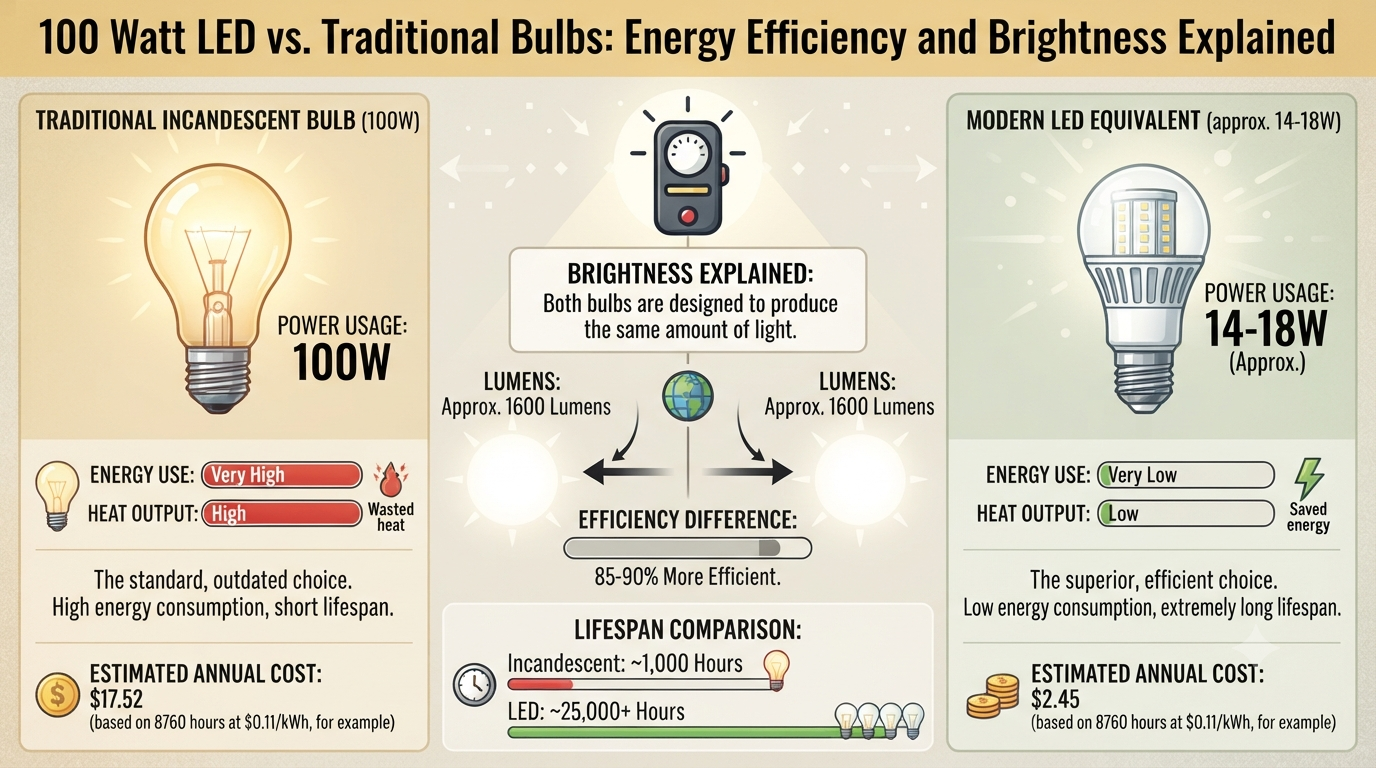
Today, watts measure energy consumption, while lumens measure visible light output. A modern 9W LED bulb can produce similar illumination to an old 60W incandescent lamp, even though it uses a fraction of the electricity.
That makes understanding LED light watts, LED bulb wattage, lumens, and efficiency essential when selecting lighting for homes, offices, commercial buildings, factories, and outdoor applications.
The real question isn't simply
- "How many watts does this LED use?"
- It's
- "How many lumens do I get for every watt of electricity consumed?"
That calculation reveals the true efficiency of the lighting product.
This guide explains how lumens and wattage work, how to calculate LED efficacy, why driver efficiency matters, and how to compare energy efficient bulbs without falling for misleading wattage comparisons.
Lumens vs. Watts: The Fundamental Difference
- The simplest way to understand modern LED lighting is this
Lumens = How much visible light you get.
Watts = How much electrical power the light consumes.
These are two completely different measurements.
Consider the following example
- Light Source
- Approx. Wattage
- Approx. Lumens
- Incandescent bulb
- 60W
- 700–800 lm
- Halogen bulb
- 42–50W
- 600–800 lm
- CFL
- 12–15W
- 700–900 lm
- LED bulb
- 8–10W
- 700–900 lm
The exact figures vary by product, but the general principle is clear.
An LED can produce a similar amount of light using dramatically less electrical power.
That's the core reason LEDs are considered energy efficient bulbs.
What Are Lumens?
A lumen (lm) is the standard unit used to describe the amount of visible light produced by a light source.
The higher the lumen output, the more light the source produces.
For example
- 450 lumens = relatively modest brightness
- 800 lumens = typical general-purpose bulb brightness
- 1,500 lumens = substantially brighter
- 3,000+ lumens = high-output lighting
- However, perceived brightness also depends on
- Beam angle
- Fixture design
- Room size
- Ceiling height
- Wall color
- Light distribution
A 1,000-lumen spotlight with a narrow beam can appear much brighter in one area than a 1,000-lumen bulb spreading light across an entire room.
That's why lumens should always be considered alongside the optical design of the fixture.
What Is LED Light Wattage?
LED light watts describe the electrical power consumed by an LED lamp or fixture.
For example
- 5W LED
- 9W LED
- 12W LED
- 18W LED
- 30W LED
- 50W LED
The wattage tells you how much electricity the product requires under specified operating conditions.
It does not, by itself, tell you how bright the light will be.
A poorly designed 12W LED may produce less useful light than a high-quality 9W LED.
Why?
Because efficiency depends on more than the LED chip.
The complete lighting system includes
- LED chips
- Driver
- Optical components
- Diffuser
- Thermal management
- Electrical losses
This is why comparing products solely by LED bulb wattage can lead to the wrong purchasing decision.
What Is LED Efficacy?
The most useful metric for comparing lighting efficiency is luminous efficacy.
The basic formula is
- Efficacy = Lumens ÷ Watts
- The result is expressed as
- Lumens per watt (lm/W)
- For example, suppose an LED bulb produces
- 900 lumens
- and consumes
- 9 watts
- The calculation is
- 900 ÷ 9 = 100 lm/W
The bulb produces 100 lumens for every watt of electrical power consumed.
Now consider another product
- 900 lumens ÷ 12 watts = 75 lm/W
Both bulbs produce the same amount of light.
But the 9W model is more electrically efficient.
This is the key difference between simply looking at wattage and calculating true efficiency.
How to Calculate LED Efficiency Step by Step
Use this simple process.
Step 1: Find the Lumen Output
Look for the rated lumen output on the packaging or datasheet.
Step 2: Find the Power Consumption
Identify the actual wattage of the complete LED lamp or fixture.
Step 3: Divide Lumens by Watts
- Use
- lm/W = Lumens ÷ Watts
- Example
- An LED bulb provides
- 1,200 lumens
- and consumes
- 12W
- Therefore
- 1,200 ÷ 12 = 100 lm/W
- Its rated efficacy is
- 100 lumens per watt
- This is a much more meaningful efficiency figure than simply saying it is a "12W LED."
- LED Efficiency Comparison Table
- LED Product
- Power
- Light Output
- Calculated Efficacy
- LED A
- 6W
- 600 lm
- 100 lm/W
- LED B
- 9W
- 900 lm
- 100 lm/W
- LED C
- 12W
- 1,200 lm
- 100 lm/W
- LED D
- 15W
- 1,500 lm
- 100 lm/W
- LED E
- 20W
- 1,600 lm
- 80 lm/W
The first four products have the same calculated efficacy.
The 20W product produces more total light than the others but is less efficient per watt.
This distinction matters.
Brightness and efficiency are not the same thing.
A 20W LED may be the right choice if you need 1,600 lumens.
You shouldn't automatically choose the lowest-wattage bulb.
Instead, choose the product that delivers the required light output with the best practical efficiency.
Why Higher Wattage Doesn't Always Mean More Brightness
This is one of the most common misunderstandings in LED lighting.
Imagine two bulbs
- Bulb A: 10W, 1,000 lumens
- Bulb B: 12W, 900 lumens
Bulb B consumes more electricity but produces less light.
Therefore, Bulb A is both
- Brighter
- More energy efficient
The reason is that LED components and drivers vary in efficiency.
This is why comparing LED light watts without checking lumens can be misleading.
When evaluating products, ask
- How many lumens does this product produce?
- Then ask
- How many watts does it consume?
- Finally
- What is the lm/W rating?
- LED Wattage Equivalency: What Does "60W Equivalent" Mean?
- You may see LED bulbs labeled
- "60W Equivalent"
This does not mean the LED consumes 60 watts.
It means the LED is intended to provide approximately the same amount of light as a traditional 60W incandescent bulb.
For example
- 60W incandescent equivalent → approximately 800 lumens
- An LED designed to replace that bulb may consume only
- 8–10W
- So when buying LEDs, distinguish between
- Actual wattage
- and
- Equivalent wattage
The first tells you energy consumption.
The second provides a familiar brightness reference for consumers transitioning from traditional lamps.
The lumen rating is the more precise specification.
Why Lumens Are Better Than Wattage for Choosing Brightness
Suppose you're replacing a traditional 60W incandescent bulb.
If you buy another bulb based only on wattage, you may choose the wrong brightness.
Instead, find the original lamp's approximate lumen output.
Then choose an LED with a similar lumen rating.
For example
- Old bulb: Approximately 800 lumens
- New LED: Approximately 800 lumens
The LED might consume only 9W.
The result is similar brightness with substantially lower energy consumption.
This approach is especially useful when replacing
- Incandescent bulbs
- Halogen lamps
- CFLs
- Older fluorescent fixtures
- Energy Efficient Bulbs: What Makes an LED Truly Efficient?
- A product isn't efficient simply because it is labeled "LED."
Several factors influence real-world performance.
LED Chip Efficiency
The LED package converts electrical energy into light.
Higher-quality chips can provide greater luminous output at a given power level.
Driver Efficiency
The driver converts and regulates electrical power for the LED.
Energy is lost during this process.
A poor-quality driver can reduce system efficiency.
Thermal Management
LEDs generate heat.
Although they are much more efficient than incandescent lamps, not all input energy becomes visible light.
Excessive heat can reduce performance and shorten component life.
Optical Efficiency
The LED may produce a certain number of lumens, but the fixture's diffuser, reflector, and lens can absorb or redirect some of that light.
This means the efficiency of the complete fixture may differ from the theoretical efficiency of the LED chip.
LED Chip Efficiency vs. System Efficiency
This distinction is particularly important for professional lighting.
A manufacturer might advertise a high lm/W figure for the LED chip.
But the finished product may have a lower efficacy.
Why?
- Because the complete system includes
- Driver losses
- Optical losses
- Thermal effects
- Housing design
- For example
- LED chip output: 150 lm/W
- After driver and optical losses
- Finished fixture: 110 lm/W
The 110 lm/W figure is more relevant to the customer.
When comparing commercial lighting products, look for system efficacy or fixture efficacy rather than relying solely on LED chip specifications.
The Role of LED Drivers
The LED driver is one of the most important components inside an LED product.
It regulates electrical power and provides the correct operating conditions for the LED chips.
A good driver can provide
- Stable current
- Better efficiency
- Lower flicker
- Improved thermal performance
- Better power factor
- Longer product life
- A poor-quality driver may result in
- Flickering
- Audible buzzing
- Shorter lifespan
- Electrical losses
- Poor dimming performance
This is why two LED bulbs with identical wattage can perform very differently.
The LED chip gets most of the attention.
The driver deserves just as much scrutiny.
Power Factor: Another Measure of Electrical Performance
For AC-powered LED lighting, power factor (PF) is an important electrical characteristic.
Power factor describes how effectively electrical power is being used by the load.
A product with a high power factor generally makes better use of the electrical supply than one with a low power factor.
For residential consumers, the impact may be less obvious on a small individual bulb.
But for
- Offices
- Factories
- Warehouses
- Hospitals
- Retail stores
where hundreds or thousands of fixtures may operate simultaneously, power factor becomes more significant.
Professional lighting specifications may therefore include
- Wattage
- Lumens
- lm/W
- Power factor
- THD
- Driver type
These metrics provide a more complete picture of electrical performance.
Energy Savings: How Much Can LEDs Reduce Electricity Consumption?
Let's consider a simple example.
Suppose you replace
- 10 × 60W incandescent bulbs
- Total power
- 600W
- Now replace them with
- 10 × 9W LED bulbs
- Total power
- 90W
- The reduction is
- 600W − 90W = 510W
That's an 85% reduction in rated lighting power.
If the lights operate for 5 hours per day
- 510W × 5 hours = 2,550Wh
- or
- 55kWh saved per day
- Over a 30-day month
- 55 × 30 = 76.5kWh
The actual financial savings depend on your electricity tariff.
Use
- Monthly Savings = kWh Saved × Electricity Rate
This is why replacing frequently used incandescent lighting with efficient LEDs can produce substantial energy savings over time.
LED Bulb Wattage and Total Cost of Ownership
The cheapest bulb isn't always the cheapest lighting solution.
Consider two products.
Product A
- 9W
- 900 lumens
- Lower purchase price
- Shorter rated life
- Product B
- 10W
- 1,100 lumens
- Higher purchase price
- Longer rated life
- Better driver
Product B consumes slightly more electricity.
But it produces more light.
It may also last longer and require fewer replacements.
Therefore, the correct purchasing decision should consider
- Purchase price
- Wattage
- Lumens
- Efficacy
- Lifespan
- Warranty
- Maintenance
- Electricity cost
This is called total cost of ownership.
Why Heat Dissipation Affects LED Efficiency
LED efficiency isn't just about the electrical circuit.
Temperature matters.
As LED junction temperature increases, performance can decline.
Excessive heat can contribute to
- Reduced light output
- Faster lumen depreciation
- Driver stress
- Shortened component life
- This is why quality LED bulbs often use
- Aluminum heat sinks
- Thermal paths
- Ventilation
- Thermally conductive materials
An LED bulb with excellent chips but poor heat management may not deliver its rated performance over its entire service life.
Pro Tip
When comparing LED products, don't evaluate the electronics in isolation.
Look at the physical construction.
A well-designed heat sink can be a strong indicator of serious thermal engineering, especially in higher-wattage LED lamps and fixtures.
How to Compare Two LED Bulbs Properly
Imagine you're choosing between two products.
Bulb A
- 12W
- 1,000 lumens
- 83 lm/W
- Bulb B
- 10W
- 1,000 lumens
- 100 lm/W
Both produce the same light output.
Bulb B uses less electricity.
Therefore, it is more efficient.
Now consider another comparison.
Bulb C
- 15W
- 1,500 lumens
- 100 lm/W
Bulb C consumes more electricity than Bulb B.
But it also produces 50% more light.
So the correct question is not
- "Which bulb uses fewer watts?"
- The correct question is
- "Which bulb provides the required lumens with the lowest practical energy consumption?"
That's the foundation of intelligent LED selection.
How Many Lumens Do You Need?
The answer depends on the application.
Approximate residential targets vary by room and activity, but a useful starting point is:
Bedroom
Soft general lighting with additional task lighting.
Living Room
Moderate ambient illumination with layered lighting.
Kitchen
Higher illumination, particularly for countertops and preparation areas.
Bathroom
Adequate general lighting plus dedicated mirror illumination.
Home Office
Higher task illumination with careful glare control.
Garage or Workshop
Higher lumen levels may be necessary for detailed work.
The best approach is to design lighting based on lux, not just lumens.
Lumens describe the total light produced by the source.
Lux describes the amount of light reaching a surface.
1 lux = 1 lumen per square meter
This distinction becomes critical in professional lighting design.
Lumens, Lux, and Beam Angle
- Suppose two spotlights both produce
- 1,000 lumens
- One has a
- 15° beam angle
- The other has
- 60° beam angle
The narrow-beam spotlight concentrates light into a smaller area.
The wide-beam fixture spreads the same total light over a much larger area.
Therefore
- Narrow beam = higher intensity in a focused area
- Wide beam = broader, more uniform coverage
This is why you should never select a lighting product based only on lumen output.
Consider the entire optical system.
Common Mistakes When Comparing LED Light Watts
- Mistake 1: Assuming More Watts Means More Light
Not necessarily.
Check lumens.
Mistake 2: Ignoring Efficacy
Two bulbs with the same wattage may have very different lumen outputs.
Mistake 3: Comparing LED Chip lm/W With Fixture lm/W
These are not necessarily equivalent measurements.
Mistake 4: Buying the Lowest Wattage Available
A low-wattage bulb may not provide enough light.
Mistake 5: Ignoring Driver Quality
The driver influences efficiency, reliability, flicker, and lifespan.
Mistake 6: Ignoring Heat
Poor thermal management can reduce long-term performance.
Mistake 7: Forgetting Beam Angle
Two products with identical lumens can distribute light very differently.
A Simple LED Efficiency Buying Checklist
- Before buying an LED bulb or fixture, check
- Lumens
- How much light do you need?
- Wattage
- How much electricity will it consume?
- Efficacy
- Calculate
- Lumens ÷ Watts = lm/W
- Color Temperature
Choose the appropriate Kelvin rating.
CRI
Check color-rendering performance.
Beam Angle
Consider how the light will be distributed.
Driver Quality
Look for reliable, well-engineered electronics.
Thermal Management
Check whether the product is designed to dissipate heat effectively.
Lifespan
Look at rated life and lumen maintenance.
Warranty
A good warranty provides additional protection against premature failure.
Frequently Asked Questions
- What is the difference between LED light watts and lumens?
Watts measure electrical power consumption, while lumens measure visible light output. A higher wattage does not automatically mean a brighter LED. To compare LED efficiency, divide lumens by watts to calculate lumens per watt.
What LED bulb wattage replaces a 60W incandescent bulb?
A typical 60W incandescent bulb produces approximately 700–800 lumens. An LED producing a similar amount of light may consume roughly 8–10W, depending on the product's efficiency and design. Always compare the lumen rating rather than relying only on the "60W equivalent" label.
Are higher-lumen LED bulbs always less energy efficient?
No. A high-lumen LED can be highly efficient if it produces a large amount of light relative to its wattage. For example, a 20W LED producing 2,000 lumens has an efficacy of 100 lm/W, which may be more efficient than a 10W LED producing only 700 lumens.
How do I calculate the efficiency of an LED bulb?
- Use the formula
- LED efficacy = Lumens ÷ Watts
For example, a 12W LED producing 1,200 lumens has an efficacy of 100 lumens per watt (100 lm/W).
Final Takeaway: Think in Lumens, Then Check Watts
- The biggest shift in modern lighting is simple
Stop using wattage as a substitute for brightness.
When selecting energy efficient bulbs, start with the amount of light you actually need. Check the lumens first. Then look at LED bulb wattage to determine how much electricity the product consumes. Finally, calculate lumens per watt to understand its efficiency.
For professional or commercial applications, go further.
Evaluate
System efficacy. Driver efficiency. Power factor. Thermal management. Beam angle. CRI. Lumen maintenance.
A genuinely efficient LED lighting system isn't defined by a low wattage number printed on the box. It is defined by how effectively it converts electrical energy into useful, well-distributed light over its service life.
The simplest formula to remember is
- Efficiency = Lumens ÷ Watts
Once you understand that relationship, comparing LED light watts, selecting the right LED bulb wattage, and identifying truly energy efficient bulbs becomes far easier.
And that's the real advantage of LED technology: more useful light, less wasted energy, and lower operating costs over time.