bolt Quick Answer (As of 2026)
Switching from traditional incandescent bulbs to energy efficient light bulbs is one of the simplest ways to reduce household electricity consumption. The technology is straightforward: LEDs produce much more light from each watt of electricity th...
Switching from traditional incandescent bulbs to energy efficient light bulbs is one of the simplest ways to reduce household electricity consumption. The technology is straightforward: LEDs produce much more light from each watt of electricity than incandescent lamps, while also lasting considerably longer.
But how much money can you actually save?
That depends on several factors: the type of bulb you're replacing, the LED wattage you choose, how many hours the light operates each day, and your local electricity tariff. A single bulb may save only a modest amount each month. Replace dozens of frequently used bulbs, however, and the numbers can become significant.
For example, replacing a 60W incandescent bulb with a 9W LED that produces a similar amount of light can reduce the bulb's electricity consumption by about 85%. If that light operates for several hours every day, the savings accumulate year after year.
This guide explains how energy saving bulbs work, how to calculate electricity savings, what LED wattage you actually need, and whether upgrading to energy saving light bulbs is financially worthwhile.
Energy Efficient Light Bulbs: Quick Comparison
- Lighting Type
- Typical Wattage for Similar General Illumination
- Relative Energy Use
- Typical Lifespan
- Main Advantage
- Incandescent
- 60W
- Very High
- ~1,000 hours
- Low initial cost
- Halogen
- 40–50W
- High
- ~2,000 hours
- Better efficiency than incandescent
- CFL
- 13–15W
- Moderate
- ~8,000 hours
- Lower energy use
- Standard LED
- 8–10W
- Low
- ~15,000–25,000+ hours
- Excellent efficiency
- High-quality LED
- Varies
- Very Low
- Often 15,000–50,000 hours
- Efficiency and long service life
Exact performance varies by product, lumen output, operating conditions, and manufacturer.
The most important comparison is not simply wattage.
Compare light output in lumens.
A 9W LED isn't automatically equivalent to every 60W incandescent bulb. The correct comparison is whether both products provide approximately the same usable illumination.
What Makes a Light Bulb Energy Efficient?
An energy-efficient light source produces the required amount of light while consuming as little electrical power as reasonably possible.
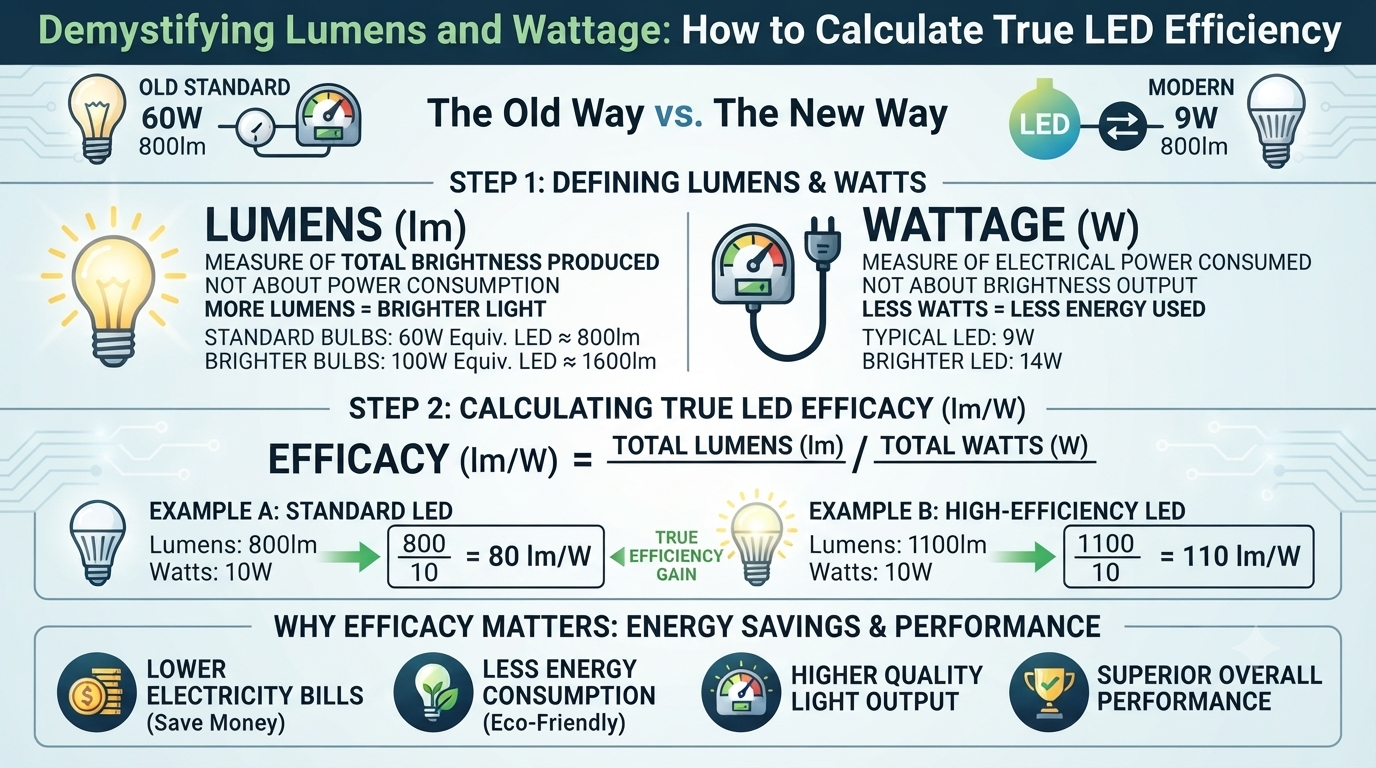
For LED lighting, efficiency is often expressed as lumens per watt (lm/W).
For example
- Lamp A: 800 lumens ÷ 10W = 80 lm/W
- Lamp B: 800 lumens ÷ 8W = 100 lm/W
Both lamps produce the same nominal light output, but Lamp B uses less electricity.
This is why comparing only the wattage printed on a package can be misleading.
A 12W LED may be more efficient than a 15W LED if both produce similar brightness.
When shopping for energy efficient light bulbs, look at
- Lumens
- Watts
- Lumens per watt
- Color temperature
- CRI
- Rated lifespan
- Driver quality
The goal is to achieve the required brightness with the lowest practical energy consumption.
Why LEDs Save So Much Electricity
Traditional incandescent bulbs generate light by heating a filament until it glows.
The problem is that most of the electrical energy is converted into heat rather than visible light.
LEDs work differently.
A semiconductor device produces light through electroluminescence. The process is much more efficient, allowing an LED to produce comparable illumination using substantially less electrical power.
That difference is easy to see in a typical replacement.
A conventional 60W incandescent bulb may be replaced by an LED consuming approximately 8–10W for a similar general-purpose lumen output.
The result is a dramatic reduction in electricity consumption.
This is the fundamental reason energy saving light bulbs have become so popular.
The Real Electricity Savings: A Simple Example
- Let's compare
- 60W incandescent bulb
- with
- 9W LED bulb
Assume both provide similar usable brightness.
The incandescent uses
- 60 watts
- The LED uses
- 9 watts
- The energy reduction is
- 60W − 9W = 51W
The LED therefore uses only about 15% of the power of the incandescent in this example.
That means an approximate 85% reduction in lighting energy consumption.
The exact savings depend on the products being compared, but the principle remains the same.
How Much Can One LED Bulb Save?
Let's use a practical example.
Assume a 60W incandescent bulb is replaced with a 9W LED.
Suppose the bulb operates
- 5 hours per day
- The incandescent consumes
- 60W × 5 hours = 300Wh per day
- That's
- 3 kWh per day
- The LED consumes
- 9W × 5 hours = 45Wh per day
- That's
- 045 kWh per day
- The daily energy saving is therefore
- 255 kWh
- Over one year
- 255 × 365 = approximately 93 kWh
So one frequently used bulb can avoid roughly 93 kWh of electricity consumption per year in this example.
The financial value depends entirely on your electricity tariff.
For example, if your electricity rate were $0.15 per kWh, the annual saving would be approximately:
93 × $0.15 = $13.95 per year
- At a higher electricity rate of $0.30 per kWh, the same bulb would save approximately
- 93 × $0.30 = $27.90 per year
- The calculation is simple
- Annual electricity savings = (Old watts − New watts) × Hours per day × 365 ÷ 1,000
- Then
- Annual money savings = Annual kWh savings × Electricity rate
This is why the economics of LED upgrades depend heavily on local electricity prices.
What If You Replace 10 Bulbs?
The savings become much more noticeable.
Imagine replacing
- 10 × 60W incandescent bulbs
- with
- 10 × 9W LEDs
- The total old lighting load is
- 600W
- The new load is
- 90W
- The difference is
- 510W
- At five hours of daily operation, the household could avoid approximately
- 930 kWh of electricity consumption per year
using the same assumptions.
At an electricity price of $0.15 per kWh, that's approximately $139.50 in annual energy savings.
At $0.30 per kWh, the saving would be approximately $279 per year.
This illustrates an important point
The more bulbs you replace—and the longer they operate—the greater the potential savings.
Not All Bulbs Are Equally Worth Replacing
If you want the fastest return on your LED investment, don't necessarily replace every bulb at once.
Prioritize lights that operate the most.
Highest Priority
- Kitchen lights
- Living room lights
- Hallway lights
- Security lights
- Outdoor lights
- Commercial lighting
- Warehouse lighting
- Office lighting
- Lower Priority
- Guest-room lights used occasionally
- Decorative lamps used for short periods
- Storage-room lights
Replacing a 60W bulb used for 10 minutes a week won't save much electricity.
Replacing a 60W bulb used for six hours every day can make a significant difference.
Pro Tip
Think of LED upgrades as an investment.
Start with your highest-use lighting points.
The energy savings will accumulate faster there.
Energy Saving Bulbs and Payback Period
The payback period tells you how long it takes for electricity savings to recover the purchase price of the new bulb.
For example, imagine
- LED bulb price: $5
- Equivalent incandescent: $1
- Additional upfront cost: $4
- Annual electricity saving: $14
The incremental purchase cost could theoretically be recovered in only a few months.
After that, the continued energy savings become a financial benefit.
The actual payback depends on
- Bulb price
- Electricity rate
- Operating hours
- Wattage difference
This is why high-use applications usually offer the fastest return.
LED Lifespan Adds Another Layer of Savings
Energy consumption isn't the only financial advantage.
LEDs generally last much longer than incandescent bulbs.
A typical incandescent lamp may be rated around
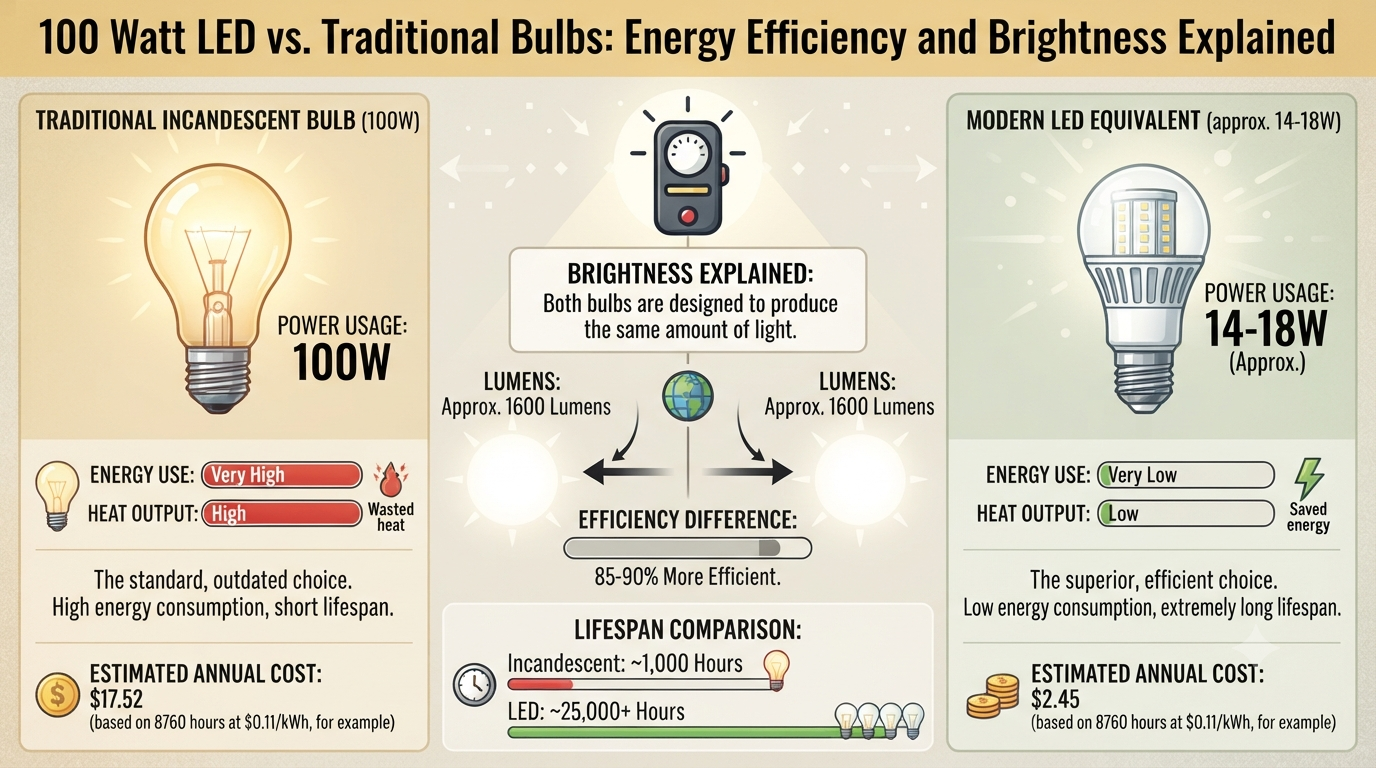
- 1,000 hours
- Many LED products are rated for
- 15,000–25,000+ hours
Some premium LED products may have even longer rated lifespans.
Suppose a light operates five hours per day.
That's
- 1,825 operating hours per year
A 1,000-hour incandescent bulb might need replacement roughly every six to seven months.
A 15,000-hour LED could theoretically operate for many years under rated conditions.
That reduces
- Replacement costs
- Maintenance labor
- Ladder work
- Disruption
For commercial facilities, the maintenance savings can be particularly valuable.
Why LED Lifespan Ratings Can Be Misleading
A bulb rated for 25,000 hours doesn't necessarily mean it will produce identical brightness for 25,000 hours.
LED products gradually experience light depreciation.
This is why professional lighting specifications often consider
- L70
- L80
- L90
These ratings describe the expected lumen maintenance over time.
For example, an L70 rating indicates the point at which the light source is expected to maintain approximately 70% of its initial lumen output under specified conditions.
The quality of the
- LED chip
- Driver
- Thermal management
can significantly influence real-world performance.
A cheap LED bulb with poor heat dissipation may not perform like a professionally engineered product.
Heat Dissipation Affects Energy Efficiency
LEDs are efficient, but they still generate heat.
That heat must be managed properly.
A high-quality LED bulb may use
- Aluminum heat sinks
- Thermally conductive materials
- Proper driver placement
- Ventilation pathways
Poor thermal management can increase LED junction temperature.
Over time, excessive heat can contribute to
- Faster lumen depreciation
- Driver failure
- Shorter lifespan
- Color shift
This means that buying the cheapest energy saving bulb isn't always the best financial decision.
A slightly more expensive product with better thermal design and driver quality may provide better total cost of ownership.
Are LED Bulbs More Efficient Than CFLs?
Yes, in many cases.
Compact fluorescent lamps were a major improvement over incandescent lighting.
However, LED technology generally offers several advantages
- Higher efficiency
- Instant startup
- Better dimming options
- No mercury content
- Greater durability
- Better directional control
- Wider range of color temperatures
CFLs also tend to have more limitations in cold conditions and frequent switching applications.
For most new installations, quality LEDs are the more practical long-term choice.
Energy Saving Light Bulbs and Color Temperature
Color temperature doesn't directly determine how much electricity a bulb consumes.
A 3000K LED and a 5000K LED with the same wattage may consume approximately the same power.
But the visual experience is different.
2700K–3000K
Warm white.
Ideal for
- Bedrooms
- Living rooms
- Restaurants
- Hospitality
- 3500K–4500K
Neutral white.
Suitable for
- Kitchens
- Offices
- Retail
- General commercial applications
- 5000K–6500K
Cool white or daylight appearance.
Common in
- Workshops
- Garages
- Industrial environments
- Some outdoor applications
Choose the color temperature based on the space.
Don't choose a cooler color simply because you think it will save more electricity.
It won't.
Lumens vs. Watts: The Most Important Buying Lesson
This deserves special attention.
Watts tell you how much energy the bulb consumes.
Lumens tell you how much visible light it produces.
When replacing an old bulb, match the approximate lumen output rather than blindly matching wattage.
For example
- Traditional Bulb
- Approximate LED Replacement
- 40W incandescent
- ~5–7W LED
- 60W incandescent
- ~8–10W LED
- 75W incandescent
- ~10–12W LED
- 100W incandescent
- ~14–17W LED
These are approximate examples, not universal conversion rules.
Always check the actual lumen rating.
A quality LED manufacturer should clearly specify lumen output.
How Much Can a 100W Bulb Upgrade Save?
Consider a 100W incandescent bulb replaced with a 15W LED.
The power reduction is
- 100W − 15W = 85W
That's an 85% reduction in electricity consumption for the same operating time.
If used five hours every day
- The incandescent consumes approximately
- 5 kWh per year
- The LED consumes approximately
- 4 kWh per year
- The annual energy saving is approximately
- 1 kWh
- At $0.15 per kWh, that's around
- $23.27 per year
- At $0.30 per kWh, that's around
- $46.53 per year
Multiply that by several high-use bulbs and the savings can become substantial.
What About LED Floodlights?
Outdoor and industrial lighting can produce even larger savings because fixtures often operate for long periods.
Consider a traditional 500W halogen floodlight replaced with a 100W LED floodlight.
The power reduction is
- 400W
If it operates for five hours every night, the energy savings can be significant.
LED floodlights also provide benefits such as
- Long service life
- High lumen output
- Better directional control
- Lower maintenance
- Instant startup
For businesses, warehouses, parking areas, and security applications, upgrading old high-wattage floodlights can offer a strong return on investment.
However, don't replace a fixture based solely on wattage.
Check
- Lumens
- Beam angle
- Mounting height
- Light distribution
- IP rating
A lower-wattage LED fixture is only a successful replacement if it provides adequate illumination.
Smart Controls Can Increase Energy Savings
The most efficient bulb is the one that isn't unnecessarily switched on.
Smart controls can improve savings by reducing operating time.
Useful technologies include
- Motion sensors
- Occupancy sensors
- Timers
- Photocells
- Dimmers
- Smart lighting controls
For example, a warehouse light operating at full output all night may consume considerably more energy than necessary.
A properly designed occupancy-controlled system can reduce operating hours while maintaining adequate illumination when people are present.
This is where energy saving light bulbs and smart controls work together.
The bulb reduces the power required during operation.
The control system reduces unnecessary operating time.
Together, the effect can be significant.
Energy Efficient Light Bulbs: Where the Biggest Savings Come From
If you're planning an LED upgrade, focus on these areas.
Replace High-Wattage Incandescent Lamps
These offer some of the largest immediate savings.
Target Frequently Used Lights
The more hours a bulb operates, the faster the energy savings accumulate.
Replace Halogen Spotlights
Halogen lamps can consume significantly more electricity than equivalent LED spotlights.
Upgrade Outdoor Floodlighting
High-wattage outdoor fixtures can be major electricity consumers.
Use Sensors
Motion and occupancy controls reduce unnecessary operation.
Use Dimming Where Appropriate
Reducing light output can reduce energy consumption, provided the lighting system is designed for dimming.
Common Mistakes When Buying Energy Saving Bulbs
- Choosing by Wattage Alone
Always compare lumen output.
Buying the Cheapest Available Product
Low-quality drivers and poor thermal design can shorten the useful life.
Ignoring Color Temperature
The wrong color temperature can make a room uncomfortable even if the bulb is efficient.
Using Too Many Lumens
More light isn't always better.
Excessive illumination wastes energy and can create glare.
Ignoring Beam Angle
A narrow beam may be ideal for accent lighting but unsuitable for general room illumination.
Forgetting Fixture Compatibility
Check bulb base, voltage, physical dimensions, dimming requirements, and enclosed-fixture compatibility.
Assuming Every LED Lasts 25,000 Hours
Lifespan depends on product quality, operating temperature, and conditions.
Are Energy Saving Bulbs Worth the Investment?
For most applications, yes.
The strongest case exists when
- Electricity costs are high
- Lights operate for many hours
- You are replacing incandescent or halogen lamps
- Multiple bulbs are involved
- Maintenance costs are significant
The financial return becomes weaker when replacing a bulb that is rarely used and still functioning properly.
Even then, an LED upgrade may make sense when the existing bulb reaches the end of its life.
The smartest strategy is usually to prioritize high-use lighting first.
Frequently Asked Questions
- How much electricity can energy efficient light bulbs save?
The savings depend on the old and new wattages and how long the bulb operates. Replacing a 60W incandescent bulb with a 9W LED can reduce the lighting energy consumption of that bulb by approximately 85%. The actual financial savings depend on your electricity rate and operating hours.
Are energy saving bulbs the same as LED bulbs?
The term "energy saving bulb" can refer broadly to efficient lighting technologies, including CFLs and LEDs. Today, LEDs are generally the preferred option for new installations because they offer high efficiency, long lifespan, instant startup, and excellent design flexibility.
Do LED bulbs really reduce electricity bills?
Yes, especially when they replace higher-wattage incandescent or halogen lamps. The greatest savings occur when the lights are used frequently. Replacing ten high-use 60W incandescent bulbs with 9W LEDs, for example, can substantially reduce annual lighting energy consumption.
Which LED bulb saves the most electricity?
The most energy-efficient bulb is not necessarily the one with the lowest wattage. Choose a bulb that delivers the required lumen output using the least power. Compare lumens per watt while ensuring that the brightness, beam pattern, color quality, and application are appropriate.
Final Takeaway: How Much Can You Actually Save?
Energy efficient light bulbs can make a meaningful difference to electricity consumption, particularly when replacing incandescent and halogen lighting.
A typical LED replacement may use around 80–90% less electricity than an equivalent incandescent bulb. The exact financial savings depend on the number of bulbs, their wattage, daily operating hours, and your electricity tariff.
The calculation is straightforward
Lower wattage × longer operating hours × higher electricity rates = greater potential savings.
But electricity isn't the only consideration.
Quality LEDs can also reduce replacement frequency, maintenance requirements, and downtime. In commercial and industrial environments, these indirect savings can be just as important as the electricity bill.
When upgrading, don't simply buy the lowest-wattage bulb available. Select the correct lumens, color temperature, CRI, beam angle, and fixture compatibility for the application. Then prioritize the lights that operate the longest.
The most effective LED upgrade isn't about replacing every bulb blindly. It's about replacing the right bulbs—those that consume the most energy, operate the longest, and provide the fastest return on investment.