bolt Quick Answer (As of 2026)
A power outage rarely happens at a convenient time.
A power outage rarely happens at a convenient time.
The electricity may fail during a storm, late at night, while you're cooking dinner, or just when you need to find your way safely through a dark staircase. Suddenly, ordinary lighting becomes useless, and searching for candles or a flashlight in complete darkness becomes a frustrating—or potentially dangerous—task.
This is where rechargeable light bulbs and battery operated light bulb solutions can make a real difference.
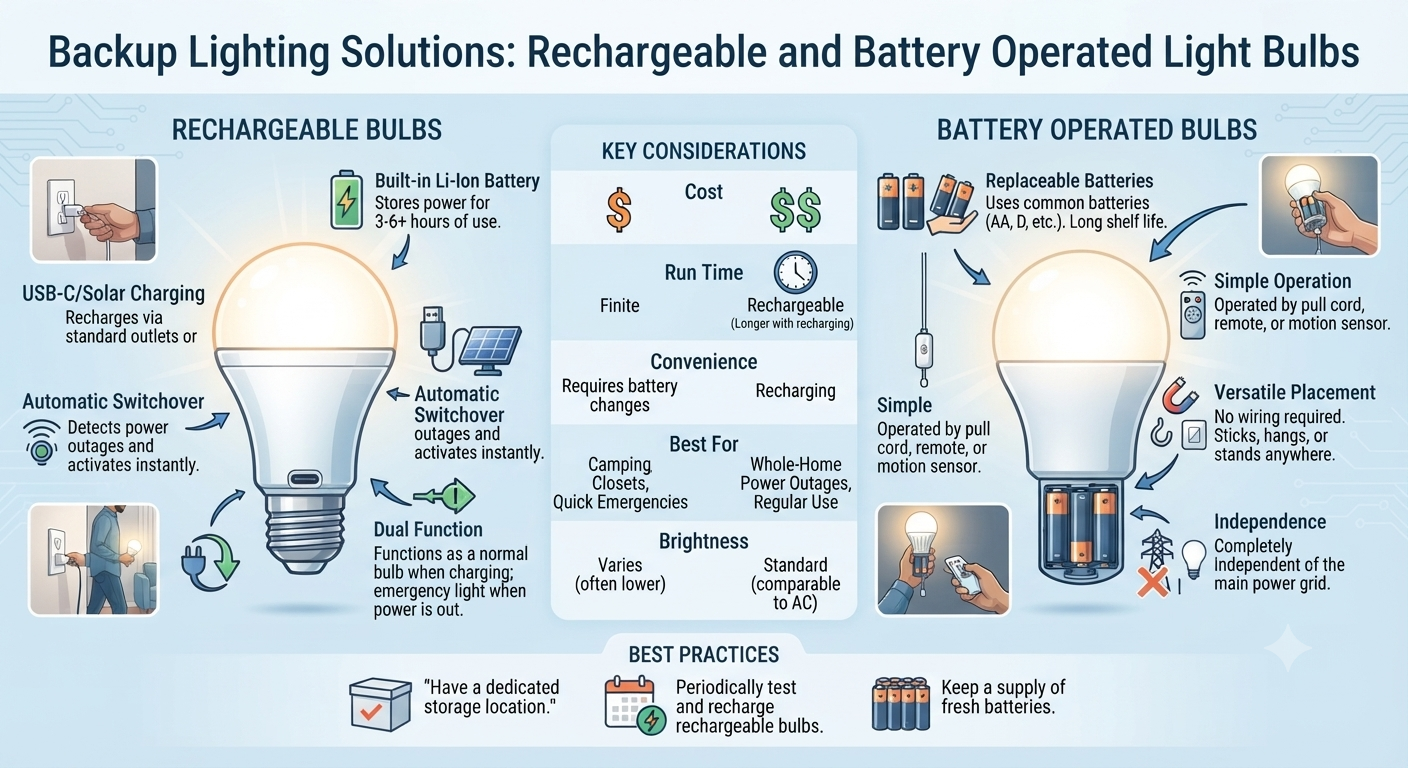
Unlike conventional LED bulbs that depend entirely on mains electricity, emergency lighting products are designed to continue providing illumination when the power goes out. Depending on the design, they may contain a built-in rechargeable battery that charges while the bulb is connected to the electrical supply, or they may operate using replaceable or rechargeable batteries.
For households, these products offer an inexpensive layer of emergency preparedness. They can help illuminate bedrooms, hallways, kitchens, staircases, and entrances during unexpected outages without requiring a generator or complicated electrical installation.
But not every emergency bulb performs the same way.
Battery capacity, charging time, emergency runtime, lumen output, bulb base, charging method, and battery technology all affect real-world performance.
This guide explains how emergency bulbs work, when to choose rechargeable or battery-powered options, what specifications to look for, and how to build a practical home lighting backup system.
Why Emergency Lighting Belongs in Every Home
Electricity is so integrated into modern life that we often forget how dependent we are on it.
When the power goes off, the first problem is usually visibility.
Without adequate lighting, simple tasks become difficult
- Walking through hallways
- Finding electrical switches
- Navigating stairs
- Checking circuit breakers
- Preparing food
- Looking after children
- Accessing the front door
- Finding medical supplies
- Locating a flashlight
The situation becomes more challenging when an outage lasts for several hours.
A candle can provide light, but it introduces an open flame.
A flashlight works well for portable illumination, but it only lights the direction in which you point it.
An emergency rechargeable light bulb offers a different solution: it can illuminate an entire room using a familiar light fitting.
That makes it particularly convenient for everyday household use.
How Rechargeable Light Bulbs Work
- A rechargeable emergency bulb typically contains
- LED light source
- Rechargeable battery
- Charging circuit
- LED driver
- Standard bulb base
Under normal conditions, the bulb operates like a conventional LED lamp.
When connected to mains electricity, it provides illumination while simultaneously charging its internal battery.
When the electricity fails, the internal battery powers the LEDs.
The transition can happen automatically, depending on the product design.
This means you don't necessarily need to search for a separate flashlight when the power goes out.
The emergency bulb is already installed where you need it.
Rechargeable vs. Battery-Operated Light Bulbs
Although the terms are sometimes used interchangeably, there is an important distinction.
Feature
- Rechargeable Light Bulbs
- Battery Operated Light Bulb
- Power Source
- Built-in rechargeable battery
- Replaceable or rechargeable batteries
- Charging
- Usually charges from mains electricity
- Depends on battery type
- Ongoing Cost
- Low after initial purchase
- Depends on battery replacement
- Convenience
- Very high
- Moderate to high
- Emergency Use
- Excellent
- Excellent
- Maintenance
- Battery eventually degrades
- Batteries need replacement/recharging
- Best For
- Permanent emergency lighting
- Portable or independent lighting
A rechargeable bulb is generally more convenient for rooms where you want emergency lighting available automatically.
A battery-operated bulb can be useful in locations without electrical wiring or where you want portable lighting.
Both have a place in a well-prepared home.
Rechargeable Light Bulbs vs. Flashlights
You don't necessarily need to choose one over the other.
They solve different problems.
Rechargeable Bulbs
- Best for
- Room illumination
- Bedrooms
- Living rooms
- Kitchens
- Hallways
- Ceiling fixtures
- Flashlights
- Best for
- Moving around outdoors
- Checking electrical panels
- Walking between buildings
- Emergency evacuation
- Directional illumination
A good emergency preparedness kit should ideally include both.
The bulb illuminates the room.
The flashlight helps you move and inspect specific areas.
The Advantage of Familiar Light Fixtures
One of the biggest advantages of emergency bulbs is simplicity.
Suppose a power failure occurs at midnight.
You don't need to
Find a flashlight.
Locate batteries.
Replace dead batteries.
Walk around in darkness.
If the emergency bulb is already installed, it can provide immediate illumination when the mains supply fails.
This is particularly useful for
- Children's bedrooms
- Elderly family members
- Staircases
- Hallways
- Main entrances
The best emergency equipment is often the equipment you don't have to think about using.
Where Should You Install Emergency Bulbs?
You don't necessarily need emergency bulbs in every room.
Prioritize locations where darkness could create a safety problem.
Staircases
Stairs are one of the highest-priority areas.
A sudden blackout can make them hazardous.
Hallways
Hallway lighting helps people move safely between rooms.
Main Entrance
Useful when power fails at night and you need to open the door.
Kitchen
Important for safe movement around countertops, appliances, and cooking areas.
Bedroom
An emergency bulb can provide immediate light without requiring you to search for equipment.
Living Room
Useful as a central gathering area during extended outages.
Garage or Utility Area
A battery-operated light can be particularly useful where a conventional ceiling fixture may not be practical during a blackout.
How Bright Should an Emergency Bulb Be?
Brightness should be measured in lumens, not simply watts.
Wattage tells you how much electrical power the LED consumes.
Lumens indicate how much visible light the bulb produces.
For emergency lighting, consider the purpose of the room.
A low-output bulb may be enough for
- Corridors
- Bedrooms
- Nighttime navigation
- Higher output may be preferable for
- Kitchens
- Living rooms
- Utility areas
- Larger spaces
However, maximum brightness isn't always the goal.
A very bright bulb may drain its battery faster.
This creates a fundamental trade-off
Higher brightness = greater energy consumption = potentially shorter emergency runtime.
The ideal product balances usable illumination with sufficient battery duration.
Emergency Runtime: The Specification That Matters Most
- One of the most important questions to ask is
- How long will the bulb operate during a power outage?
- Manufacturers may advertise runtime figures such as
- 2 hours
- 3 hours
- 4 hours
- 6 hours
But always check the conditions behind the claim.
Runtime can vary depending on
- Brightness level
- Battery capacity
- Battery age
- Ambient temperature
- LED efficiency
- Battery condition
A bulb that operates for six hours at low brightness may provide considerably less runtime at maximum output.
Look for products that clearly specify their emergency runtime and operating conditions.
Battery Capacity and Energy Storage
- Battery capacity is usually expressed in
- mAh (milliamp-hours)
- Ah (amp-hours)
- Wh (watt-hours)
Watt-hours are particularly useful for comparing energy storage.
The basic relationship is
- Energy (Wh) = Voltage (V) × Capacity (Ah)
- For example, a battery rated at 3.7V and 2Ah theoretically stores
- 7 × 2 = 7.4Wh
Actual usable energy will be lower because of conversion losses and battery discharge characteristics.
This illustrates why battery capacity should be evaluated alongside LED power consumption.
A larger battery can potentially provide longer runtime, but it may also increase the bulb's size, cost, and charging time.
Rechargeable Light Bulbs and Charging Time
Charging time is another important specification.
If a bulb requires several hours to fully recharge, it may not recover completely after a short power interruption.
For example, imagine an outage occurs in the evening and the power returns for only a few hours before another outage.
A bulb with a long charging cycle may not have enough stored energy for the second event.
When comparing rechargeable light bulbs, consider
- Full charging time
- Battery capacity
- Emergency runtime
- Charging method
- Charge indicator, if available
Products with clear charging specifications are easier to evaluate.
Battery Technology Matters
Not all rechargeable batteries have the same characteristics.
Common technologies include
- Lithium-Ion
- Widely used because of
- High energy density
- Compact size
- Good weight-to-capacity ratio
- Lithium Iron Phosphate (LiFePO₄)
- Known for
- Strong cycle life
- Good thermal stability
- Long service potential
- Nickel-Metal Hydride (NiMH)
Used in some rechargeable applications.
The battery technology affects
- Lifespan
- Charging characteristics
- Size
- Weight
- Cost
For emergency bulbs, battery quality is particularly important because the battery may remain on standby for long periods before being called into service.
What Happens When the Power Goes Out?
The exact behavior depends on the bulb.
Some emergency bulbs
Automatically turn on when mains power fails.
Others
Require a compatible fixture or circuit configuration.
Some products may also provide a manual emergency mode.
Before purchasing, verify how the bulb behaves during a blackout.
A product that requires a specific type of wall switch or electrical configuration may not work as expected in every installation.
Always follow the manufacturer's instructions.
Can Rechargeable Bulbs Be Used Like Normal LED Bulbs?
Many emergency rechargeable bulbs are designed to function as normal household lighting while the electricity is available.
This is one of their biggest advantages.
Under normal conditions
- Mains power → LED illumination + battery charging
- During a blackout
- Battery power → LED illumination
However, compatibility varies.
Check
- Voltage rating
- Bulb base
- Fixture compatibility
- Charging requirements
- Switch operation
Some emergency bulbs may not work correctly with certain dimmers, smart switches, or specialized fixtures.
Choosing the Correct Bulb Base
Before buying a battery operated light bulb or rechargeable emergency bulb, check the socket type.
Common bases include
- E27
- E26
- B22
- GU10
- Other specialized fittings
The bulb must physically fit the fixture and match the electrical specifications.
Don't assume that all emergency bulbs use the same base.
If you're replacing a standard household lamp, remove the existing bulb and check the base specification before ordering.
Rechargeable Bulbs and Dimmers
Dimming can be complicated with emergency lighting.
A standard LED bulb may be designed for dimming, but an emergency bulb with integrated battery electronics may not support the same functionality.
Potential problems include
- Flickering
- Limited dimming range
- Battery charging issues
- Incorrect emergency operation
If dimming is important, choose a product specifically designed to support it.
Never assume that because a bulb is LED, it is automatically dimmable.
Emergency Bulbs and Smart Home Systems
Smart lighting systems can add convenience, but compatibility needs careful consideration.
A smart switch may interrupt the electrical supply to a rechargeable bulb.
If the bulb depends on continuous power to charge its battery, leaving the smart switch off for extended periods may prevent proper charging.
Similarly, some smart dimmers may not be compatible with emergency bulbs.
For emergency applications, simplicity is often an advantage.
A standard switch and a properly designed rechargeable bulb may provide more dependable emergency functionality than a complicated control system.
Battery-Operated Bulbs for Areas Without Power
A battery operated light bulb can be particularly useful where there is no reliable electrical supply.
Applications include
- Sheds
- Garages
- Storage rooms
- Temporary shelters
- Camping areas
- Remote structures
- Construction locations
- These products may use
- Replaceable batteries
- Rechargeable battery packs
- USB charging
- Solar charging
The best choice depends on how frequently the light is used.
For occasional emergency use, replaceable batteries can be convenient.
For frequent use, a rechargeable system may be more economical and environmentally practical.
Rechargeable Bulbs vs. Generator Backup
A generator can power an entire home, but it comes with complexity.
Generators may require
- Fuel
- Maintenance
- Outdoor operation
- Ventilation
- Electrical transfer equipment
- Regular testing
A rechargeable bulb is much simpler.
It can provide immediate lighting without
- Fuel
- Noise
- Exhaust
- Electrical rewiring
Of course, it can't power refrigerators, pumps, fans, or other appliances.
This is why the two technologies shouldn't be considered direct replacements.
A generator provides whole-home backup power.
Emergency bulbs provide localized lighting resilience.
For many households, rechargeable bulbs are an inexpensive first layer of emergency preparedness.
Safety Advantages Over Candles
Candles have been used for emergency lighting for centuries.
They're simple.
They're also an open flame.
A candle can be knocked over.
It can ignite nearby materials.
It can be dangerous around
- Children
- Pets
- Curtains
- Bedding
- Paper
- Furniture
LED emergency lighting eliminates the open flame.
It provides consistent illumination without producing combustion gases or an exposed flame.
For everyday emergency preparedness, LED-based lighting is generally the safer option.
How to Build a Home Emergency Lighting Plan
A practical plan doesn't need to be complicated.
Step 1: Identify Critical Areas
- Locate
- Stairs
- Hallways
- Entrances
- Kitchen
- Bedrooms
- Step 2: Install Rechargeable Bulbs
Use them in fixtures where automatic emergency illumination is valuable.
Step 3: Keep Flashlights Available
Place flashlights in known locations.
Step 4: Keep Spare Batteries
For battery-powered devices, maintain fresh replacement batteries.
Step 5: Test Regularly
Don't wait for an actual blackout to discover that your emergency bulb no longer holds a charge.
Step 6: Check Battery Health
Rechargeable batteries degrade over time.
Replace products when emergency runtime becomes inadequate.
Testing Your Emergency Bulbs
Emergency equipment should be tested periodically.
A simple test is
Ensure the bulb has been fully charged.
Switch off the mains power to the fixture safely.
Confirm that the emergency mode activates.
Observe brightness.
Check runtime.
Restore power.
For hardwired systems, electrical testing should be performed safely and in accordance with applicable requirements.
If you're unsure how to isolate a circuit safely, use a qualified electrician.
The purpose of testing is simple
You want to discover a failed battery before the blackout—not during it.
Common Mistakes When Buying Emergency Bulbs
- Mistake 1: Looking Only at Wattage
Wattage doesn't tell you how long the bulb will operate during an outage.
Mistake 2: Ignoring Lumens
A bulb may have excellent battery life but insufficient light output.
Mistake 3: Forgetting Runtime
Always check how long the bulb can provide useful illumination.
Mistake 4: Ignoring Charging Time
A long recharge cycle may be inconvenient during repeated outages.
Mistake 5: Assuming All Bulbs Are Compatible
Check the socket, voltage, fixture, and control system.
Mistake 6: Never Testing the Battery
A rechargeable bulb can appear normal until its battery is needed.
Mistake 7: Choosing the Cheapest Product
Poor battery quality can reduce real-world reliability.
Mistake 8: Installing Emergency Lighting Only in One Room
Blackouts affect the entire house.
Critical pathways should also receive attention.
Rechargeable Light Bulb Buying Checklist
- Before purchasing, check
- Light Output
- Lumens
- Color temperature
- Beam distribution
- Battery
- Capacity
- Battery chemistry
- Expected service life
- Replaceability
- Emergency Performance
- Runtime
- Full-brightness runtime
- Emergency activation method
- Low-battery behavior
- Charging
- Charging time
- Charging method
- Charge indicator
- Compatibility
- Bulb base
- Voltage
- Fixture compatibility
- Dimmer compatibility
- Smart switch compatibility
- Long-Term Ownership
- Warranty
- Replacement availability
- Manufacturer support
- Frequently Asked Questions
- How do rechargeable light bulbs work during a power outage?
Most rechargeable emergency bulbs charge their internal battery while connected to the mains supply. When the electricity fails, the bulb switches to battery power and continues illuminating the LED. The exact operation depends on the product design and electrical installation.
How long do rechargeable light bulbs last during a blackout?
Emergency runtime varies widely depending on battery capacity, LED power, brightness, and battery condition. Some products provide a few hours of illumination, while others can last considerably longer at reduced brightness. Always check the manufacturer's specified runtime.
Are battery operated light bulbs worth buying?
Yes, particularly for locations without reliable electrical power or as part of an emergency preparedness kit. They can provide useful illumination in garages, sheds, storage areas, and during power outages. The value depends on battery life, brightness, and how often the product is used.
Do rechargeable emergency bulbs charge automatically?
Many are designed to charge automatically while connected to mains electricity, but the exact behavior varies. Some require continuous power to charge, while others may have specific switch or fixture requirements. Always verify the manufacturer's instructions.
Final Takeaway: Prepare for the Darkness Before It Arrives
A power outage is inconvenient.
A power outage in complete darkness can be dangerous.
That's why rechargeable light bulbs deserve a place in a practical home emergency plan. They provide an automatic layer of backup illumination without requiring fuel, generators, or complicated electrical systems.
For permanent household fixtures, choose emergency bulbs based on lumens, battery capacity, runtime, charging time, bulb base, and compatibility.
For garages, sheds, remote spaces, and areas without dependable mains power, a battery operated light bulb can provide flexible illumination where traditional fixtures aren't practical.
The smartest approach is to combine several technologies.
Use rechargeable emergency bulbs in critical ceiling fixtures.
Keep reliable flashlights available for portable illumination.
Maintain spare batteries where required.
Test your equipment periodically.
And consider a generator or larger backup power system if your household depends on electricity for essential appliances.
Emergency preparedness doesn't always require expensive equipment. Sometimes, a simple LED bulb with a dependable internal battery is enough to make the difference between sitting in complete darkness and having a safe, usable room when the power goes out.
The best emergency lighting is the lighting that's already charged, already installed, and ready to work when you need it most.