bolt Quick Answer (As of 2026)
Lighting is one of the easiest places to start when you want to reduce household electricity consumption.
Lighting is one of the easiest places to start when you want to reduce household electricity consumption.
Unlike major appliances, lighting upgrades don't require a complete lifestyle change. Replacing an inefficient bulb with a modern energy saving light bulb can immediately reduce the electricity required to produce the same amount of useful light. Multiply that change across a home, office, shop, factory, or commercial building, and the savings can become significant.
But there is a catch.
Not every bulb marketed as "energy saving" delivers the same performance. Wattage alone doesn't tell you how much light you get. A cheap LED with a poor driver may consume little electricity but provide disappointing brightness, poor color quality, or a short service life. Meanwhile, a well-designed LED can deliver excellent illumination with low energy consumption while operating reliably for years.
The key is to understand the relationship between watts, lumens, efficacy, operating hours, lifespan, and electricity rates.
This guide explains how energy efficient light bulbs work, how much you can realistically save, how to calculate your potential electricity reduction, and how to choose the right energy saving bulbs for homes, offices, retail stores, and industrial applications.
What Are Energy-Saving Light Bulbs?
An energy-saving light bulb is a lamp designed to produce useful illumination while consuming less electrical power than older lighting technologies.
Today, the most common high-efficiency solution is the LED bulb.
Older incandescent bulbs generate light by heating a filament until it becomes extremely hot. Unfortunately, most of the electrical energy is converted into heat rather than visible light.
LED technology takes a fundamentally different approach.
A semiconductor device produces light when electrical current passes through it. The process is significantly more efficient than heating a filament.
The result is a bulb that can provide comparable or greater brightness using substantially less electricity.
For example, a modern LED producing the same general light output as an older incandescent bulb may require only a fraction of the electrical power.
That difference is where the savings begin.
LED vs. Incandescent vs. CFL
- Lighting Technology
- Energy Efficiency
- Typical Lifespan
- Heat Output
- Instant Start
- Current Relevance
- Incandescent
- Low
- Short
- Very high
- Yes
- Mostly legacy applications
- Halogen
- Low to moderate
- Short to moderate
- High
- Yes
- Limited
- CFL
- Moderate to high
- Moderate
- Lower than incandescent
- Some warm-up
- Declining
- LED
- High
- Long
- Generally lower
- Yes
- Preferred modern option
LEDs have become the dominant choice for energy-efficient general lighting because they combine low power consumption with long service life and strong design flexibility.
However, the actual performance of an LED depends heavily on the quality of its components.
Why LED Energy Saving Bulbs Use Less Electricity
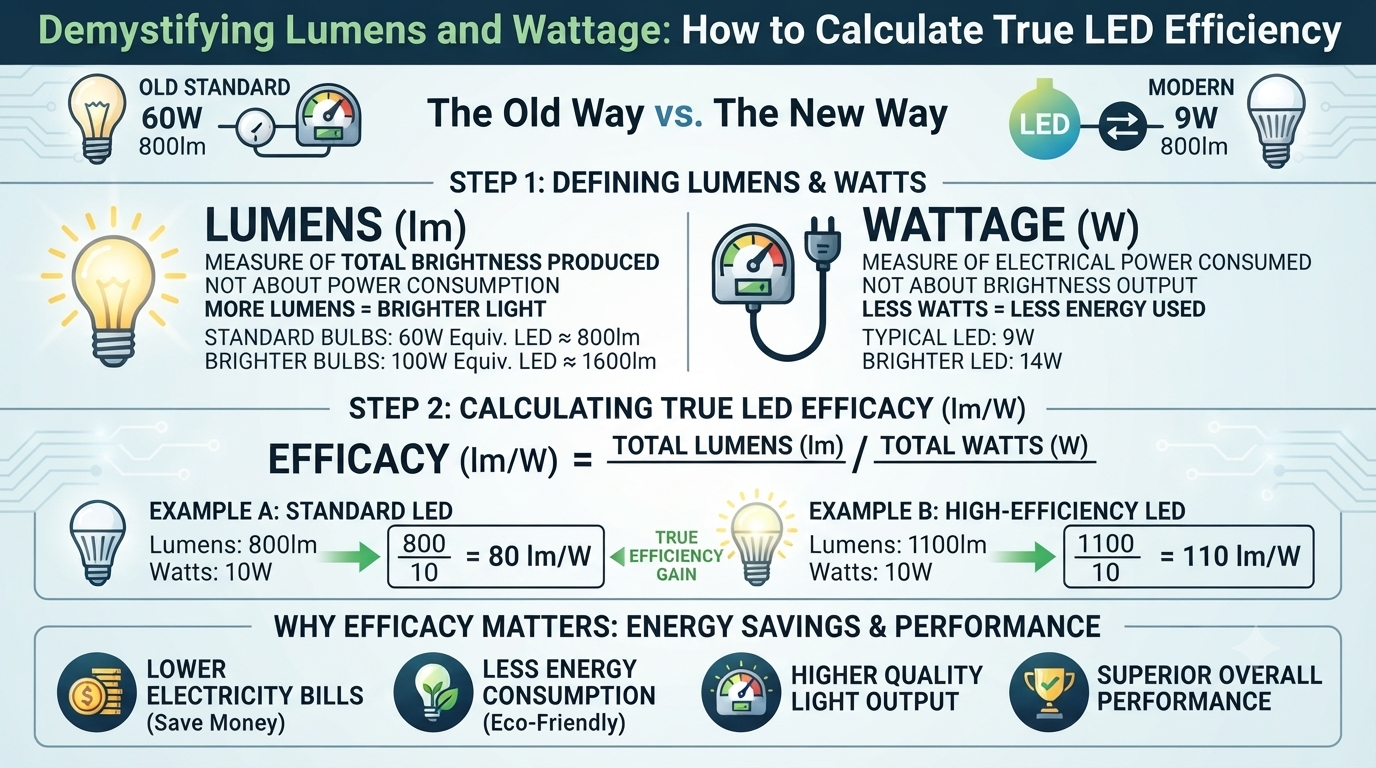
The most important metric is luminous efficacy.
It is typically expressed as
- Lumens per watt (lm/W)
This tells you how much visible light a lighting product produces for each watt of electrical power consumed.
For example
- Bulb A: 800 lumens ÷ 10 watts = 80 lm/W
- Bulb B: 800 lumens ÷ 8 watts = 100 lm/W
Both produce the same nominal light output, but Bulb B uses less electricity to produce it.
This is why comparing only wattage can be misleading.
The better question is
- How many useful lumens do I receive for each watt of electricity?
That's the fundamental question behind energy-efficient lighting.
Lumens vs. Watts: The Most Important Conversion
Older lighting habits often revolve around wattage.
People say
- "I need a 60W bulb."
But wattage doesn't actually describe brightness.
It describes power consumption.
Lumens describe light output.
This means the modern approach is to choose lighting based on the required lumen output first, then select the most efficient product that can deliver those lumens.
For example, if your room needs approximately 800 lumens, you don't necessarily need an incandescent 60W bulb.
A suitable LED may provide similar useful illumination using substantially less electrical power.
This is one of the simplest ways to reduce electricity consumption without sacrificing brightness.
How Much Can Energy-Saving Light Bulbs Save?
- The answer depends on
- Existing bulb technology
- LED wattage
- Number of bulbs
- Daily operating hours
- Electricity tariff
- Fixture efficiency
Let's consider a simple example.
Suppose you replace
- 10 × 60W incandescent bulbs
- with
- 10 × 9W LED bulbs
- The old system consumes
- 60W × 10 = 600W
- The new system consumes
- 9W × 10 = 90W
- The reduction is
- 510W whenever all lights are operating
- If these lights operate for 5 hours every day
- Old consumption
- 6 kW × 5 hours × 365 days = 1,095 kWh/year
- New consumption
- 09 kW × 5 hours × 365 days = 164.25 kWh/year
- Annual energy reduction
- 75 kWh
Your actual financial savings depend on your electricity tariff and billing structure, but the energy reduction itself is substantial.
The more hours your lights operate, the greater the potential savings.
The Simple Energy-Savings Formula
- You can estimate lighting energy consumption using
- Energy Used (kWh) = Wattage ÷ 1000 × Hours of Use
- For multiple bulbs
- Energy Used = Number of Bulbs × Wattage ÷ 1000 × Operating Hours
- To estimate annual consumption
- Annual Energy = Number of Bulbs × Wattage ÷ 1000 × Hours Per Day × 365
- To estimate annual electricity cost
- Annual Cost = Annual Energy Consumption × Electricity Rate
This calculation gives you a basic estimate.
For real utility bills, taxes, demand charges, tiered tariffs, and other billing components may affect the final amount.
The Hidden Savings: LED Lifespan
Electricity isn't the only cost associated with lighting.
There is also maintenance.
A traditional incandescent lamp may need frequent replacement.
A quality LED can operate for many thousands of hours.
This means fewer
- Replacement bulbs
- Maintenance visits
- Ladder trips
- Downtime events
The savings become particularly valuable in difficult-to-access locations.
Imagine replacing lamps in
- High ceilings
- Warehouses
- Factories
- Shopping centers
- Stairwells
- Street-facing façades
The labor required to replace a lamp can cost more than the lamp itself.
Long-life LEDs reduce this maintenance burden.
Energy Savings vs. Total Cost of Ownership
The cheapest bulb isn't always the cheapest lighting solution.
Consider two products.
Option A
- Low purchase price
- Low efficiency
- Shorter lifespan
- Frequent replacement
- Option B
- Higher initial price
- Better energy efficiency
- Longer service life
- Lower maintenance requirements
Option B may cost more upfront but less over the entire ownership period.
This is known as total cost of ownership (TCO).
A useful TCO calculation includes
- Purchase cost
- Installation cost
- Electricity consumption
- Replacement cost
- Maintenance labor
For commercial projects, TCO is often more meaningful than initial purchase price.
Choosing Energy Efficient Light Bulbs by Lumens
Instead of replacing a bulb based on its wattage label, start with the light output.
A rough household comparison might look like
- Traditional Incandescent
- Approximate LED Replacement
- General Light Output
- 40W
- 4–6W LED
- Around 450 lumens
- 60W
- 8–10W LED
- Around 800 lumens
- 75W
- 10–12W LED
- Around 1,100 lumens
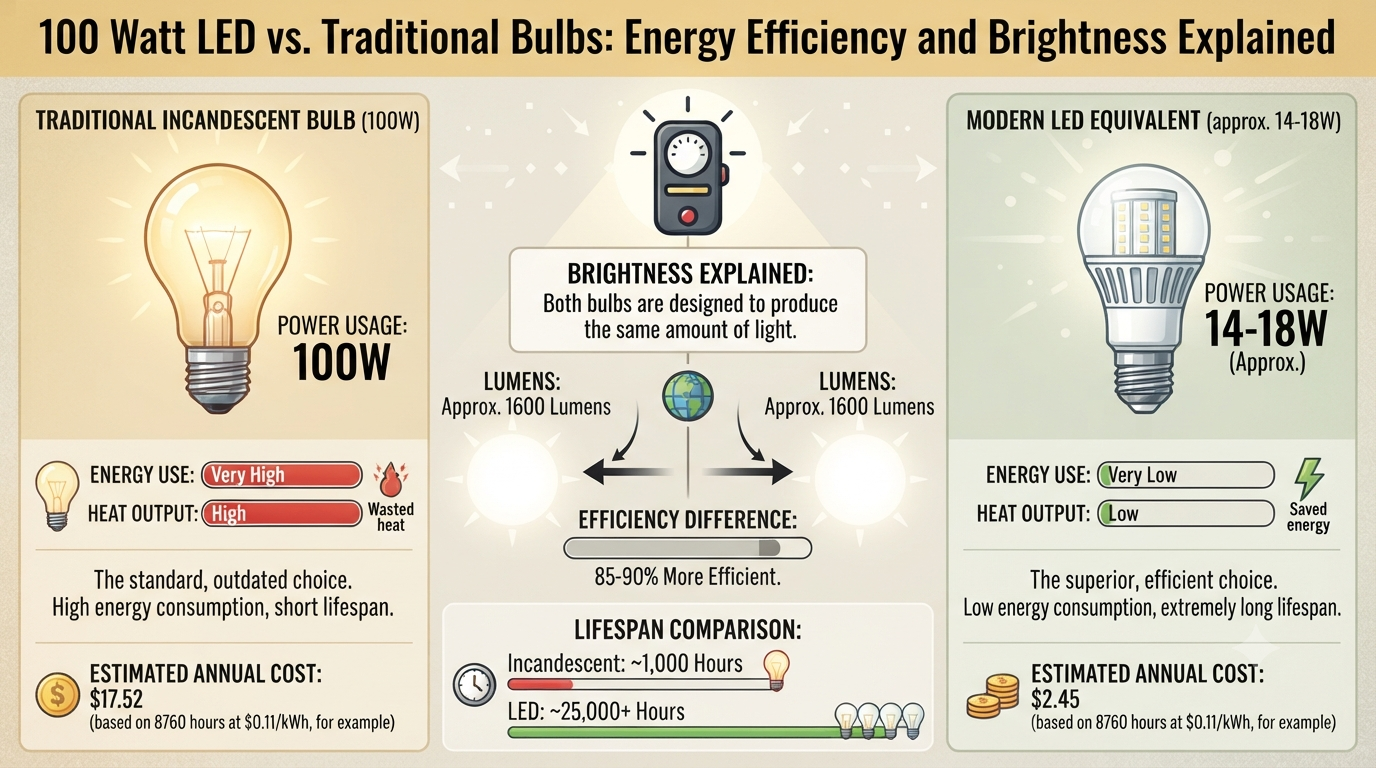
- 100W
- 14–17W LED
- Around 1,600 lumens
- 150W
- 20–25W LED
- Around 2,600 lumens
Actual performance varies by product.
Always check the manufacturer's lumen rating rather than relying solely on wattage equivalency.
Energy-Saving Bulbs for Different Applications
The best energy saving bulbs depend on where they're installed.
Bedrooms
- Choose efficient LEDs with
- Warm white color temperature
- Comfortable brightness
- Good color rendering
- Dimming capability if desired
A 2700K–3000K LED often works well.
Living Rooms
- Consider
- Dimmable LEDs
- Warm white lighting
- Multiple light sources
- High-quality drivers
Dimming can reduce power consumption when full brightness isn't required.
Kitchens
Kitchens often require more light than bedrooms.
Look for
- High lumen output
- Good CRI
- Neutral white color temperature
- Under-cabinet LED lighting
A combination of ceiling LEDs and task lighting can provide better illumination without over-lighting the entire room.
Offices
- Energy-efficient office lighting should balance
- Efficiency
- Glare control
- Color quality
- Visual comfort
LED panels and linear fixtures are often better choices than simply installing many small bulbs.
Occupancy sensors can further reduce electricity consumption.
Warehouses and Industrial Facilities
Industrial lighting can produce major savings because operating hours are often long.
Consider
- LED high-bay fixtures
- Motion sensors
- Daylight harvesting
- Automated controls
In a large facility, even a small reduction in wattage per fixture can create significant annual energy savings.
Smart Controls Make Efficient Lighting Even Better
An energy-efficient bulb can still waste electricity if it remains switched on when nobody needs it.
This is where controls become valuable.
Consider
- Motion Sensors
Lights activate when someone enters the area.
Useful for
- Corridors
- Bathrooms
- Storage rooms
- Parking areas
- Occupancy Sensors
Lights remain active while people are present and switch off after the space is empty.
Timers
- Useful for
- Outdoor lighting
- Signage
- Security lighting
- Dimming
Reduce light output when full brightness isn't required.
Daylight Sensors
Automatically reduce artificial lighting when sufficient natural light is available.
The most efficient system combines efficient LEDs with intelligent controls.
Do Smart Bulbs Save More Electricity?
Sometimes.
But don't assume that a smart bulb is automatically more efficient than a conventional LED.
Both may use similar LED technology.
The advantage of smart lighting comes from control.
For example, automation can
- Turn lights off automatically
- Reduce brightness
- Schedule operation
- Activate lights only when needed
A basic 8W LED running unnecessarily for five hours wastes more energy than necessary.
A smart 8W LED that operates only when needed can reduce that waste.
The biggest energy savings often come from reducing unnecessary operating time.
The Importance of Driver Quality
An LED bulb isn't just an LED chip.
It also contains a driver.
The driver converts and regulates electrical power for the LED.
A high-quality driver can improve
- Efficiency
- Reliability
- Power factor
- Flicker performance
- Thermal stability
- Service life
Poor-quality drivers may lead to premature failure.
They can also contribute to
- Flickering
- Buzzing
- Poor power quality
- Reduced lifespan
If you're purchasing large quantities of energy efficient light bulbs, driver quality should be part of your evaluation.
Heat Dissipation Still Matters
LEDs produce significantly less heat than incandescent bulbs, but they are not completely heat-free.
The LED junction temperature affects long-term performance.
Poor thermal management can accelerate lumen depreciation and shorten component life.
Quality LED bulbs may use
- Aluminum heat sinks
- Thermally conductive materials
- Ventilated designs
- Efficient internal layouts
This is especially important for high-wattage LED products.
A 30W or 50W LED requires substantially more thermal management than a small 5W household bulb.
Don't Ignore Power Factor
For residential users, power factor may not directly affect the electricity bill in the same way it can for large commercial or industrial consumers.
But for commercial installations, it can matter.
A high-quality LED driver may offer a better power factor and lower reactive power requirements.
For large-scale projects, evaluate
- Power factor
- Total harmonic distortion
- Driver efficiency
These specifications become increasingly relevant as the number of fixtures increases.
The Role of Color Temperature
Energy efficiency and color temperature are separate considerations.
A 3000K warm white LED can be energy efficient.
A 4000K neutral white LED can be energy efficient.
A 6500K daylight LED can also be energy efficient.
The choice should be based on the environment.
2700K–3000K
- Best for
- Bedrooms
- Living rooms
- Restaurants
- Hospitality
- 3500K–4000K
- Best for
- Kitchens
- Offices
- Retail
- General commercial areas
- 5000K–6500K
- Best for
- Workshops
- Garages
- Industrial environments
- Detailed task lighting
Don't choose a higher Kelvin rating simply because you think it will save more electricity.
It doesn't work that way.
How to Maximize Your Lighting Energy Savings
Replacing bulbs is only the first step.
For maximum savings
- Replace the Highest-Use Bulbs First
Start with lights that operate the longest.
Replace High-Wattage Inefficient Lamps
Target older incandescent and halogen lighting.
Match Lumens, Not Watts
Maintain the required light output while reducing power consumption.
Install Sensors
Prevent lights from operating in empty spaces.
Use Dimmers
Reduce output when full brightness isn't required.
Improve Fixture Design
A highly efficient bulb inside a poorly designed fixture may still deliver disappointing useful illumination.
Keep Fixtures Clean
Dust and dirt reduce light output.
Use Daylight Strategically
Natural light can reduce the need for artificial illumination.
A Practical Payback Example
Suppose you operate 20 old 60W incandescent bulbs for six hours per day.
Annual energy consumption
- 20 × 60W ÷ 1000 × 6 × 365
- = 2,628 kWh per year
- Now replace them with 9W LED bulbs
- 20 × 9W ÷ 1000 × 6 × 365
- = 394.2 kWh per year
- Annual energy reduction
- 2,233.8 kWh
To calculate the financial saving, multiply that figure by your effective electricity rate.
If the electricity rate is Rs. 50 per kWh
- 2,233.8 × Rs. 50
- = Rs. 111,690 estimated annual energy-cost reduction
This is a simplified example.
Your actual savings will depend on your tariff, operating schedule, taxes, and other billing factors.
The important point is that high-use lighting loads can generate substantial savings after an efficient retrofit.
Are Expensive LED Bulbs Worth It?
Sometimes.
Price alone doesn't determine quality.
Look for measurable specifications such as
- Lumens
- Lumens per watt
- CRI
- Rated lifespan
- Power factor
- Driver quality
- Warranty
- Operating temperature
- Flicker performance
- A slightly more expensive bulb may be worthwhile if it provides
- Higher efficiency
- Better reliability
- Longer service life
- Better light quality
For large projects, even a small difference in efficacy can have a meaningful impact on lifetime energy consumption.
Common Mistakes When Buying Energy Saving Bulbs
- Mistake 1: Choosing the Lowest Wattage
Low wattage isn't useful if the bulb doesn't provide enough light.
Always check lumens.
Mistake 2: Ignoring Lifespan
A cheap bulb that fails quickly isn't necessarily economical.
Mistake 3: Buying Without Checking Compatibility
Some fixtures require specific bulb sizes, bases, or voltage ratings.
Mistake 4: Ignoring Heat
High-power LEDs need appropriate thermal management.
Mistake 5: Overlooking Flicker
Poor-quality drivers can produce uncomfortable or camera-visible flicker.
Mistake 6: Using Too Many Bulbs
Better lighting design can sometimes reduce the number of fixtures required.
Mistake 7: Ignoring Controls
The most efficient bulb still consumes energy when left on unnecessarily.
Energy-Saving Lighting: A Quick Buying Checklist
- Before purchasing energy saving light bulbs, check
- Lumens: Is the light output sufficient?
- Wattage: How much electricity does it consume?
- Efficacy: How many lumens per watt?
- Color temperature: Warm, neutral, or daylight?
- CRI: Are colors rendered accurately?
- Dimmability: Does it work with your dimmer?
- Voltage: Is it compatible with your electrical supply?
- Base: Does it fit the existing socket?
- Lifespan: How many operating hours are expected?
- Driver: Is the internal electronics design reliable?
- Warranty: What protection does the manufacturer provide?
- Thermal design: Can the bulb handle the installation environment?
- For commercial projects, also consider
- Power factor
- Surge protection
- Total harmonic distortion
- Photometric performance
- Maintenance requirements
- Frequently Asked Questions
- How much electricity do energy saving light bulbs save?
The savings depend on the bulb being replaced and how long the light operates. Replacing a 60W incandescent bulb with an efficient 9W LED reduces the lighting load by 51W. Multiply that reduction by the number of bulbs and operating hours to estimate total energy savings.
Are LED bulbs the most energy efficient light bulbs?
Modern LED technology is generally among the most energy-efficient mainstream lighting options. However, efficiency varies between products. Compare lumen output and lumens-per-watt performance rather than assuming every LED bulb is equally efficient.
Do energy saving bulbs reduce electricity bills?
Yes, replacing inefficient lighting with efficient LEDs can reduce the electricity consumed by lighting. The financial impact depends on the number of bulbs, wattage reduction, operating hours, and local electricity tariff. Savings can be especially significant in commercial or industrial facilities where lights operate for long periods.
Is a higher-wattage LED always brighter?
Not necessarily. Wattage measures electrical power consumption, while lumens measure light output. A more efficient lower-wattage LED can produce the same or greater lumen output than a less efficient higher-wattage product. Always compare lumens when selecting replacement bulbs.
Final Takeaway: The Biggest Lighting Savings Come From Better Decisions
Switching to energy efficient light bulbs is one of the simplest ways to reduce lighting-related electricity consumption.
But the smartest strategy isn't simply to buy the bulb with the lowest wattage.
Start with the amount of light you actually need.
Then compare lumens, efficacy, driver quality, lifespan, CRI, color temperature, and compatibility. Calculate how many hours each light operates and prioritize the fixtures that consume the most electricity.
For homes, this might mean replacing frequently used incandescent bulbs with efficient LEDs.
For businesses, the opportunity can be much larger. A complete lighting retrofit combined with occupancy sensors, daylight controls, dimming, and efficient fixtures can dramatically reduce operating costs.
Remember the basic formula
Less power × fewer operating hours × efficient light output = lower energy consumption.
The best energy saving bulbs don't merely consume fewer watts. They deliver the right amount of useful light, operate reliably, last for years, and work efficiently within the lighting system around them.
If you want to slash your utility bills, start by replacing inefficient high-use lighting, then take the next step: control when, where, and how brightly those lights operate.