bolt Quick Answer (As of 2026)
Security lighting is one of the simplest ways to make a property safer, more visible, and easier to monitor after dark. A strategically positioned floodlight can illuminate a driveway, discourage unwanted activity, improve visibility around entran...
Security lighting is one of the simplest ways to make a property safer, more visible, and easier to monitor after dark. A strategically positioned floodlight can illuminate a driveway, discourage unwanted activity, improve visibility around entrances, and help security cameras capture clearer footage.
But installing the brightest possible fixture isn't necessarily the best solution.
Effective outdoor lighting depends on where the light is positioned, how evenly it illuminates the area, how much glare it produces, and how efficiently it operates. Modern outdoor LED flood lights have become a popular choice because they combine high lumen output with comparatively low energy consumption, long service life, and excellent control options.
The right system can illuminate a residential driveway, commercial parking area, warehouse perimeter, farm entrance, or industrial facility. The wrong system can create deep shadows, blind neighbors, waste electricity, and even make security cameras less effective through overexposure and glare.
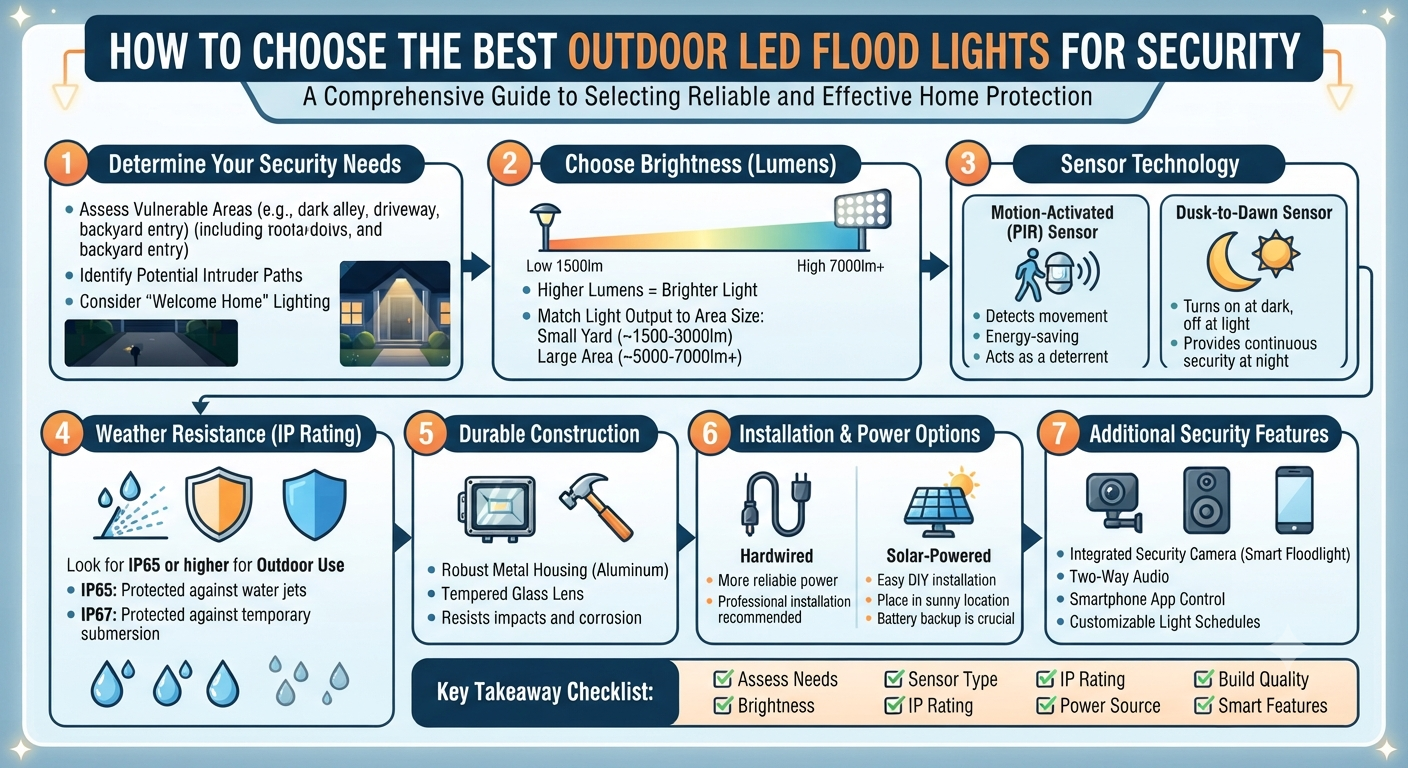
This guide explains how to choose and install outdoor flood lights for security, including lumen output, beam angle, IP ratings, color temperature, motion sensors, smart controls, mounting height, security camera compatibility, and practical positioning strategies.
Why Outdoor Flood Lights Matter for Security
Darkness creates opportunities for accidents and unwanted activity.
Poorly illuminated areas around a property can make it difficult to
- Identify people approaching an entrance
- See vehicles entering a driveway
- Monitor gates and fences
- Detect movement around buildings
- Capture useful security camera footage
- Navigate safely at night
Good security lighting improves visibility without turning the entire property into a stadium.
The objective is controlled illumination.
A well-designed floodlight system should illuminate important areas while minimizing
- Glare
- Light trespass
- Excessive energy consumption
- Unnecessary shadows
- Overlapping beams
- Disturbance to neighbors
This is why fixture selection and positioning matter as much as raw brightness.
What Are Outdoor LED Flood Lights?
An outdoor LED flood light is a high-output lighting fixture designed to distribute light over a relatively broad area.
Compared with traditional halogen or metal-halide floodlights, LED technology typically offers:
Lower energy consumption
- Longer service life
- Faster startup
- High lumen output
- Better directional control
- Lower maintenance requirements
Modern fixtures are available in a wide range of power ratings and optical designs.
You may find products intended for
- Residential security
- Driveways
- Gardens
- Parking lots
- Warehouses
- Construction sites
- Industrial facilities
- Sports areas
The right fixture depends on the size of the area and the level of illumination required.
LED Flood Lights vs. Traditional Flood Lights
- Feature
- LED Flood Lights
- Halogen Flood Lights
- Metal-Halide Flood Lights
- Energy Efficiency
- High
- Low
- Moderate
- Startup
- Instant
- Instant
- May require warm-up
- Service Life
- Generally long
- Shorter
- Moderate
- Maintenance
- Low
- Frequent lamp replacement
- Lamp replacement required
- Heat Output
- Lower than halogen
- Very high
- High
- Dimming/Controls
- Often flexible
- Available with compatible systems
- More limited
- Security Applications
- Excellent
- Functional but less efficient
- Better suited to large legacy installations
For most modern residential and commercial security applications, LED is the practical choice.
The major advantage isn't simply that LEDs consume less power.
It's that they can provide high output with precise optical control.
That makes it easier to put light exactly where it is needed.
How Bright Should Security Flood Lights Be?
Brightness should be determined by the application rather than wattage alone.
A common mistake is to ask
- "How many watts do I need?"
- A better question is
- "How many lumens do I need to illuminate this area effectively?"
Wattage indicates energy consumption.
Lumens indicate the amount of visible light produced.
Two LED floodlights with the same wattage can produce different lumen outputs because of differences in:
LED efficiency
- Driver performance
- Optical losses
- Thermal management
- Product design
For residential applications, a modest floodlight may be sufficient for a doorway or small side passage.
Larger driveways and commercial areas may require multiple higher-output fixtures rather than one extremely powerful unit.
General Flood Light Applications
The required output depends heavily on the target area.
Doorways and Entrances
Moderate output is often sufficient.
The goal is to illuminate faces, locks, steps, and immediate surroundings.
Driveways
A broader beam and greater output may be necessary to cover vehicles and pedestrian paths.
Large Gardens
Multiple fixtures may provide better coverage than one extremely bright light.
Parking Areas
Uniform illumination is usually more important than extreme brightness.
Warehouses and Industrial Sites
High-output fixtures may be required, particularly when mounted at greater heights.
The key principle is simple
Distribute light intelligently rather than relying on maximum brightness.
Beam Angle: One of the Most Important Specifications
Beam angle determines how widely a floodlight spreads its light.
A narrow beam concentrates light over a smaller area.
A wide beam covers a larger area with less intensity at any single point.
Narrow Beam
- Useful for
- Gates
- Long driveways
- Specific entrances
- Perimeter walls
- Medium Beam
- Suitable for
- Building exteriors
- Small parking areas
- General security zones
- Wide Beam
- Useful for
- Large yards
- Open spaces
- Broad wall illumination
A fixture with the wrong beam angle can produce poor results.
For example, a narrow-beam fixture mounted over a small doorway may create excessive brightness in one location while leaving surrounding areas dark.
Conversely, an extremely wide beam mounted high above a large property may not provide enough intensity where it matters.
Why Uniform Lighting Is Better Than Extreme Brightness
Security lighting works best when it reduces dark hiding places.
Imagine a property illuminated by one extremely bright floodlight.
The area directly beneath the fixture is intensely bright.
But beyond the beam, deep shadows remain.
The human eye adapts to the bright area, making darker surroundings appear even darker.
Security cameras can experience a similar problem.
A better approach is often to use multiple appropriately positioned outdoor LED flood lights that create more consistent illumination.
This can improve
- Human visibility
- Camera performance
- Perceived security
- Navigation
- Overall visual comfort
- Motion Sensor Flood Lights
Motion sensors are one of the most useful additions to outdoor security lighting.
Instead of operating continuously, the floodlight activates when movement is detected.
Benefits include
- Reduced energy consumption
- Immediate illumination when activity occurs
- Increased deterrence
- Less unnecessary nighttime lighting
- Motion-activated lighting can be particularly useful around
- Side entrances
- Driveways
- Garages
- Gates
- Backyards
- Storage areas
However, sensor adjustment is critical.
A poorly configured sensor may activate because of
- Passing vehicles
- Small animals
- Tree branches
- Strong winds
- Temperature changes
- Look for fixtures with adjustable
- Detection range
- Sensitivity
- Activation duration
- Detection angle
- Motion Sensors vs. Continuous Lighting
Both approaches have their place.
Continuous Lighting
- Useful for
- Main entrances
- Commercial premises
- Parking areas
- High-traffic locations
- CCTV monitoring zones
- Motion-Activated Lighting
- Useful for
- Residential side yards
- Back entrances
- Garages
- Low-traffic areas
- Perimeter zones
A hybrid system can be particularly effective.
For example
Low-level lighting: Operates throughout the night.
Floodlight: Activates at full brightness when movement is detected.
This provides visibility without wasting energy.
Choosing the Right IP Rating
Outdoor fixtures must withstand environmental exposure.
The IP rating indicates protection against solid particles and water.
The first digit relates primarily to protection against solids and dust.
The second digit indicates water protection.
Common ratings include
- IP44
Protection against water splashes.
May be suitable for sheltered outdoor locations, depending on installation conditions.
IP54
Provides limited dust protection and splash resistance.
IP65
Dust-tight and protected against water jets.
A common choice for exposed outdoor lighting applications.
IP66
Dust-tight with stronger protection against powerful water jets.
IP67
Dust-tight and designed to withstand temporary immersion under specified conditions.
For exposed outdoor flood lights, IP65 or higher is often considered a practical starting point, but the correct rating depends on the location and environmental exposure.
A fixture mounted beneath a covered porch doesn't face the same conditions as one installed on an exposed perimeter wall.
Color Temperature for Security Lighting
Color temperature is measured in Kelvin (K).
2700K–3000K
Warm white.
Creates a softer, more residential appearance.
4000K
Neutral white.
Provides a balanced combination of clarity and comfort.
5000K–6500K
Cool white or daylight appearance.
Often selected for security, commercial, industrial, and outdoor applications where crisp visibility is desired.
For security lighting, 4000K–5000K can provide a useful balance.
However, higher Kelvin does not automatically mean higher brightness.
A 5000K LED isn't necessarily producing more lumens than a 3000K LED with the same rated output.
Color temperature changes the appearance of the light, not simply its quantity.
CRI and Security Lighting
The Color Rendering Index (CRI) describes how accurately a light source reveals colors.
This can matter for security applications.
Good color rendering can help people and cameras distinguish
- Clothing colors
- Vehicle colors
- Surface details
- Landscaping
- Objects around entrances
A high-quality LED with good CRI can provide more natural-looking illumination.
For general outdoor security applications, CRI 70+ may be acceptable depending on the environment, while higher CRI can be beneficial when accurate color identification is important.
Outdoor Flood Lights and Security Cameras
Lighting and surveillance should be designed together.
A camera may have excellent specifications but still produce poor footage if the scene is badly illuminated.
Common problems include
- Excessive backlighting
- Direct glare into the lens
- Overexposed faces
- Deep shadows
- Uneven illumination
Avoid pointing a floodlight directly toward the camera lens.
Instead, position the light so that it illuminates the target area from an angle.
For example
- Poor setup
- Floodlight → Camera → Person
The camera may experience glare.
Better setup
- Camera → Person ← Floodlight
The person is illuminated while the light source remains outside the camera's direct field of view.
This can significantly improve image quality.
Security Lighting and CCTV Night Vision
Many security cameras use infrared illumination for night vision.
Adding visible LED floodlights can change how the camera operates.
Some cameras automatically switch from black-and-white infrared mode to full-color night recording when sufficient visible light is available.
This can be useful when identifying
- Vehicle colors
- Clothing
- Property details
However, excessive brightness can still cause overexposure.
The best solution is to test the complete system at night.
Don't judge the lighting only during daylight.
Mounting Height and Position
Where you install an outdoor floodlight affects its performance.
A fixture mounted too low may be
- Easy to tamper with
- More likely to cause glare
- Too concentrated in coverage
- A fixture mounted too high may
- Spread light too broadly
- Reduce illumination intensity
- Require a higher-output product
- Mounting position should be determined by
- Coverage area
- Fixture beam angle
- Wall height
- Security requirements
- Camera locations
- Accessibility
For many residential applications, mounting fixtures above normal reach provides a useful balance between security and maintenance access.
Strategic Locations for Outdoor Flood Lights
- Consider illuminating
- Main Entrance
Improves visibility around doors and locks.
Garage
Helps illuminate vehicles and access points.
Driveway
Improves pedestrian and vehicle visibility.
Side Passages
These areas are often overlooked and can become dark zones.
Rear Doors
Useful for both security and safe access.
Gates
Illuminates people entering or leaving the property.
Perimeter Walls
Can reduce dark areas around the boundary.
Storage Areas
Useful for detecting movement around sheds and outbuildings.
Don't Create Blind Spots
One of the most common security lighting mistakes is focusing only on the front entrance.
A property may have a beautifully illuminated front door while the side or rear remains completely dark.
Walk around the property after sunset.
Look for
- Dark corners
- Hidden pathways
- Areas behind structures
- Fence gaps
- Side gates
- Unlit windows
- Areas shielded by landscaping
These are the locations that often deserve attention.
The goal isn't to illuminate every square meter.
It's to eliminate unnecessary concealment opportunities.
Lighting Perimeters With Multiple Fixtures
Large properties often benefit from multiple smaller or medium-output fixtures rather than one massive floodlight.
For example
- Fixture A: Main entrance
- Fixture B: Side passage
- Fixture C: Rear entrance
- Fixture D: Garage
- Fixture E: Gate
Each fixture addresses a specific security zone.
This approach can provide more uniform coverage and reduce shadows.
It also allows you to control different zones independently.
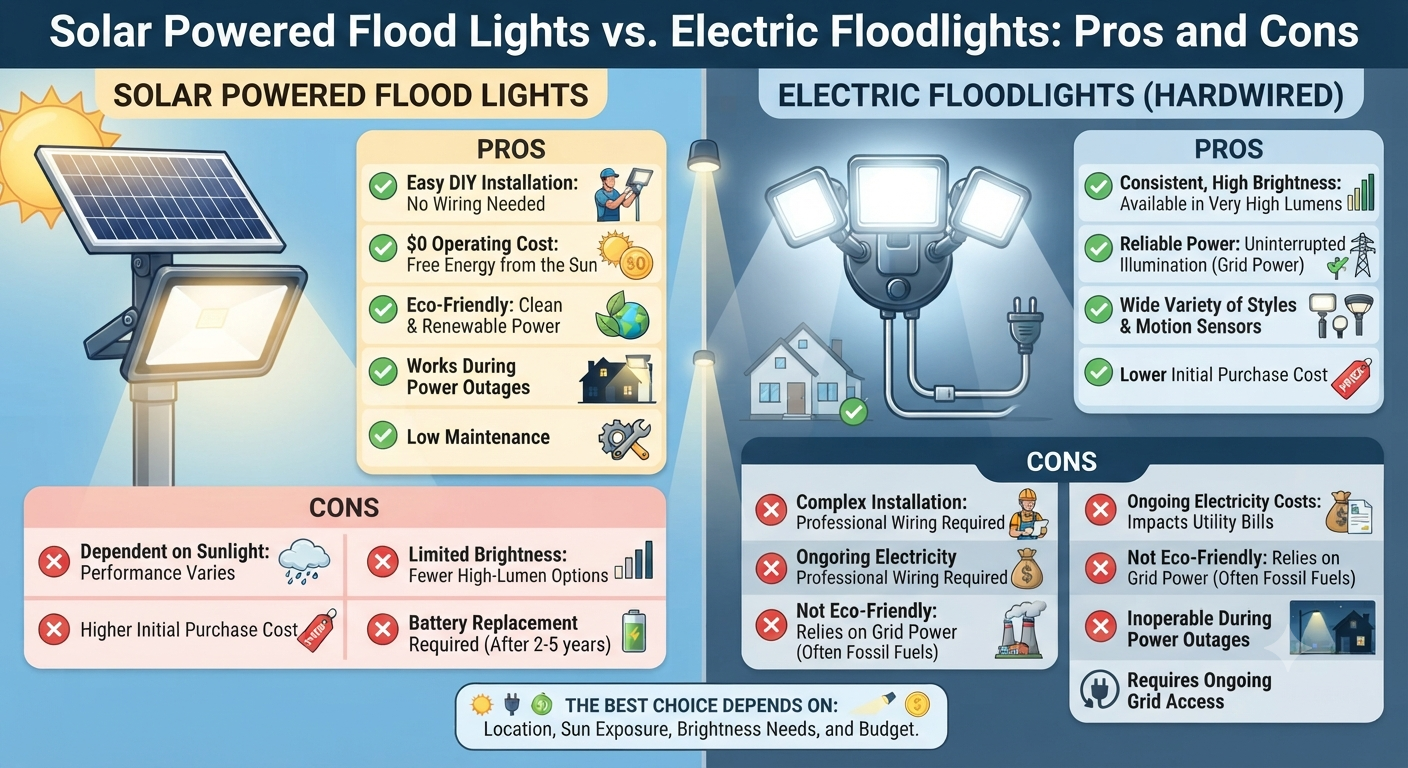
Solar vs. Wired Outdoor Flood Lights
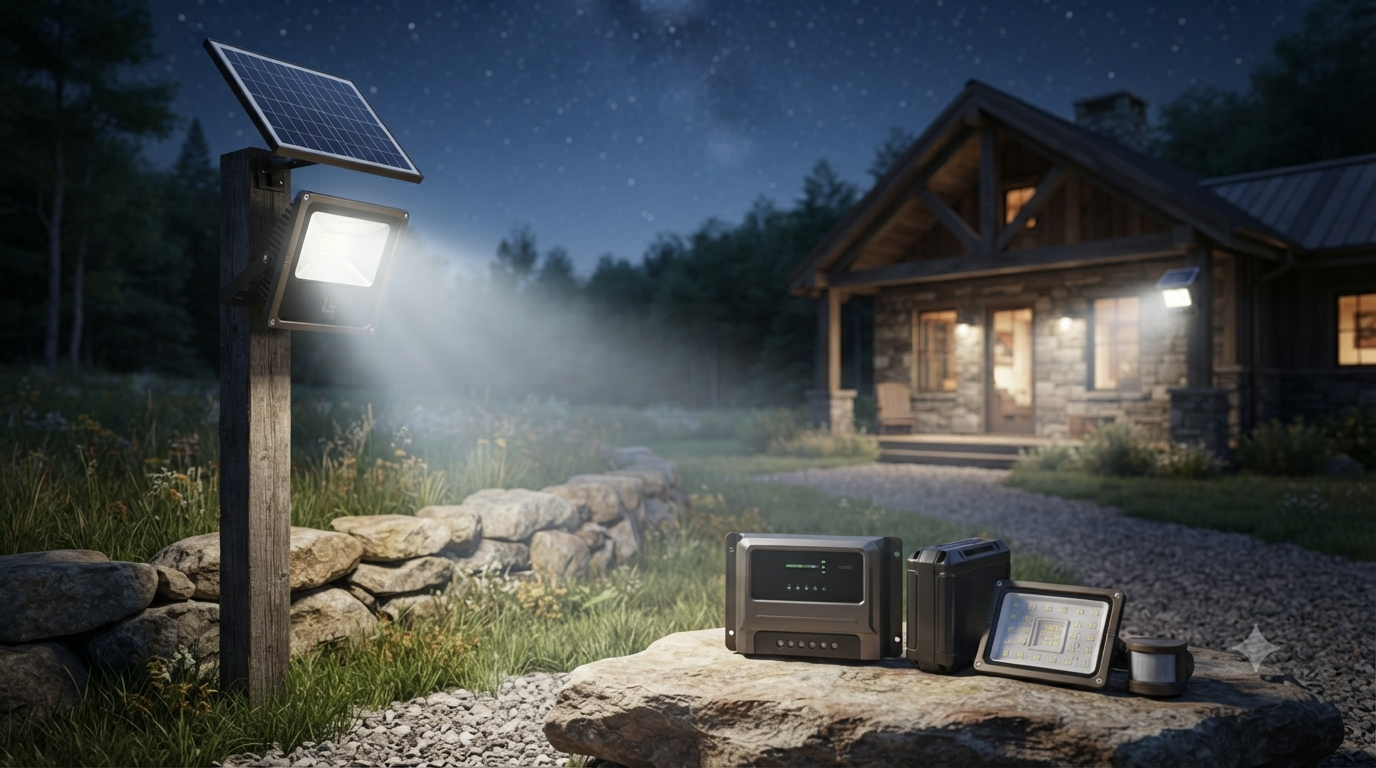
Solar-powered floodlights can be useful where electrical wiring is difficult.
Advantages include
- Easy installation
- No mains wiring to the fixture
- Low operating cost
- Useful for remote locations
- However, performance depends on
- Sunlight availability
- Panel orientation
- Battery capacity
- Weather conditions
- Seasonal changes
Wired outdoor LED flood lights generally offer more predictable performance, particularly for high-output security applications.
For critical security zones, reliable mains-powered lighting may be preferable.
Energy Efficiency and Operating Costs
LED technology can significantly reduce energy consumption compared with traditional high-wattage floodlights.
The potential savings depend on
- Fixture wattage
- Hours of operation
- Electricity tariff
- Number of fixtures
- Use of motion sensors
For example, replacing a 500W halogen floodlight with a much lower-wattage LED fixture that provides comparable useful illumination can substantially reduce electricity consumption.
Adding motion sensors can reduce operating hours even further.
The best energy strategy is often
- Efficient LED + appropriate lumen output + smart controls
Not simply installing the lowest-wattage fixture available.
A weak light that fails to illuminate the area properly isn't an efficient solution.
Heat Dissipation and LED Flood Light Lifespan
LEDs are efficient, but they still generate heat.
The heat must be transferred away from the LED chips and electronics.
Look for quality fixtures with
- Aluminum housings
- Effective heat sinks
- Good thermal pathways
- Quality LED drivers
- Appropriate ventilation where the design requires it
Poor thermal management can reduce LED lifespan and cause lumen depreciation.
This is especially important for high-output floodlights operating for extended periods.
A product's advertised lifespan is only meaningful when the fixture is installed and operated within its specified conditions.
Driver Quality Matters
The LED driver converts and regulates electrical power for the LEDs.
It plays a major role in
- Flicker performance
- Efficiency
- Reliability
- Surge protection
- Dimming behavior
A high-quality LED chip paired with a poor driver may still result in an unreliable product.
When buying outdoor flood lights, especially for commercial or security-critical installations, look beyond the LED wattage.
Check the complete system.
Surge Protection for Outdoor LED Flood Lights
Outdoor lighting is exposed to electrical disturbances and environmental conditions.
Depending on the installation, surge protection may be worth considering.
This is particularly relevant for
- Large commercial sites
- Industrial facilities
- Tall structures
- Exposed locations
- Areas with frequent electrical disturbances
The appropriate protection strategy depends on the electrical system and local conditions.
For critical installations, consult a qualified electrical professional.
Smart Outdoor Flood Lights
Modern security lighting can integrate with smart home or building management systems.
Depending on the product, you may have access to
- Smartphone control
- Motion alerts
- Scheduling
- Remote switching
- Dimming
- Camera integration
Some systems can trigger lights when a security camera detects movement.
Others can coordinate multiple fixtures across a property.
Smart controls are particularly useful for larger properties where manually managing multiple lights would be inconvenient.
Common Mistakes When Installing Outdoor Flood Lights
- Mistake 1: Choosing the Brightest Fixture
More brightness doesn't automatically mean better security.
Mistake 2: Ignoring Beam Angle
A powerful narrow beam may leave large areas dark.
Mistake 3: Pointing Lights Directly at Cameras
This can cause glare and reduce image quality.
Mistake 4: Installing Only One Floodlight
One fixture often creates harsh shadows.
Mistake 5: Ignoring IP Rating
Outdoor exposure requires appropriate environmental protection.
Mistake 6: Forgetting Light Trespass
Don't direct powerful lights toward neighbors' windows or public roads unnecessarily.
Mistake 7: Mounting Fixtures Too Low
Low fixtures may be vulnerable to tampering.
Mistake 8: Ignoring Driver Quality
The LED chip isn't the only critical component.
Mistake 9: Overlooking Maintenance
Even durable fixtures require occasional cleaning and inspection.
A Practical Outdoor Security Lighting Plan
For a typical residential property, consider dividing the lighting into zones.
Zone 1: Front Entrance
Use a moderate-output fixture with motion detection.
Zone 2: Driveway
Use broader coverage to illuminate vehicles and pedestrian movement.
Zone 3: Side Passage
Use a motion-activated fixture to eliminate a potential dark zone.
Zone 4: Rear Entrance
Use focused illumination around doors and access points.
Zone 5: Perimeter
Use multiple fixtures where necessary rather than one extremely powerful unit.
Zone 6: CCTV Coverage
Position lights to illuminate camera targets without shining directly into camera lenses.
This creates a more coordinated security system.
Outdoor LED Flood Light Buying Checklist
- Before purchasing, check
- Lumen output
- Power consumption
- Beam angle
- IP rating
- Color temperature
- CRI
- LED driver quality
- Surge protection
- Motion sensor compatibility
- Mounting options
- Operating temperature range
- Housing material
- Heat dissipation
- Warranty
- Expected service life
- For commercial projects, also consider
- Photometric data
- Lighting calculations
- Maintenance factors
- Control systems
- Emergency lighting requirements where applicable
- Local electrical and building regulations
- Frequently Asked Questions
- How many lumens do I need for an outdoor security flood light?
The required lumen output depends on the size of the area, mounting height, beam angle, surface reflectance, and desired illumination level. Small entrances require considerably less output than large driveways or commercial parking areas. Instead of selecting by wattage alone, consider the fixture's lumen output and how effectively its beam covers the target zone.
Are LED flood lights good for home security?
Yes. Outdoor LED flood lights provide efficient, high-output illumination and can be combined with motion sensors, timers, smart controls, and security cameras. Their effectiveness depends heavily on correct placement and aiming.
What IP rating should outdoor flood lights have?
The appropriate IP rating depends on exposure to rain, water jets, dust, and the specific installation environment. IP65 is a common choice for exposed outdoor applications, while more demanding locations may require higher protection. Always check the manufacturer's specifications and local installation requirements.
Should outdoor security flood lights be warm white or daylight?
Both can work. Warm white around 2700K–3000K creates a softer residential appearance, while 4000K–5000K generally provides a crisper, clearer appearance often preferred for security applications. The best choice depends on the property, surroundings, camera requirements, and personal preference.
Final Takeaway: Security Lighting Is About Control, Not Maximum Brightness
The best outdoor flood lights don't simply turn night into day.
They create visibility where it matters.
They illuminate entrances, driveways, gates, pathways, and vulnerable areas. They reduce deep shadows, improve camera performance, and make the property easier to navigate after dark.
When choosing outdoor LED flood lights, evaluate the complete system
Lumens. Beam angle. IP rating. Color temperature. CRI. Mounting height. Motion detection. Driver quality. Heat management. Camera compatibility.
Then think strategically about placement.
A few well-positioned fixtures can often outperform a collection of extremely bright lights installed without a plan.
For residential properties, a combination of motion-activated and low-level continuous lighting can provide an excellent balance between security and energy efficiency. For commercial and industrial sites, photometric planning and multiple lighting zones can deliver more uniform coverage and better long-term operating performance.
The fundamental principle is simple
Illuminate the areas that need visibility, control the areas that don't, and design the lighting system around how the property is actually used.
With the right flood lights, your outdoor lighting becomes more than a source of brightness. It becomes an integrated part of your property's security, safety, and nighttime functionality.