bolt Quick Answer (As of 2026)
Lighting a driveway, garden, gate, boundary wall, or remote outdoor area shouldn't always require running electrical cables across your property. Solar powered flood lights offer an alternative: they collect energy from sunlight during the day, s...
Lighting a driveway, garden, gate, boundary wall, or remote outdoor area shouldn't always require running electrical cables across your property. Solar powered flood lights offer an alternative: they collect energy from sunlight during the day, store it in a rechargeable battery, and use that stored energy to illuminate an outdoor area after dark.
The concept sounds simple. A solar panel charges a battery. A controller manages the charging process. An LED floodlight uses the stored electricity at night.
Yet the real-world performance of solar lights floodlights depends on much more than the wattage printed on the product box. Panel efficiency, battery chemistry, battery capacity, LED output, charging conditions, motion sensors, operating temperature, and installation angle all influence how well a system performs.
This makes choosing solar flood lights outdoor applications slightly different from buying conventional mains-powered lighting.
A high-quality solar floodlight can provide reliable illumination with virtually no routine electricity cost and minimal wiring. A poorly designed product may produce impressive brightness for a short time but struggle to stay illuminated through a long winter night.
This guide explains how solar floodlights work, what specifications actually matter, how to position the solar panel, how to estimate runtime, and how to select a system that fits your property's lighting requirements.
How Do Solar Powered Flood Lights Work?
A solar floodlight is essentially a small off-grid energy system.
During daylight hours
- Sunlight → Solar Panel → Charge Controller → Rechargeable Battery
- At night
- Battery → LED Driver → LED Light Source
The process is automatic.
During the day, the solar panel generates electricity. The charge controller regulates that electricity and sends it to the battery. Once it becomes dark, a light sensor detects the change in ambient light and activates the LED fixture.
Some systems also include a PIR motion sensor.
In that configuration, the light may operate at low brightness or remain off until movement is detected. When someone approaches, the floodlight switches to a higher brightness level.
This approach can significantly extend nighttime runtime.
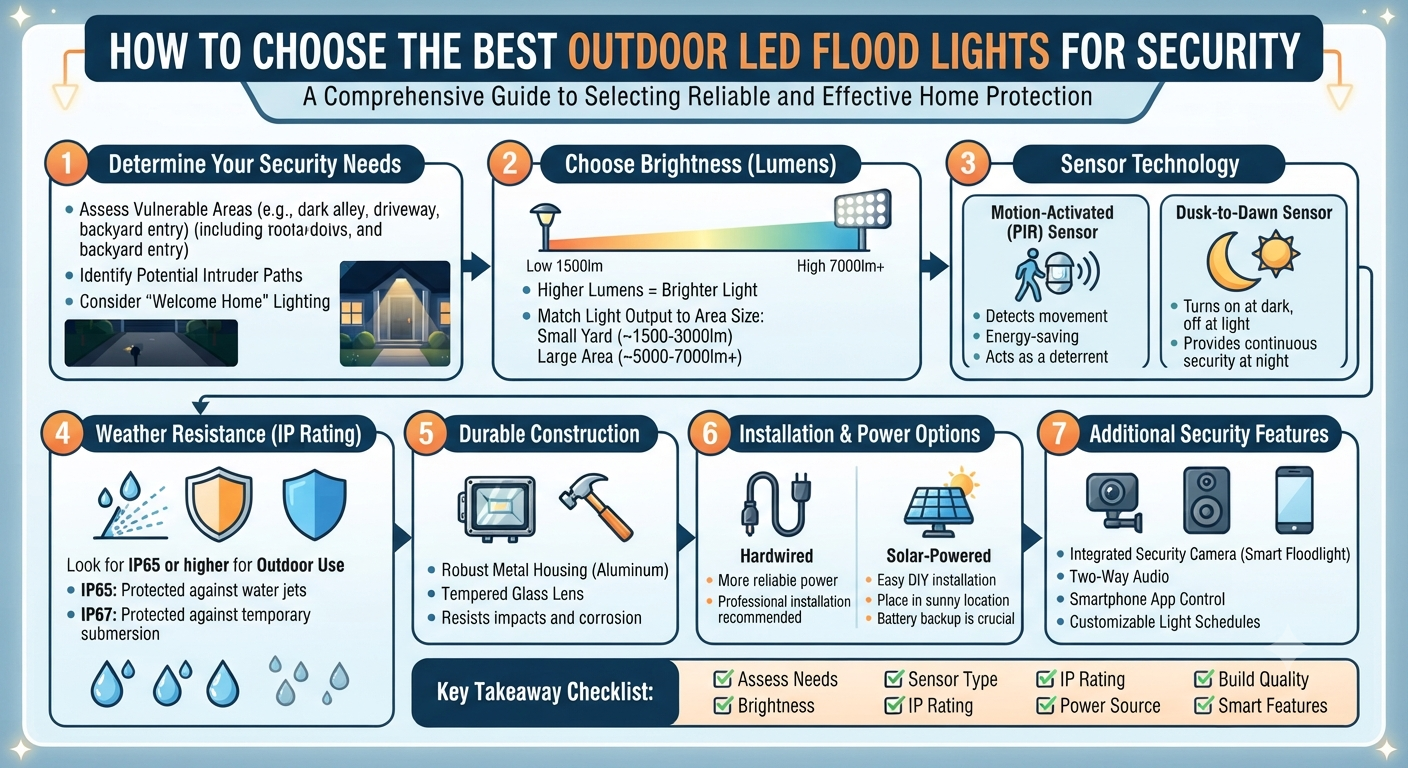
The Main Components of a Solar Floodlight
Understanding the individual components makes it easier to compare products.
Solar Panel
The panel converts sunlight into electrical energy.
Its performance depends on
- Panel size
- Cell efficiency
- Sunlight intensity
- Panel orientation
- Tilt angle
- Shading
- Weather conditions
- Seasonal variation
A larger or more efficient panel can generally collect more energy during the day.
However, panel size alone doesn't tell the complete story.
The panel must be properly matched to the battery and LED load.
Rechargeable Battery
The battery stores energy for nighttime operation.
Common battery technologies include
- Lithium-ion
- Lithium iron phosphate (LiFePO₄)
- Other rechargeable chemistries depending on the product
Battery capacity is typically expressed in watt-hours (Wh) or sometimes in ampere-hours (Ah).
For solar floodlights, battery quality is critical.
A high-output LED with a small battery may produce excellent brightness initially but have limited runtime.
A lower-power fixture with a well-sized battery may provide useful illumination throughout the night.
LED Light Source
The LED converts stored electrical energy into light.
Important specifications include
- Wattage
- Lumens
- Color temperature
- Beam angle
- LED efficiency
Don't judge a solar floodlight solely by its advertised wattage.
A 20W LED fixture from one manufacturer may produce a different amount of light from another 20W product because LED efficiency and optical design vary.
Lumens are a better indicator of actual light output.
Charge Controller
The charge controller regulates energy flowing from the solar panel to the battery.
It helps manage
- Battery charging
- Overcharging protection
- Discharge control
- System operation
The controller is a relatively small component, but its quality can influence battery life and overall reliability.
Light Sensor
Most solar floodlights use a light sensor to determine when to switch on.
When daylight fades below a certain threshold, the system activates.
At sunrise, it switches off and begins charging again.
This automatic operation is one of the biggest advantages of solar lighting.
Motion Sensor
Some solar lights floodlights include PIR motion detection.
The system can operate in several ways.
Mode 1: Off Until Motion
The light remains off and activates at full brightness when movement is detected.
Mode 2: Low Brightness + Full Brightness on Motion
The fixture operates at low brightness and increases output when movement is detected.
Mode 3: Timed Operation
The light operates for a predefined period after detecting movement.
Motion-controlled operation can dramatically reduce energy consumption.
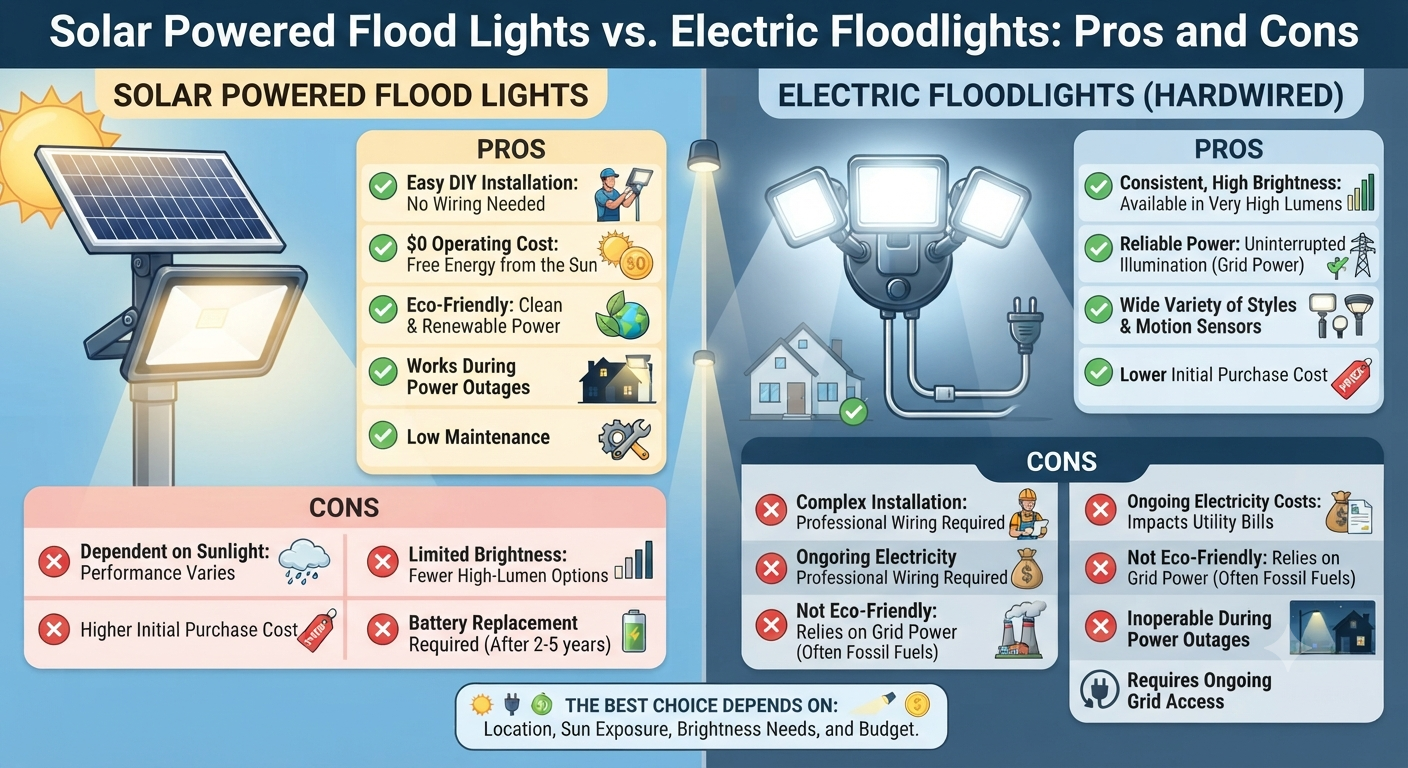
Solar Floodlights vs. Mains-Powered Floodlights
- Feature
- Solar Flood Lights
- Mains-Powered LED Flood Lights
- Electricity Connection
- Not normally required
- Required
- Wiring
- Minimal
- Requires electrical wiring
- Operating Electricity Cost
- Very low
- Ongoing
- Installation
- Generally simpler
- May require electrician
- Reliability
- Depends on sunlight and battery
- Generally consistent
- Remote Locations
- Excellent
- Difficult if wiring is unavailable
- Runtime
- Limited by stored energy
- Continuous
- Maintenance
- Battery/panel maintenance
- Mainly fixture maintenance
- Best For
- Remote or low-use areas
- Continuous security lighting
Neither technology is universally better.
The choice depends on the application.
If you need a floodlight to illuminate a commercial parking area continuously throughout the night, mains-powered LED lighting may be the more practical option.
If you need light beside a remote gate where running an electrical cable would be expensive, solar is extremely attractive.
The Biggest Advantage: No Trenching or Long Cable Runs
One of the strongest reasons to choose solar flood lights outdoor applications is installation flexibility.
Imagine a garden gate located 50 meters from the nearest electrical connection.
A conventional floodlight may require
- Cable trenching
- Conduit
- Electrical protection
- Junction boxes
- Professional installation
- A solar floodlight may require only
- Fixture mounting
- Solar panel positioning
- Basic installation
This can significantly reduce installation complexity.
The savings are particularly valuable for
- Farms
- Large gardens
- Construction sites
- Remote gates
- Boundary walls
- Rural properties
- Temporary installations
- The Solar Panel Is the Heart of the System
A solar floodlight can only perform as well as its energy system allows.
This is where many inexpensive products disappoint.
The marketing may highlight
- "Super Bright 100W Solar Floodlight"
- But the actual system may have
- A small solar panel
- A modest battery
- Limited runtime
- Low sustained output
This is why the headline wattage should not be your only buying criterion.
Instead, evaluate the complete energy balance
- How much energy can the panel collect?
- How much energy can the battery store?
- How much energy does the LED consume?
- How many hours must the light operate?
That's the real equation.
Battery Capacity: The Key to Nighttime Runtime
Battery capacity is one of the most important specifications.
A simplified calculation is
- Runtime ≈ Battery Energy (Wh) ÷ LED Power (W)
- For example, a theoretical 60Wh battery powering a 10W LED could provide
- 60Wh ÷ 10W = 6 hours
- But real-world runtime will be lower because of
- Driver losses
- Battery discharge characteristics
- Temperature
- Battery age
- Controller efficiency
If the light operates at reduced brightness, runtime may increase substantially.
This is why motion-activated systems can remain operational much longer than continuously illuminated fixtures.
Why Advertised Runtime Can Be Misleading
Some solar floodlight manufacturers advertise very long runtime figures.
Always ask
- At what brightness level?
A fixture may operate for 12 hours at low brightness but only several hours at maximum output.
The most useful specifications are those that clearly explain
- Full-power runtime
- Low-power runtime
- Sensor mode runtime
- Battery capacity
- Charging time
A transparent specification sheet is generally a good sign.
Solar Panel Positioning Matters
Even an excellent solar floodlight can perform poorly if the panel is installed incorrectly.
The panel should receive as much direct sunlight as possible.
Avoid
- Tall trees
- Building shadows
- Roof overhangs
- Walls
- Other obstructions
Remember that shadows move throughout the day.
A location that appears sunny at 10 a.m. may be shaded by a building at 3 p.m.
Observe the installation location over several hours before permanently mounting the panel.
Panel Orientation and Tilt
The ideal panel orientation depends on your geographic location.
As a general principle, the panel should be positioned to maximize exposure to direct sunlight throughout the day.
The correct orientation and tilt angle vary with
- Latitude
- Season
- Roof or wall geometry
- Local climate
For fixed installations, optimizing the panel's position can improve charging performance significantly.
A panel facing a bright sky but receiving little direct sunlight may generate considerably less energy than one with unobstructed exposure.
Integrated vs. Separate Solar Panel Designs
Solar floodlights generally come in two configurations.
Integrated Solar Floodlight
The panel and light are built into one housing.
Advantages
- Simple installation
- Compact design
- Minimal wiring
- Easy setup
- Disadvantages
- The entire fixture must be positioned toward sunlight
- The best lighting direction may not be the best panel direction
This can be a problem.
Your driveway may need light facing north, while the strongest sunlight comes from the opposite direction.
Separate Solar Panel
The solar panel is connected to the LED fixture using a cable.
Advantages
- Greater installation flexibility
- Panel can face the sun
- Light can be aimed independently
- Disadvantages
- More installation work
- Cable routing required
- More connection points
For properties with complicated layouts, a separate-panel design is often more practical.
IP Ratings for Solar Floodlights
- Outdoor solar floodlights are exposed to
- Rain
- Dust
- Humidity
- Wind
- Temperature fluctuations
Therefore, the IP rating matters.
Common examples include
- IP44
Suitable for some sheltered outdoor environments.
IP54
Provides limited dust protection and splash resistance.
IP65
Dust-tight and protected against water jets.
A popular specification for outdoor lighting.
IP66
Provides stronger water-jet protection.
IP67
Provides protection against temporary immersion under specified test conditions.
For exposed installations, IP65 or higher is often a practical target, but the correct rating depends on the actual location.
A fixture under a covered porch doesn't face the same conditions as one mounted on an exposed boundary wall.
Solar Floodlight Color Temperature
Color temperature affects how the light appears.
2700K–3000K
Warm white.
Creates a softer, more residential appearance.
4000K
Neutral white.
A balanced option for general outdoor lighting.
5000K–6500K
Cool white/daylight appearance.
Often chosen for security applications because it provides a crisp visual appearance.
For security-focused installations, 4000K–5000K can provide a good balance between visibility and visual comfort.
For decorative gardens, warmer temperatures may be preferable.
How Bright Should a Solar Floodlight Be?
Again, focus on lumens rather than watts.
Consider the area.
Small Doorway
A lower-output fixture may be enough.
Garden Path
Moderate output with a wide beam can provide comfortable illumination.
Driveway
Higher output may be appropriate, especially for larger areas.
Large Yard
Multiple fixtures may provide better coverage than one extremely bright unit.
Security Perimeter
A combination of multiple solar floodlights with motion sensors can reduce dark zones.
A floodlight should be matched to the area rather than selected solely by its maximum advertised wattage.
Beam Angle and Light Distribution
Beam angle determines how the light spreads.
A narrow beam can illuminate a distant target.
A wide beam can cover a larger area.
For solar security lighting, consider
- Mounting height
- Distance to target
- Area width
- Desired illumination level
A wide beam may be ideal for a garden.
A narrower beam may be more effective for a gate or driveway.
The best design often uses multiple fixtures with complementary coverage.
Motion Sensors Extend Battery Life
Battery capacity is limited.
Every watt consumed at night reduces available runtime.
This makes motion sensors extremely valuable.
Suppose a floodlight operates at full power for eight hours every night.
Now imagine it only operates at full brightness for 30 minutes total because movement is detected intermittently.
The energy demand is dramatically lower.
This can help the battery last through
- Long winter nights
- Cloudy days
- Periods of reduced solar charging
For security applications, motion detection is often one of the most practical features available.
What Happens During Cloudy Weather?
This is one of the biggest differences between solar and mains-powered lighting.
Cloudy weather reduces solar energy generation.
A well-designed system should have enough battery capacity to handle short periods of reduced charging.
However, several consecutive cloudy days can affect performance.
Runtime may decrease.
Brightness may be reduced.
The light may switch off earlier than usual.
This is why local climate matters when choosing solar lighting.
If your area experiences frequent prolonged cloud cover, choose a system with
- Larger solar panel
- Higher battery capacity
- Efficient LED system
- Lower operating power
- Motion-sensing capability
- Solar Floodlights in Winter
Winter can be challenging for solar lighting.
Reasons include
- Shorter daylight hours
- Lower sun angle
- Increased cloud cover
- Longer nights
- Potential snow or dirt on panels
The solution is not necessarily to abandon solar.
Instead, select a system with sufficient energy storage and optimize the panel installation.
Keep the panel clean.
Avoid shading.
Use motion activation.
Reduce unnecessary nighttime brightness.
Solar Panel Maintenance
Solar panels are relatively low-maintenance, but they aren't maintenance-free.
Dust, dirt, bird droppings, and environmental debris can reduce sunlight reaching the cells.
Periodically inspect the panel.
Clean it according to the manufacturer's recommendations.
Also check
- Cable connections
- Mounting brackets
- Fixture seals
- Battery condition
- Sensor operation
In dusty environments, cleaning may be required more frequently.
Battery Replacement and Product Lifespan
The LED itself may last for many years.
The battery often has a shorter practical service life.
Battery performance gradually decreases with
- Charge cycles
- Heat
- Age
- Deep discharge
- Poor charging conditions
Before buying a solar floodlight, check whether the battery is replaceable.
A replaceable battery can extend the useful life of the entire system.
This is particularly important for higher-quality installations.
If the battery cannot be replaced, the entire product may eventually need to be replaced even if the LED remains functional.
Solar Floodlights for Security
Solar-powered lighting can be effective for security when strategically installed.
Good locations include
- Gates
- Driveways
- Side entrances
- Garden boundaries
- Sheds
- Garages
- Remote outbuildings
Motion sensors are particularly useful.
A sudden burst of illumination can attract attention and discourage unwanted activity.
However, solar lighting should not be considered a complete security system.
For high-security properties, combine lighting with
- CCTV
- Alarm systems
- Access control
- Physical barriers
- Security patrols where appropriate
Lighting is one layer of a broader security strategy.
Solar Floodlights for Remote Locations
This is where solar technology really shines.
Consider
- Farms
- Agricultural fields
- Rural gates
- Construction sites
- Remote pathways
- Garden structures
- Cabins
- Boundary walls
Running mains electricity to these locations may be expensive or impractical.
A properly sized solar system can provide independent lighting without extensive electrical infrastructure.
This is the true meaning of going off-grid.
Common Mistakes When Buying Solar Floodlights
- Mistake 1: Focusing Only on Wattage
A high advertised wattage doesn't guarantee high useful light output.
Mistake 2: Ignoring Battery Capacity
A bright LED with a small battery may have poor runtime.
Mistake 3: Ignoring Solar Panel Size
The battery must be recharged with enough energy each day.
Mistake 4: Installing the Panel in Shade
Even partial shading can reduce energy generation.
Mistake 5: Believing Maximum Runtime Claims
Check the brightness level associated with the advertised runtime.
Mistake 6: Ignoring Winter Conditions
Shorter days can reduce charging.
Mistake 7: Buying an Inadequate IP Rating
Outdoor fixtures need suitable environmental protection.
Mistake 8: Forgetting Battery Replacement
A replaceable battery can improve long-term value.
Mistake 9: Using One Fixture for a Large Area
Multiple smaller fixtures may provide better coverage and fewer shadows.
Solar Powered Flood Lights Buying Checklist
- Before purchasing, check
- Light Output
- Lumens
- LED wattage
- Beam angle
- Color temperature
- CRI
- Solar System
- Solar panel wattage
- Panel type
- Charging time
- Panel efficiency
- Battery
- Capacity in Wh or Ah
- Battery chemistry
- Expected cycle life
- Replaceability
- Outdoor Protection
- IP rating
- Operating temperature
- Housing material
- Corrosion resistance
- Controls
- Motion sensor
- Light sensor
- Remote control
- Brightness modes
- Timer settings
- Installation
- Integrated or separate panel
- Cable length
- Mounting hardware
- Panel adjustment options
- Long-Term Ownership
- Warranty
- Replacement parts
- Battery availability
- Manufacturer support
- A Simple Solar Floodlight Sizing Example
Suppose you need a security light that operates at approximately 10W for five hours per night.
The theoretical energy requirement is
- 10W × 5 hours = 50Wh
- Now add energy losses from
- LED driver
- Battery
- Charging system
- Wiring
The actual energy requirement will be higher.
If you also experience cloudy days, the system needs additional reserve capacity.
This demonstrates why a basic calculation based only on LED wattage isn't enough.
The complete system must balance
- Solar generation + battery storage + LED consumption + environmental conditions
That's the engineering behind reliable solar lighting.
Frequently Asked Questions
- How long do solar powered flood lights stay on at night?
Runtime depends on battery capacity, LED power, brightness settings, weather, and charging conditions. A fixture may run throughout the night under favorable conditions, while prolonged cloudy weather or high-power continuous operation can significantly reduce runtime. Motion-activated modes generally provide longer operating periods.
Are solar flood lights outdoor installations reliable?
Yes, when correctly selected and installed. Performance depends heavily on adequate sunlight, battery capacity, panel positioning, and product quality. Solar lighting is particularly reliable for locations where conventional electrical wiring is difficult or expensive.
Do solar flood lights work on cloudy days?
Yes, solar panels can still generate electricity in cloudy conditions, but output is reduced. A quality system should store enough energy to handle normal weather variations. Extended periods of poor sunlight may reduce nighttime runtime or brightness.
Are solar floodlights better than electric floodlights?
Neither is universally better. Solar floodlights are excellent for remote locations and applications where avoiding electrical wiring is valuable. Mains-powered LED floodlights are generally better for continuous, high-output lighting where reliable grid power is available.
Final Takeaway: Buy the Whole Energy System, Not Just the Floodlight
The appeal of solar powered flood lights is obvious: no complicated mains wiring, virtually no ongoing electricity consumption, and the ability to illuminate locations far from the electrical grid.
But successful solar lighting depends on balancing the entire system.
Look beyond the headline wattage.
Evaluate
Solar panel capacity. Battery storage. LED efficiency. Lumens. Runtime. IP rating. Motion detection. Weather conditions. Installation angle.
For a small garden or pathway, a compact integrated unit may be all you need.
For a remote gate or large property, a separate-panel system with a larger battery may be a much better investment.
And for security applications, motion detection can make a major difference by reducing energy consumption while delivering bright illumination exactly when movement occurs.
The most reliable solar flood lights outdoor installations are designed around the environment in which they operate. Give the panel unobstructed sunlight, size the battery for the required runtime, choose an appropriate IP rating, and match the LED output to the actual area you need to illuminate.
When those elements work together, solar lighting becomes more than a convenient alternative to mains electricity. It becomes a practical, independent lighting system that can deliver useful illumination wherever sunlight—and smart system design—can provide the energy.