bolt Quick Answer (As of 2026)
Choosing between a warm white light bulb and a daylight lamp can completely change how a room looks and feels. The difference isn't simply about whether one bulb is "brighter" than the other. Color temperature affects the atmosphere, visual comfo...
Choosing between a warm white light bulb and a daylight lamp can completely change how a room looks and feels. The difference isn't simply about whether one bulb is "brighter" than the other. Color temperature affects the atmosphere, visual comfort, perceived cleanliness, color appearance, and even how well you can perform certain tasks.
Walk into a room illuminated by a 2700K warm white bulb and the space may feel cozy, relaxed, and inviting. Replace it with a 6500K daylight lamp, and suddenly the same room can appear crisp, energetic, and much cooler.
Neither option is universally better.
The right choice depends on the room, the activity, the time of day, and the mood you want to create. A bedroom usually benefits from the softer appearance of warm light bulbs, while a workshop or utility area may perform better under a cooler daylight lamp. Kitchens and offices sit somewhere in between, where neutral white lighting often provides a practical balance.
This guide explains the Kelvin scale, compares warm white and daylight lighting, explores where yellow light bulbs work best, and provides practical recommendations for choosing the right color temperature throughout your home or business.
What Is Color Temperature?
Color temperature describes the visual appearance of white light and is measured in Kelvin (K).
The Kelvin scale can seem counterintuitive at first.
With lighting
- Lower Kelvin = warmer, more yellow/orange appearance
- Higher Kelvin = cooler, bluer/whiter appearance
- A simplified guide looks like this
- Color Temperature
- Appearance
- Common Description
- Typical Applications
- 2200K–2700K
- Amber to warm yellow
- Very warm
- Decorative lighting, restaurants
- 2700K–3000K
- Warm white
- Soft, cozy
- Bedrooms, living rooms
- 3500K–4000K
- Neutral white
- Balanced
- Kitchens, offices
- 4000K–5000K
- Cool white
- Crisp white
- Workspaces, retail
- 5000K–6500K
- Daylight
- Cool, bluish white
- Workshops, garages, task areas
The exact appearance can vary between manufacturers. Two bulbs labeled 3000K may not look perfectly identical because LED phosphor technology, spectral distribution, and surrounding surfaces influence perceived color.
Warm White vs. Daylight: The Quick Comparison
If you're trying to decide between a warm white light bulb and a daylight lamp, this comparison provides a useful starting point.
Feature
- Warm White
- Daylight
- Typical Kelvin Range
- 2700K–3000K
- 5000K–6500K
- Visual Appearance
- Yellowish, soft
- Crisp, cool, sometimes bluish
- Atmosphere
- Relaxed and cozy
- Energetic and alert
- Best For
- Bedrooms, living rooms
- Workshops, garages
- Evening Comfort
- Generally high
- Can feel stimulating
- Color Appearance
- Warm and flattering
- Crisp and high-contrast
- Common Residential Use
- High
- Moderate
- Commercial/Task Use
- Moderate
- High
There is also a middle option.
Neutral white, typically around 3500K–4500K, often works well when you want a clean appearance without the strong warmth of a 2700K bulb or the coolness of a 6500K daylight lamp.
What Are Warm White Light Bulbs?
A warm white light bulb typically falls within the 2700K–3000K range.
The light has a soft appearance with yellow, amber, or slightly orange undertones.
This color temperature is visually similar to the familiar warmth of traditional incandescent lighting.
Warm white bulbs are popular because they make many spaces feel
- Comfortable
- Relaxing
- Welcoming
- Intimate
- Residential
- Softer in appearance
They're particularly effective in spaces where people relax rather than perform visually demanding tasks.
Where Should You Use Warm Light Bulbs?
- Bedrooms
Warm light is an excellent choice for bedrooms.
A 2700K or 3000K bulb can create a relaxing environment that feels appropriate for evening use.
For bedside lamps, table lamps, and decorative fixtures, warm light is usually more comfortable than very cool daylight.
Living Rooms
Living rooms benefit from the inviting appearance of warm lighting.
If you have
- Wooden furniture
- Beige walls
- Warm-colored fabrics
- Leather furniture
a warm white light bulb can enhance those tones.
Dining Areas
Warm light works particularly well around dining tables.
It can create a more intimate atmosphere and make food and interior finishes appear warmer.
Hospitality Spaces
Restaurants, hotels, lounges, and cafés frequently use warm lighting to create a relaxed environment.
The objective isn't maximum brightness.
It's atmosphere.
What Are Daylight Lamps?
A daylight lamp typically refers to a bulb or fixture with a color temperature in the 5000K–6500K range.
The light appears
- Crisp
- Cool
- Bright
- Blue-white
Daylight lamps are often selected for environments where visual clarity and a clean appearance are priorities.
Common applications include
- Workshops
- Garages
- Utility rooms
- Industrial spaces
- Some offices
- Retail environments
- Craft rooms
- Task lighting
However, "daylight" is a marketing term as much as a technical description. Always check the actual Kelvin rating rather than relying solely on the name printed on the packaging.
Where Should You Use a Daylight Lamp?
- Garage
A garage often benefits from 5000K–6500K lighting.
The cool appearance can help make the space feel cleaner and brighter while providing good visual contrast for tools and mechanical work.
Workshop
For detailed tasks, a daylight lamp can provide a crisp visual environment.
However, color temperature should not be confused with actual illumination.
A 6500K bulb isn't automatically brighter than a 3000K bulb if both produce the same number of lumens.
The difference is primarily in the color appearance of the light.
Craft and Hobby Areas
People working with materials, paints, fabrics, and small components may prefer cooler lighting.
However, CRI (Color Rendering Index) is especially important here.
A high-CRI 4000K or 5000K light may reveal colors more accurately than a low-quality 6500K bulb.
Utility Rooms
Cooler lighting can work well in laundry rooms, storage areas, and utility spaces where a crisp appearance is desirable.
Warm White vs. Daylight: Which Is Brighter?
This is one of the most common questions.
The answer is
Not necessarily either one.
Brightness is primarily related to lumens, not Kelvin.
For example
- 3000K LED = 1,000 lumens
- 6500K LED = 1,000 lumens
Both produce the same total lumen output.
Yet the 6500K lamp may appear brighter or more visually intense because the cooler spectrum can create a different perception of brightness and contrast.
This is why some people describe daylight lamps as "brighter" even when their measured lumen output is identical.
When comparing bulbs, consider both
- Lumens = how much light
- Kelvin = what color the light looks like
Don't use color temperature as a substitute for actual lumen output.
Why Do Yellow Light Bulbs Look Warmer?
The term yellow light bulbs is commonly used to describe warm white bulbs.
At approximately 2700K–3000K, the light contains a warmer visual balance that appears yellowish or amber compared with neutral and daylight sources.
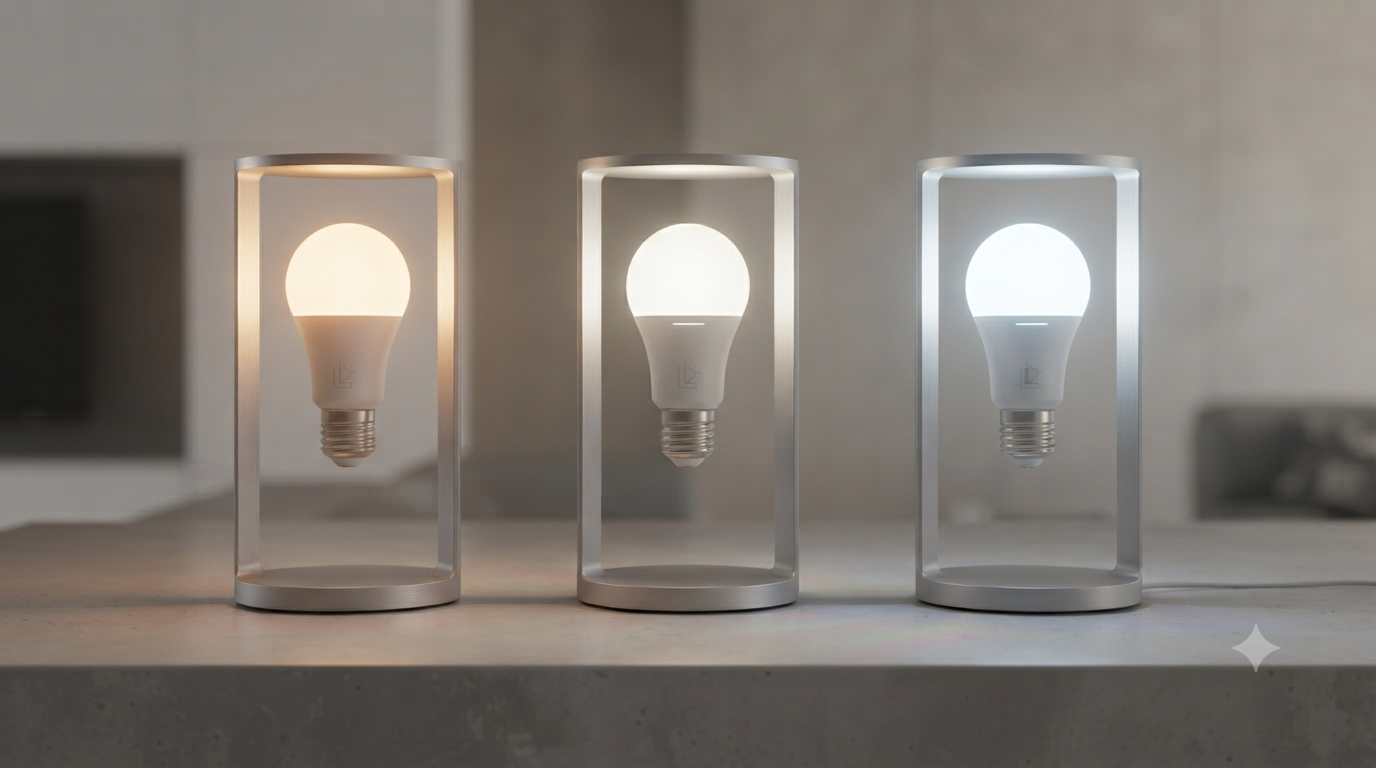
The effect becomes particularly noticeable when compared side-by-side.
A 2700K bulb may make a white wall appear
- Creamy
- Beige
- Warm
- A 6500K bulb may make the same wall appear
- Bright white
- Cool
- Slightly bluish
This doesn't mean the bulb is actually producing yellow or blue light exclusively. The terms describe the overall visual appearance of the light.
Warm White vs. Neutral White
- Many people assume they have only two choices
Warm white or daylight.
In reality, neutral white is often the most practical option for functional spaces.
Warm White
- Approximately 2700K–3000K
- Best for
- Bedrooms
- Living rooms
- Dining rooms
- Decorative lighting
- Neutral White
- Approximately 3500K–4500K
- Best for
- Kitchens
- Offices
- Bathrooms
- General-purpose areas
- Daylight
- Approximately 5000K–6500K
- Best for
- Garages
- Workshops
- Utility spaces
- Detailed task areas
If you're unsure what to choose, 4000K neutral white is often a safe middle ground for functional areas.
It feels cleaner than warm white without being as visually cool as a 6500K daylight lamp.
Choosing the Right Color Temperature Room by Room
- Bedroom: Choose Warm White
For bedrooms, a 2700K–3000K warm white light bulb is generally the safest choice.
It creates a calm atmosphere and works well with evening routines.
For bedside lamps, 2700K is particularly comfortable.
If you use the bedroom for reading, add a dedicated reading light rather than making the entire room excessively bright or cool.
Recommended
- 2700K–3000K
- Living Room: Warm White or Soft Neutral
- For most living rooms, consider
- 2700K–3000K
This is especially suitable if the room is primarily used for relaxation.
If the space also serves as a home office or reading area, consider 3000K–4000K or use separate task lighting.
Recommended
- 2700K–3500K
- Kitchen: Neutral White
Kitchens require a balance between comfort and visibility.
A 3500K–4500K LED can provide a clean appearance without making the space feel excessively cold.
For countertops and food preparation areas, task lighting is often more important than simply increasing the wattage of the main ceiling fixture.
Recommended
- 3500K–4500K
- Bathroom: Neutral to Cool White
Bathrooms often benefit from neutral or moderately cool lighting.
A 4000K light can provide a clean appearance while maintaining reasonable visual comfort.
For mirrors, pay attention to CRI.
High CRI can be more valuable than simply selecting a 6500K bulb.
Recommended
- 3500K–5000K
- Home Office: Neutral White
A home office often works well with 3500K–5000K lighting.
The best choice depends on the amount of natural daylight and the type of work being performed.
A 4000K light can provide a useful balance between warm and cool tones.
Recommended
- 3500K–5000K
- Garage: Daylight
For garages, workshops, and utility spaces, 5000K–6500K is often preferred.
The crisp appearance can make the environment feel more functional and help with visual contrast.
However, don't assume that every garage needs 6500K.
A well-designed 5000K installation can be more comfortable while still providing a clean, bright appearance.
Recommended
- 5000K–6500K
- Color Temperature and CRI: A Critical Combination
Color temperature tells you the appearance of the light.
CRI tells you how accurately objects appear under that light.
These are separate characteristics.
For example, you could have
- 3000K, CRI 80
- 3000K, CRI 90+
- 5000K, CRI 80
- 5000K, CRI 90+
The Kelvin rating doesn't tell you how accurately colors will appear.
For areas where color accuracy matters, consider a high-CRI LED.
This is especially important for
- Art studios
- Clothing stores
- Makeup areas
- Photography
- Food presentation
- Design work
A high-quality 4000K LED with CRI 90+ may be a better choice for color-sensitive tasks than a cheap 6500K bulb with poor color rendering.
Why Warm Light Bulbs Work Well in Bedrooms
There is a reason warm lighting has traditionally been associated with evening environments.
Warm light resembles the visual character of traditional incandescent lighting and firelight.
It tends to create a calmer, more intimate atmosphere.
For bedrooms, the goal is generally not maximum visual stimulation.
That's why many homeowners prefer
- 2700K bedside lamps
- 2700K ceiling lights
- Warm LED strips
- Dimmable warm white fixtures
If you want a flexible system, consider dimmable LEDs or tunable white lighting.
This allows you to use brighter, cooler-looking light during active periods and warmer, dimmer light in the evening.
Can Daylight Lamps Be Used in Bedrooms?
Technically, yes.
But whether you should depends on your preference and the purpose of the room.
A 5000K–6500K lamp can make a bedroom feel
- Cooler
- More energetic
- More clinical
- Less relaxing
Some people prefer this appearance, particularly in bedrooms that double as study spaces.
If your bedroom is also a work area, consider using separate lighting zones
- Warm ambient lighting + neutral task lighting
This gives you more flexibility than installing daylight lamps throughout the room.
Daylight vs. Warm White for Reading
Reading requires adequate illumination and good visual comfort.
Color temperature is only one part of the equation.
A warm 3000K lamp with high CRI and sufficient lumens can be excellent for reading.
A 5000K daylight lamp can also work well.
The more important factors include
- Adequate illuminance
- Low glare
- Good CRI
- Appropriate beam angle
- Correct fixture positioning
A poorly positioned 6500K lamp can cause more discomfort than a well-positioned 3000K reading light.
For most people, 3000K–4000K is a comfortable range for reading.
Color Temperature and Interior Design
The color temperature of your lighting should complement the colors and materials in your room.
Warm White + Warm Materials
- Works well with
- Wood
- Beige
- Cream
- Brown
- Warm textiles
- Neutral White + Modern Interiors
- Works well with
- White walls
- Gray finishes
- Contemporary kitchens
- Minimalist interiors
- Daylight + Utility Environments
- Works well with
- Concrete
- Metal
- Garages
- Workshops
- Industrial spaces
A mismatch can create an unpleasant result.
For example, very cool 6500K lighting in a room designed around warm wood and soft furnishings may make the interior feel stark.
Why You Shouldn't Mix Random Color Temperatures
- Imagine a room with three ceiling bulbs
- One 2700K
- One 4000K
- One 6500K
The result can look inconsistent.
Some surfaces may appear warm while others appear cool.
The human eye quickly notices the mismatch.
For a single room, try to maintain a consistent color temperature unless you're deliberately creating separate lighting zones.
This is particularly important in
- Kitchens
- Offices
- Retail spaces
- Commercial buildings
When replacing old bulbs, check the Kelvin rating before buying new ones.
Warm White vs. Daylight for Commercial Applications
Commercial lighting requires more careful consideration.
A retail clothing store may benefit from
- Neutral white
- High CRI
- Consistent color temperature
- A warehouse may prioritize
- High lumen output
- 4000K–5000K
- Energy efficiency
- Uniformity
- A restaurant may prefer
- 2700K–3000K
- High CRI
- Warm ambience
- A workshop may use
- 5000K–6500K
- High CRI
- High illuminance
The best lighting system is therefore determined by the task and environment, not by a universal preference for warm or cool light.
How to Choose the Right Color Temperature
Use this simple decision process.
Step 1: Ask What the Space Is Used For
- Relaxation?
Choose warm white.
Detailed work?
Consider neutral or daylight.
Step 2: Consider the Time of Use
- Primarily evening?
Warm white is usually more comfortable.
Primarily daytime or daytime-like work?
Neutral or daylight may be suitable.
Step 3: Consider Existing Interior Colors
Warm interiors often pair well with warm lighting.
Cool, modern interiors may suit neutral lighting.
Step 4: Check CRI
If accurate color is important, prioritize high CRI.
Step 5: Consider Dimming
If you need flexibility, choose dimmable LEDs or tunable white systems.
A Practical Color Temperature Buying Guide
- Space
- Recommended Color Temperature
- Suggested Light Character
- Bedroom
- 2700K–3000K
- Warm and relaxing
- Living Room
- 2700K–3500K
- Warm and comfortable
- Dining Room
- 2700K–3000K
- Warm and inviting
- Kitchen
- 3500K–4500K
- Neutral and functional
- Bathroom
- 3500K–5000K
- Clean and balanced
- Home Office
- 3500K–5000K
- Focused and comfortable
- Garage
- 5000K–6500K
- Crisp and functional
- Workshop
- 4000K–6500K
- Clear and task-oriented
- Retail
- 3000K–5000K
- Depends on products
- Restaurant
- 2200K–3000K
- Warm and atmospheric
These are practical starting points rather than rigid rules. Lighting design should also consider lumen output, fixture placement, reflectance, glare, and the specific visual tasks performed in the space.
Common Mistakes When Choosing Color Temperature
- Mistake 1: Assuming Daylight Means More Lumens
It doesn't.
Kelvin and lumens measure different characteristics.
Mistake 2: Using 6500K Everywhere
A daylight lamp can be excellent in a garage but uncomfortable in a bedroom.
Mistake 3: Ignoring CRI
A high Kelvin rating doesn't guarantee accurate colors.
Mistake 4: Mixing Color Temperatures
Different Kelvin ratings in the same room can create visual inconsistency.
Mistake 5: Choosing Based on the Word "Daylight"
Always check the actual Kelvin rating.
"Daylight" is not a universal technical specification.
Mistake 6: Using Warm Light for Every Task
Warm lighting is comfortable, but some environments require a crisper visual appearance.
A workshop illuminated entirely with 2700K bulbs may feel unnecessarily dim or visually soft even when the lumen output is adequate.
Frequently Asked Questions
- Is warm white better than daylight?
Neither is universally better. Warm white light bulbs are generally better for bedrooms, living rooms, dining areas, and relaxing environments. A daylight lamp is often more suitable for garages, workshops, utility areas, and detailed tasks. The right choice depends on the application.
Are yellow light bulbs the same as warm white?
Usually, the terms are used interchangeably in everyday shopping. A warm white bulb, typically around 2700K–3000K, has a yellowish or amber appearance compared with neutral or daylight lighting. However, the exact appearance varies by manufacturer and LED technology.
What color temperature is best for a bedroom?
For most bedrooms, 2700K–3000K warm white is a good choice. It creates a softer, more relaxing atmosphere. If the room also functions as a workspace, you can use separate neutral or cool task lighting.
Is a daylight lamp better for reading?
Not necessarily. Reading comfort depends on adequate illumination, low glare, good CRI, and correct positioning. A high-quality 3000K–4000K lamp can be excellent for reading, while a 5000K daylight lamp may be preferred by people who like a crisper visual environment.
Final Takeaway: Match Color Temperature to the Space
Choosing between a warm white light bulb and a daylight lamp is ultimately about matching the light to the way you use the space.
Choose 2700K–3000K warm light bulbs when you want comfort, relaxation, and a welcoming atmosphere. They're ideal for bedrooms, living rooms, dining areas, and hospitality environments.
Choose 3500K–4500K neutral white when you need a practical balance between warmth and visual clarity. This range is particularly useful in kitchens, bathrooms, offices, and general-purpose areas.
Choose 5000K–6500K daylight lamps when you want a crisp, cool appearance for garages, workshops, utility areas, and certain task-oriented environments.
And remember: Kelvin does not equal brightness. Always evaluate color temperature alongside lumens, CRI, beam angle, and fixture design.
The best lighting system isn't the one with the highest Kelvin rating or the most powerful bulb. It's the one that provides the right visual environment for the people, activities, and materials in the space.