bolt Quick Answer (As of 2026)
For many drivers, upgrading from traditional halogen headlights to LED headlight bulbs seems like an obvious improvement. LEDs are brighter, consume less power, last longer, and can give a vehicle a more modern appearance.
For many drivers, upgrading from traditional halogen headlights to LED headlight bulbs seems like an obvious improvement. LEDs are brighter, consume less power, last longer, and can give a vehicle a more modern appearance.
But headlights are not simply about producing more light.
A good headlight system must put the right amount of light in the right place.
If an LED retrofit bulb produces impressive brightness but doesn't match the optical design of the original headlamp housing, it can create glare for oncoming drivers while failing to illuminate the road properly. That's why choosing the best LED headlight bulbs isn't about finding the highest advertised lumen number.
The real goal is better usable road illumination.
A successful upgrade should improve visibility of lane markings, road edges, pedestrians, obstacles, and signs while maintaining a controlled beam pattern. The bulb must also be compatible with the vehicle's headlight housing, electrical system, and any onboard bulb monitoring.
This guide explains how LED headlight bulbs work, what to consider before upgrading, how to compare LED and halogen lighting, and how to choose a suitable headlight bulb for car applications without compromising road safety.
What Are LED Headlight Bulbs?
LED headlight bulbs use light-emitting diodes rather than a heated tungsten filament to generate light.
Traditional halogen bulbs rely on a filament that becomes extremely hot when electrical current passes through it. LEDs use semiconductor technology and electronic drivers to produce light more efficiently.
The advantages can include
- Lower electrical power consumption
- Longer potential service life
- Faster switching
- Better thermal efficiency when properly designed
- Compact light-emitting elements
- Modern white-light appearance
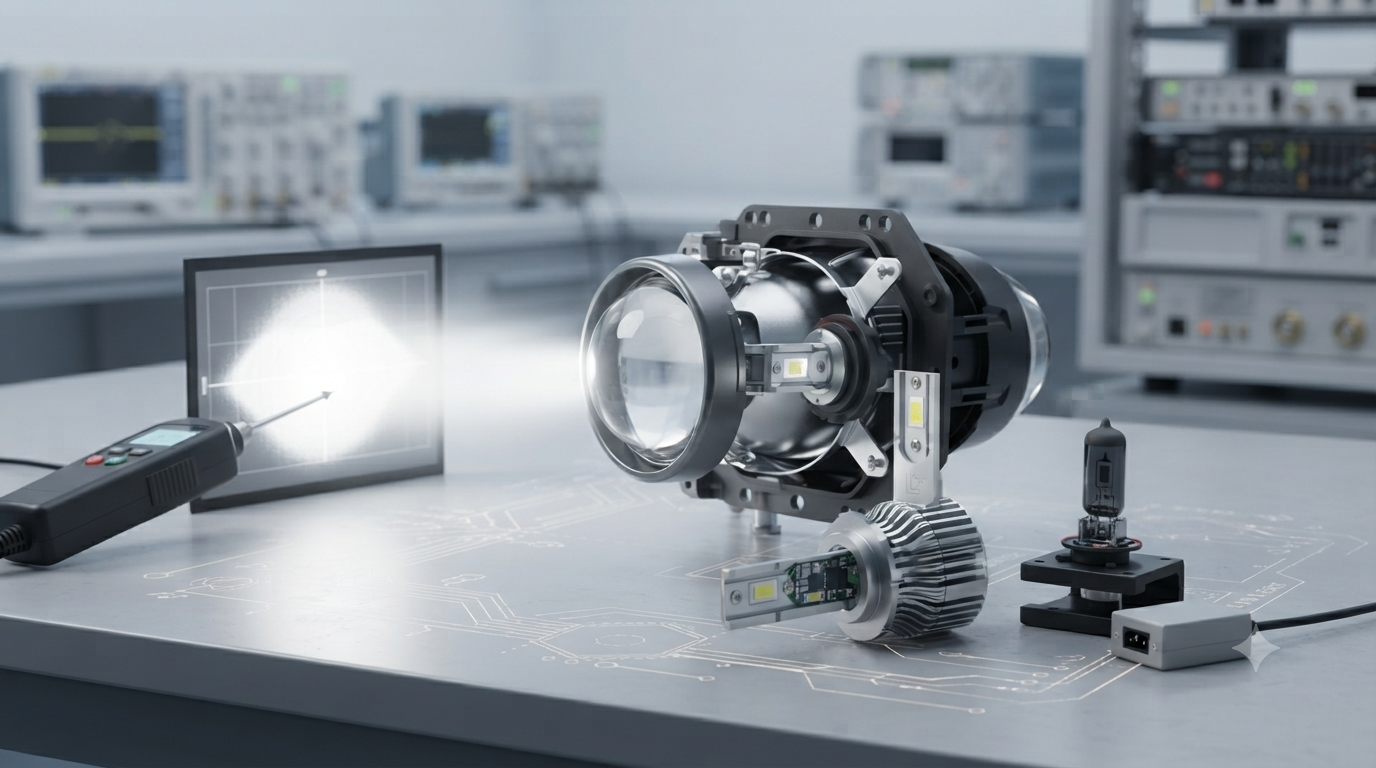
However, the performance of an LED headlight retrofit depends heavily on the optical design.
A headlight isn't just a bulb.
It's a complete system consisting of
- Light source
- Reflector or projector
- Lens
- Housing
- Beam pattern
- Electrical control system
Changing the light source can alter how the entire system behaves.
LED vs. Halogen Headlight Bulbs
- Feature
- Halogen Headlight
- LED Headlight Bulb
- Light Source
- Heated filament
- LED semiconductor
- Typical Appearance
- Warm white
- White to cool white
- Energy Efficiency
- Lower
- Generally higher
- Heat Generation
- High at filament
- Lower optical heat, but electronics require thermal management
- Lifespan
- Relatively short
- Generally longer
- Instant Operation
- Yes
- Yes
- Electrical Driver
- Usually integrated into vehicle circuit
- Often requires electronic driver
- Retrofit Complexity
- Low
- Can be moderate
- Beam Compatibility
- Original design
- Depends on LED bulb geometry
- Power Consumption
- Higher
- Often lower
The biggest potential advantage of LED technology is efficiency.
However, efficiency doesn't automatically guarantee better visibility.
The optical performance of the complete headlight system remains critical.
Why Drivers Upgrade to LED Headlights
There are several reasons vehicle owners consider an LED upgrade.
Improved Road Visibility
A well-designed LED retrofit can provide a brighter and more modern light output.
This may improve the driver's ability to see
- Road markings
- Road edges
- Pedestrians
- Animals
- Obstacles
- Traffic signs
The improvement is most noticeable when replacing old, degraded halogen bulbs or poorly performing lamps.
Lower Power Consumption
LEDs can produce useful illumination using less electrical power than traditional halogen systems.
This can reduce the electrical load placed on the vehicle's charging system.
However, the actual difference depends on the specific bulbs being compared.
Some high-output LED retrofit products use substantial power because they are designed for high light output and aggressive cooling.
Always check the actual wattage rather than assuming every LED consumes very little power.
Longer Service Life
Quality LEDs can have significantly longer rated lifespans than halogen bulbs.
This means fewer replacements over the life of the vehicle.
However, the LED chip itself may not be the component that fails first.
Other parts can determine actual service life, including
- Driver electronics
- Cooling fan
- Heat sink
- Electrical connectors
- Thermal interface materials
A bulb advertised with a very long LED lifespan may still experience premature failure if its driver or thermal management system is poorly designed.
The Most Important Factor: Beam Pattern
This is where many LED headlight upgrades go wrong.
A halogen headlamp housing is designed around the position and geometry of its filament.
The filament occupies a very specific location within the reflector or projector.
If an LED replacement places its light-emitting chips in the wrong position, the optical system may no longer focus the light correctly.
The result can be
- Scattered illumination
- Dark areas
- Excessive foreground light
- Poor long-distance visibility
- Glare for other drivers
A bulb can appear extremely bright when viewed directly but still perform poorly on the road.
That's why beam pattern is more important than headline lumen claims.
Lumens vs. Usable Light
Manufacturers often advertise LED bulbs using lumen figures.
This is useful, but it doesn't tell the whole story.
There is a major difference between
Raw lumens: Total light produced by the LED source.
Usable road illumination: How effectively that light reaches the areas the driver needs to see.
A bulb producing 5,000 theoretical lumens isn't necessarily better than one producing 3,000 lumens if the lower-output product creates a cleaner, better-controlled beam pattern.
For headlights, the goal is not simply to produce more light.
The goal is to place light accurately.
What Makes the Best LED Headlight Bulbs?
The best LED headlight bulbs typically combine several characteristics rather than relying on one specification.
Look for
- Accurate LED Chip Position
The light-emitting elements should closely replicate the position of the original halogen filament when designed as a retrofit.
Controlled Beam Pattern
The bulb should work with the vehicle's reflector or projector to produce a defined beam.
Effective Thermal Management
LEDs and drivers need appropriate cooling.
Reliable Driver Electronics
The driver should provide stable electrical operation.
Appropriate Color Temperature
A balanced white light can improve visual clarity without excessive blue tint.
Vehicle Compatibility
The bulb should be compatible with the vehicle's electrical system and headlight housing.
Good Quality Control
Consistent manufacturing tolerances matter greatly for optical performance.
Color Temperature: How White Is Too White?
Many LED headlight bulbs are marketed with color temperatures ranging from approximately 5000K to 6500K or beyond.
But higher Kelvin does not automatically mean better visibility.
A very cool, bluish light may look impressive but can introduce disadvantages in certain conditions.
For example, blue-rich light can produce more noticeable glare and may perform less favorably in rain, fog, or other conditions where atmospheric scattering becomes significant.
A balanced white LED, often around the 5000K–6000K range, can provide a modern appearance while maintaining useful visual contrast.
The ideal choice depends on the vehicle, road conditions, and local regulations.
For safety-focused applications, avoid choosing a bulb solely because its color appears extremely white or blue.
LED Headlights in Rain and Fog
Weather conditions can dramatically change how headlights perform.
Rain, fog, snow, and airborne moisture scatter light.
Higher color temperatures with more blue content may produce increased visible scatter in certain conditions.
This can create
- Glare
- Reflections
- Reduced contrast
For drivers who regularly travel in wet or foggy environments, a balanced white light may be preferable to an extremely cool blue-white LED.
However, dedicated fog lamps are designed differently from standard headlights.
Don't assume that replacing a headlight bulb with a yellow bulb or extremely bright LED automatically creates a better fog-lighting system.
Optics and beam pattern remain critical.
Choosing the Correct Headlight Bulb for Car Applications
Before purchasing a headlight bulb for car, identify the exact bulb type required by your vehicle.
Common automotive bulb families include
- H1
- H3
- H4
- H7
- H8
- H9
- H11
- 9005
- 9006
- 9012
- HB3
- HB4
This is not a complete list.
Different vehicles may use different bulbs for
- Low beam
- High beam
- Fog lights
- Daytime running lights
Never assume that two bulbs are interchangeable simply because they look similar.
Check
- Vehicle make
- Model
- Model year
- Trim level
- Headlight function
- Original bulb number
Some vehicles use different bulbs depending on the trim or headlight assembly.
Check the Bulb Base and Connector
Even if an LED bulb fits physically, the electrical connection may not be compatible.
Before purchasing, verify
- Bulb base
- Connector type
- Polarity requirements
- Voltage
- Available installation space
Some LED retrofit bulbs use external drivers.
Others have integrated drivers.
The available space behind the headlight housing can determine whether the product will fit.
CAN Bus Compatibility
Modern vehicles often use electronic systems to monitor lighting circuits.
A vehicle may detect a lower electrical load from an LED bulb and interpret it as a failed lamp.
This can trigger
- Dashboard warnings
- Flickering
- Rapid flashing
- Intermittent operation
Some LED retrofit products are marketed as CAN Bus compatible.
However, the term doesn't always guarantee universal compatibility with every vehicle.
In some cases, an additional load resistor or decoder may be required.
These components must be installed correctly because resistors can generate substantial heat.
For modern vehicles, check the manufacturer's compatibility list whenever possible.
Cooling: Fan vs. Passive Heat Sink
LED headlight bulbs need thermal management.
Two common approaches are
- Fan-Cooled LED Bulbs
These use an active cooling fan.
Advantages
- High cooling capacity
- Compact heat sink design
- Suitable for higher-power applications
- Potential disadvantages
- Moving parts
- Fan noise
- Dust accumulation
- Possible fan failure
- Passive Cooling
These use heat sinks or other thermal management methods without a fan.
Advantages
- Silent operation
- No moving fan
- Fewer mechanical failure points
- Potential disadvantages
- May require more physical space
- Cooling performance depends heavily on installation environment
Neither design is automatically superior.
The quality of the thermal engineering matters more than the marketing label.
Can LED Headlight Bulbs Overheat?
Yes.
LEDs are efficient, but they still generate heat at the semiconductor junction and within the driver electronics.
If heat isn't removed effectively, temperatures can rise.
This can accelerate
- Lumen depreciation
- Driver degradation
- Component failure
A good LED retrofit should maintain stable performance after extended operation.
Don't evaluate a product solely by how bright it looks during the first few minutes.
Long-term thermal stability matters.
Installation Considerations
Installing an LED headlight bulb may appear simple, but the process varies between vehicles.
Potential challenges include
- Limited access behind the headlight
- Dust caps
- Integrated bulb holders
- External drivers
- Cooling fans
- Wiring clearance
- After installation, confirm that
The bulb is fully seated.
The connector is secure.
The dust cap is correctly installed.
Wiring is clear of hot or moving components.
The beam pattern is properly aligned.
The headlight should then be checked from a suitable distance.
Beam Alignment Is Essential
Even a high-quality LED bulb can cause problems if the headlight assembly is misaligned.
Incorrect alignment can lead to
- Poor forward visibility
- Excessive glare
- Uneven illumination
After changing headlight bulbs, check the beam pattern.
If the vehicle's headlamp aim has been disturbed, professional adjustment may be necessary.
The goal is to illuminate the road ahead without shining excessive light into the eyes of approaching drivers.
This is a safety issue—not merely a cosmetic one.
Don't Confuse Brightness With Safety
- One of the biggest misconceptions in automotive lighting is
- "Brighter is always safer."
Not necessarily.
Excessive brightness can create glare.
A poorly controlled LED retrofit may make the vehicle appear brighter from the outside while actually reducing visibility for other road users.
A good headlight should provide
- Adequate foreground lighting
- Strong distance illumination
- Useful side visibility
- Defined cutoff
- Minimal upward glare
The best solution is balanced optical performance.
LED Headlight Bulbs vs. Complete LED Headlights
There are two fundamentally different upgrade approaches.
LED Retrofit Bulb
You replace the original halogen bulb with an LED bulb.
Advantages
- Lower cost
- Easier installation
- Reuses existing housing
- Disadvantages
- Beam compatibility may be imperfect
- Performance depends heavily on bulb design
- May require compatibility accessories
- Complete LED Headlamp Assembly
The entire headlight unit is designed around LED technology.
Advantages
- Optimized optics
- Better thermal integration
- Engineered beam pattern
- Disadvantages
- Higher cost
- More complex installation
- Vehicle-specific compatibility
A purpose-designed LED headlamp assembly will generally offer better optical integration than a generic retrofit bulb.
Are LED Headlight Bulbs Legal?
This is a critical question.
The legality of replacing halogen bulbs with LED retrofit bulbs varies by country and jurisdiction.
Some regions allow specific approved retrofit products.
Others restrict or prohibit certain conversions unless the entire headlamp assembly meets applicable regulations.
There may also be requirements concerning
- Beam pattern
- Glare
- Light color
- Intensity
- Certification
- Headlamp approval
Before installing an LED retrofit, check your local vehicle regulations and inspection requirements.
A product being sold online does not automatically mean it is road-legal in your jurisdiction.
How to Choose the Best LED Headlight Bulbs
Use this checklist before buying.
Step 1: Confirm the Bulb Size
Identify the exact original bulb number.
Step 2: Check Vehicle Compatibility
Confirm the make, model, year, and headlamp configuration.
Step 3: Examine Beam Pattern
Look for evidence of proper optical performance rather than relying solely on lumen claims.
Step 4: Check Color Temperature
Choose a practical white light rather than an excessively blue appearance.
Step 5: Evaluate Cooling
Consider whether fan or passive cooling suits the available installation space.
Step 6: Check Driver Quality
Stable electronics are essential for reliable performance.
Step 7: Confirm CAN Bus Compatibility
Especially important for newer vehicles.
Step 8: Check Physical Clearance
Make sure the heat sink, fan, and driver fit inside the headlight assembly.
Step 9: Verify Legal Compliance
Confirm that the conversion is permitted in your region.
Step 10: Align the Headlights
Check the beam pattern after installation.
Pro Tips for a Safer LED Headlight Upgrade
- Pro Tip 1: Don't Buy Based on Lumens Alone
Look for real-world beam performance.
Pro Tip 2: Replace Both Sides Together
Mixing different bulb models can create inconsistent color and output.
Pro Tip 3: Clean the Headlight Lens
A cloudy or oxidized lens can reduce light output dramatically.
Sometimes restoring the lens provides a larger visibility improvement than changing the bulb.
Pro Tip 4: Check the Original Wiring
Corroded connectors or damaged wiring can cause performance problems.
Pro Tip 5: Keep the Dust Cap Sealed
Moisture and contamination can damage the headlight assembly.
Pro Tip 6: Don't Ignore Alignment
Always check the beam after installation.
Pro Tip 7: Consider the Complete Headlight System
The best bulb cannot compensate for a badly designed or damaged headlight housing.
Common LED Headlight Upgrade Mistakes
- Mistake 1: Choosing the Highest Lumen Rating
Raw lumens don't guarantee useful road illumination.
Mistake 2: Installing an LED in the Wrong Housing
Optical compatibility matters.
Mistake 3: Ignoring Cooling
High-power LEDs need proper thermal management.
Mistake 4: Using Extremely Blue Light
Higher Kelvin doesn't automatically improve visibility.
Mistake 5: Forgetting CAN Bus Compatibility
Modern vehicles may require additional electronics.
Mistake 6: Poor Beam Alignment
Incorrect aiming can create dangerous glare.
Mistake 7: Ignoring Local Regulations
Always verify road legality before modifying headlights.
Frequently Asked Questions
- Are LED headlight bulbs better than halogen bulbs?
They can offer advantages including lower power consumption, longer potential lifespan, and a whiter appearance. However, the actual visibility improvement depends heavily on the LED bulb's design and its compatibility with the vehicle's headlight housing. A poorly designed retrofit may perform worse than a good halogen bulb.
What are the best LED headlight bulbs?
The best LED headlight bulbs are those that provide a well-controlled beam pattern, accurate light-source positioning, reliable driver electronics, effective thermal management, appropriate color temperature, and compatibility with the vehicle. The highest advertised lumen rating is not necessarily the best indicator of performance.
How do I choose the right headlight bulb for my car?
Start by identifying the original bulb number used by your vehicle. Then verify the make, model, year, headlight function, connector, physical dimensions, and electrical compatibility. If you're replacing halogen bulbs with LEDs, also check beam performance, CAN Bus compatibility, cooling requirements, and local regulations.
Do LED headlights improve road safety?
A properly designed and correctly installed LED headlight system can improve visibility by providing effective illumination of the road ahead. However, excessive brightness, poor beam control, or incorrect alignment can increase glare and reduce safety for other drivers. Road safety depends on controlled optical performance, not brightness alone.
Final Takeaway: Upgrade for Better Light, Not Just More Light
Upgrading to LED headlight bulbs can be an excellent way to modernize a vehicle's lighting system. LEDs can provide efficient illumination, long service life, and a crisp white appearance while potentially reducing electrical power consumption.
But the best upgrade is not necessarily the brightest bulb on the market.
The real measure of performance is how effectively the headlight illuminates the road.
Choose a headlight bulb for car applications based on exact vehicle compatibility, optical design, beam pattern, thermal management, driver quality, and legal requirements. Verify the installation, maintain a clean headlight lens, and ensure correct beam alignment.
If you're searching for the best LED headlight bulbs, look beyond marketing claims.
The right LED retrofit should help you see more clearly without creating unnecessary glare for everyone else on the road.
That's the standard that matters: better visibility, controlled light, reliable performance, and safer driving.