bolt Quick Answer (As of 2026)
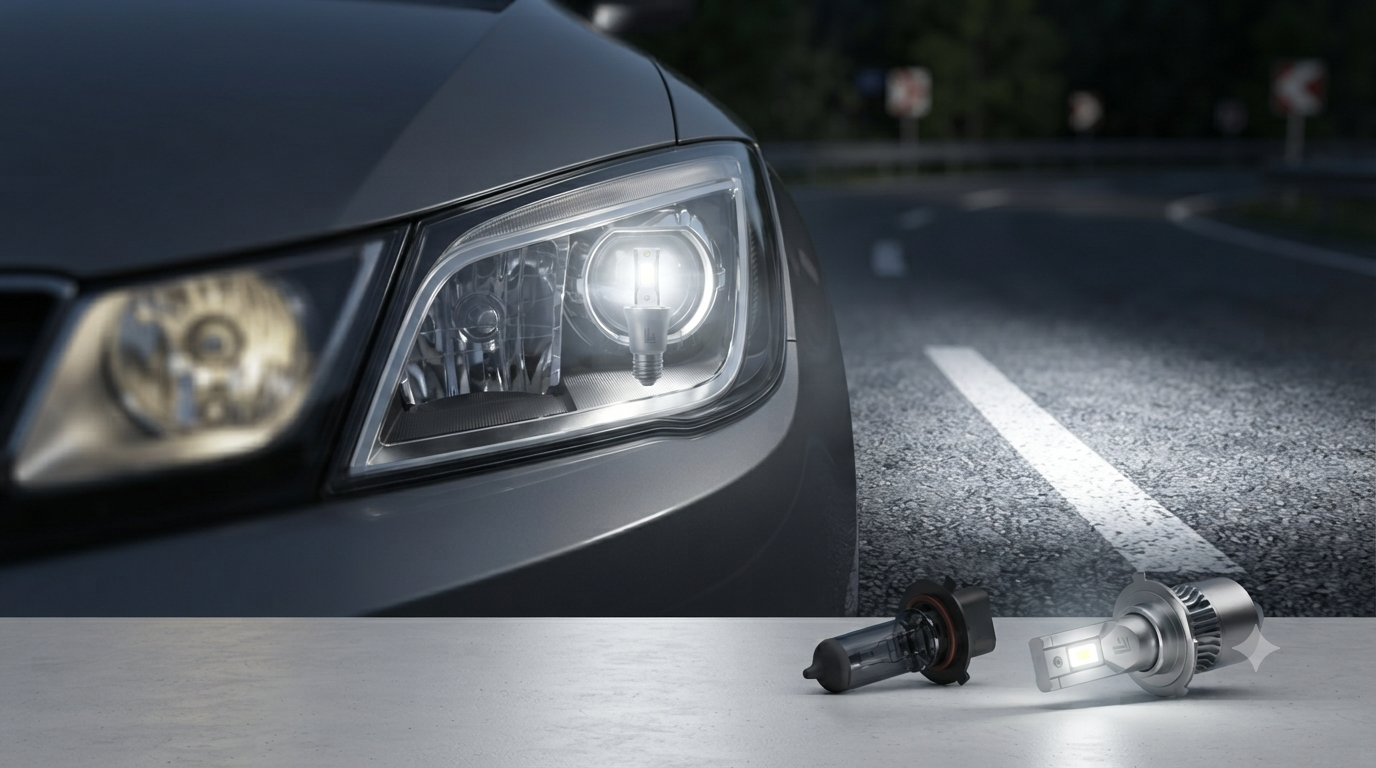
Yes, in many cases you can put LED bulbs in car headlights—but whether you should depends on the vehicle, headlight housing, bulb type, electrical system, beam pattern, and local regulations.
Yes, in many cases you can put LED bulbs in car headlights—but whether you should depends on the vehicle, headlight housing, bulb type, electrical system, beam pattern, and local regulations.
This distinction matters.
Replacing a halogen bulb with an LED retrofit may seem as simple as removing one bulb and installing another. Mechanically, that can sometimes be true. Technically, however, a headlight is a precision optical system. The original reflector or projector was engineered around the position, size, and shape of the original light source. If a replacement LED does not replicate that geometry accurately, the result may be more glare, scattered light, dark spots, or worse road visibility.
That is why choosing an LED light for car headlight applications requires more than comparing wattage or advertised lumens.
You need to consider the complete system
- The original bulb type
- Reflector or projector housing
- LED chip placement
- Beam pattern
- Color temperature
- Driver electronics
- Thermal management
- CAN Bus compatibility
- Physical clearance
- Legal requirements
This guide explains exactly what happens when you install LED bulbs in car headlights, when an LED retrofit makes sense, what problems can occur, and how to choose a suitable headlight bulb for car applications.
Can You Replace a Halogen Headlight Bulb With an LED?
Technically, often yes.
Many vehicles originally equipped with halogen headlight bulbs can accept an LED retrofit bulb designed to match the same base and connector.
For example, if a vehicle uses an H7 halogen bulb, an H7 LED retrofit may be physically designed to fit the same socket.
But physical fitment is only the first step.
A proper retrofit should also consider
- Light-source geometry
- Beam pattern
- Electrical compatibility
- Thermal management
- Available installation space
- Headlight housing design
- Legal compliance
A bulb that fits the socket may still produce a poor or unsafe beam.
The question isn't simply
- "Will the LED bulb fit?"
- The better question is
- "Will the LED bulb work correctly with my vehicle's complete headlight system?"
- How a Car Headlight Actually Produces a Beam
To understand LED retrofits, you need to understand the basic architecture of a headlight.
A typical headlight assembly may contain
- Light source
- Reflector or projector
- Lens
- Housing
- Beam-control components
The light source produces light.
The reflector or projector then directs that light.
The lens and optical elements shape the final beam.
This is why the location of the light source is so important.
A halogen bulb has a filament positioned at a very precise location.
The reflector was designed around that filament.
When you replace the filament with LED chips, the new light source should ideally occupy a very similar position.
If the LED chips are too far forward, too far backward, too wide, or incorrectly oriented, the optical system may not focus the light correctly.
Why LED Chip Position Matters
This is one of the most important technical considerations when choosing an LED light for car headlight applications.
Imagine shining a flashlight through a magnifying lens.
Move the light source slightly, and the beam changes.
The same principle applies inside a vehicle headlight.
The original halogen filament is essentially the reference point around which the headlight optics were engineered.
A poorly designed LED retrofit may create
- Excessive foreground brightness
- Dark zones
- Uneven illumination
- Scattered light
- Excessive upward light
- Glare for approaching drivers
This is why some LED retrofits appear extremely bright when viewed directly but don't actually improve the driver's view of the road.
Brightness is not the same as optical performance.
Reflector vs. Projector Headlights
The type of headlight housing makes a significant difference.
Reflector Headlights
A reflector headlight uses a shaped reflective surface to direct light forward.
The original bulb's position is particularly important.
A replacement LED must replicate the original filament geometry as closely as possible.
If the LED light source is poorly positioned, the reflector may distribute light incorrectly.
Potential results include
- Excessive glare
- Poor cutoff
- Uneven road illumination
- Projector Headlights
- Projector headlights use a more controlled optical system that typically includes
- Reflector bowl
- Lens
- Shield or cutoff mechanism
Projector housings can sometimes provide better control of retrofit light sources, but they are not automatically compatible with every LED bulb.
The LED still needs to produce light in the correct location and pattern.
A projector designed specifically for a halogen bulb is not necessarily equivalent to a projector designed for an OEM LED system.
LED Retrofit Bulbs vs. Factory LED Headlights
These are often confused.
They are fundamentally different technologies.
LED Retrofit Bulb
You keep the original headlight assembly and replace the halogen bulb with an LED bulb.
Advantages
- Lower initial cost
- Relatively simple installation
- Reuses existing headlight housing
- Potentially lower power consumption
- Long potential service life
- Limitations
- Optical compatibility can vary
- Beam pattern may not be ideal
- Cooling may be challenging
- CAN Bus issues may occur
- Legal approval may vary
- Factory LED Headlight
The complete headlight assembly is engineered around LED light sources.
This may include
- Dedicated optics
- LED modules
- Heat management
- Electronic control
- Beam shaping
- Adaptive lighting
The entire system is designed together.
That's why factory LED headlights generally offer better integration than simply inserting an LED bulb into a halogen housing.
What Is the Right Headlight Bulb for Car Applications?
Before buying any headlight bulb for car, identify the original bulb type.
Common automotive bulb types include
- H1
- H3
- H4
- H7
- H8
- H9
- H11
- 9005
- 9006
- HB3
- HB4
- 9012
The exact bulb type depends on the vehicle.
Even vehicles from the same manufacturer can use different bulb types depending on
- Model
- Year
- Trim
- Market
- Headlight configuration
- Some vehicles also use separate bulbs for
- Low beam
- High beam
- Fog lights
Never rely solely on appearance.
Two bulbs can look similar but use different bases, connectors, or electrical specifications.
Check the vehicle manual or confirm the original bulb number before ordering.
What Happens When You Install the Wrong LED Bulb?
Several problems can occur.
Problem 1: The Bulb Doesn't Fit
The base or locking tabs may be incompatible.
Problem 2: The Connector Doesn't Match
The electrical plug may require an adapter.
Problem 3: The Bulb Doesn't Sit Correctly
Even a compatible base can be installed incorrectly.
A small change in LED orientation can affect beam quality.
Problem 4: The Dust Cap Won't Close
Some LED bulbs have large heat sinks or cooling fans.
If the dust cap cannot be properly installed, moisture and dust may enter the headlight assembly.
Problem 5: The Vehicle Shows a Warning
Modern vehicles may detect that the LED draws less current than the original halogen bulb.
This can trigger a bulb-out warning.
CAN Bus Compatibility Explained
Modern vehicles increasingly use electronic monitoring systems.
The vehicle may measure electrical current flowing to the headlight.
A halogen bulb may consume considerably more power than an LED retrofit.
The vehicle's computer may interpret the lower electrical load as a failed bulb.
Possible symptoms include
- Dashboard warning
- Flickering
- Rapid flashing
- Intermittent operation
Some LED products include built-in circuitry designed to improve compatibility with vehicle monitoring systems.
Others may require an external decoder.
However, "CAN Bus compatible" should not be treated as a universal guarantee.
Different vehicles use different electrical architectures.
Always check compatibility for your specific vehicle.
Why Some LED Headlight Bulbs Flicker
Flickering can have several causes.
Possible Causes
- Incompatible driver
- Vehicle PWM control
- CAN Bus monitoring
- Voltage fluctuations
- Poor electrical connections
- Low-quality LED driver
- Insufficient electrical load
A high-quality LED bulb should have a properly engineered driver designed for automotive electrical conditions.
Automotive electrical systems can experience voltage fluctuations, temperature extremes, and electrical transients.
A driver designed for general-purpose LED lighting is not necessarily suitable for automotive headlights.
LED Headlight Bulbs Need Thermal Management
One common misconception is that LEDs don't produce heat.
They produce less waste heat than incandescent or halogen technology, but the LED junction still generates heat.
That heat must be removed.
A typical high-performance LED headlight retrofit may use
- Aluminum heat sinks
- Copper components
- Thermal interface materials
- Cooling fans
- Flexible cooling structures
The design must remove heat from the LED junction and driver electronics.
Poor thermal management can cause
- Reduced brightness
- Faster lumen depreciation
- Driver failure
- Shorter operating life
A bulb that is extremely bright for the first few minutes may not maintain the same performance after extended operation if its thermal design is inadequate.
Fan-Cooled vs. Fanless LED Headlight Bulbs
When selecting an LED headlight bulb, you may encounter two major cooling designs.
Fan-Cooled
These bulbs use an active cooling fan.
Advantages
- Strong heat removal
- Compact high-output designs
- Suitable for some high-power applications
- Disadvantages
- Moving parts
- Potential fan failure
- Possible noise
- Dust accumulation
- Fanless
These use passive heat dissipation.
Advantages
- Silent
- No moving fan
- Simpler mechanical design
- Disadvantages
- May require more physical space
- Cooling performance depends on heat sink design
- May be less suitable for extremely high thermal loads
Neither approach is automatically better.
The quality of the thermal design matters most.
Does an LED Headlight Use Less Power?
Generally, an LED retrofit can provide comparable light output using less electrical power than a traditional halogen bulb.
But don't assume every LED product uses dramatically less power.
Some high-output LED bulbs consume significant power.
Compare the actual rated wattage.
For example
- Halogen: 55W
- LED retrofit: 25W
The LED consumes less electrical power.
However
- Halogen: 55W
- LED retrofit: 45W
The difference is much smaller.
Power consumption should be evaluated alongside
- Actual lumen output
- Beam efficiency
- Driver efficiency
- Thermal performance
A lower wattage is only beneficial if the bulb still provides useful illumination.
Don't Choose an LED Based Only on Lumens
Advertised lumen numbers can be misleading.
There is a difference between
- Source lumens
- and
Useful road illumination.
A bulb may claim an extremely high lumen output, but if its light is poorly controlled, much of that output may not reach the road where it is needed.
The ideal headlight provides
- Strong forward illumination
- Useful side visibility
- Good distance coverage
- Controlled foreground lighting
- Minimal glare
When comparing an LED light for car headlight applications, beam quality should be evaluated alongside lumen output.
What Color Temperature Should You Choose?
Most automotive LED headlight retrofits are designed to produce a white appearance.
Color temperature is typically expressed in Kelvin.
A general guide
- Color Temperature
- Appearance
- General Characteristics
- 3000K
- Yellow
- Often associated with fog lighting
- 4000K
- Neutral white
- Balanced appearance
- 5000K
- Clean white
- Good balance of appearance and practicality
- 6000K
- Cool white
- Popular modern appearance
- 6500K+
- Bluish white
- More blue appearance, potentially more glare/scatter
For everyday headlights, a balanced white output is often more practical than an extremely blue appearance.
Higher Kelvin values do not automatically mean better visibility.
In rain, fog, or other conditions with airborne moisture, shorter-wavelength blue light can be scattered more noticeably.
For many drivers, a neutral-to-cool white LED offers a good compromise between appearance and practical visibility.
Can LED Headlights Improve Visibility?
Yes—if the retrofit is properly designed and compatible with the headlight housing.
Potential improvements include
- Better illumination
- Whiter light
- More efficient operation
- Improved visibility of road markings
- Longer service life
But the improvement isn't guaranteed.
A poor LED retrofit can actually make the lighting worse.
For example, if the LED chips don't replicate the halogen filament position, the headlight may lose its intended beam pattern.
The driver might see more light directly in front of the vehicle but less useful light farther down the road.
That's why a properly engineered beam pattern is more valuable than an impressive marketing number.
The Importance of Beam Cutoff
A properly designed low-beam headlight should create a controlled cutoff.
This prevents excessive light from being projected upward into the eyes of approaching drivers.
A poor retrofit may create scattered light above the intended cutoff.
This can produce glare.
If an LED conversion causes excessive glare, it isn't a successful upgrade—even if the driver believes the road looks brighter.
The correct objective is
Maximum useful illumination with minimum unnecessary glare.
Should You Install LED Bulbs in High Beams?
High-beam applications can sometimes be more forgiving because they don't require the same strict low-beam cutoff.
However, the optical system still matters.
The LED should provide
- Adequate forward illumination
- Consistent beam distribution
- Reliable thermal performance
The exact suitability depends on the vehicle's headlight design.
Never assume that a bulb that works well in a high beam will automatically be suitable for low-beam use.
What About LED Bulbs in Fog Lights?
LED retrofit bulbs are commonly marketed for fog-light applications.
But fog lights have a specific purpose.
A good fog-light beam is typically
- Wide
- Low
- Controlled
Simply installing a brighter LED doesn't necessarily improve performance in fog.
A poorly designed bulb can produce excessive glare from moisture and reduce useful contrast.
For fog conditions, optical design is more important than raw brightness.
Are LED Headlight Conversions Legal?
This depends entirely on the jurisdiction.
Some countries or regions permit certain approved LED retrofit products.
Others may require the entire headlight assembly to meet specific certification requirements.
Potential regulatory requirements may cover
- Beam pattern
- Light intensity
- Color
- Glare
- Headlamp certification
- Vehicle inspection
Before converting a halogen headlight to LED, verify your local laws and inspection requirements.
A product being available for purchase does not necessarily mean it is legal for road use.
This is particularly important for low-beam headlights.
How to Install an LED Headlight Bulb Correctly
Installation procedures vary by vehicle.
In general
- Step 1: Confirm the Correct Bulb
Verify the original bulb number.
Step 2: Turn Off the Vehicle
Switch off the ignition and lighting system.
Step 3: Remove the Original Bulb
Follow the vehicle manufacturer's procedure.
Step 4: Install the LED
Ensure the bulb is fully seated.
Step 5: Check LED Orientation
Some retrofit bulbs require the LED chips to face a specific direction.
Incorrect orientation can affect beam quality.
Step 6: Connect the Driver
If the product uses an external driver, secure it properly.
Step 7: Reinstall the Dust Cap
Ensure the housing remains sealed.
Step 8: Test the Headlights
Check operation and look for flickering or warning messages.
Step 9: Verify Beam Pattern
Inspect the cutoff and alignment.
Step 10: Adjust if Necessary
Professional headlight alignment may be appropriate after installation.
When You Should Not Install an LED Retrofit
- An LED bulb conversion may not be the best option when
- The vehicle requires a certified complete LED assembly
- The headlight housing is damaged
- The lens is heavily oxidized
- The LED cannot produce a controlled beam
- The bulb doesn't fit correctly
- The dust cap cannot be sealed
- The electrical system isn't compatible
- The conversion isn't legal in your jurisdiction
In these situations, restoring the existing system or installing a properly designed complete headlight assembly may be a better solution.
A Practical Buying Checklist
- Before purchasing an LED light for car headlight applications, check
- Vehicle Compatibility
- Make
- Model
- Year
- Trim
- Original bulb number
- Optical Performance
- LED chip position
- Beam pattern
- Cutoff quality
- Light distribution
- Electrical Compatibility
- Voltage
- Wattage
- CAN Bus compatibility
- Driver design
- Thermal Performance
- Fan or fanless cooling
- Heat sink quality
- Available installation space
- Light Quality
- Color temperature
- CRI, where relevant
- Lumen output
- Installation
- Bulb dimensions
- Connector
- Dust-cap clearance
- Driver location
- Legal Requirements
- Local regulations
- Vehicle inspection requirements
- Product certification
- Pro Tips for Choosing a Headlight Bulb for Car
- Pro Tip 1: Check the Original Bulb First
Never order an LED based only on your vehicle's brand and model.
Confirm the actual bulb number.
Pro Tip 2: Inspect the Headlight Housing
A cloudy lens can reduce light output significantly.
Restoring the lens may be more beneficial than installing a more powerful bulb.
Pro Tip 3: Avoid Extreme Lumen Claims
A realistic, well-controlled beam is more valuable than exaggerated numbers.
Pro Tip 4: Check the Beam After Installation
Don't assume that installation automatically means correct alignment.
Pro Tip 5: Replace Both Bulbs
Replacing both sides together helps maintain consistent brightness and color.
Pro Tip 6: Don't Ignore Cooling
High-power LEDs require serious thermal management.
Pro Tip 7: Consider a Complete LED Assembly
If your vehicle's optics are incompatible with retrofit bulbs, a purpose-designed LED headlight assembly may be the better technical solution.
Common Mistakes When Installing LED Headlight Bulbs
- Mistake 1: Assuming "Plug and Play" Means Optically Compatible
A bulb may be electrically and mechanically compatible while still producing a poor beam.
Mistake 2: Choosing Maximum Brightness
Excessive light can increase glare.
Mistake 3: Ignoring LED Chip Orientation
Incorrect positioning can distort the beam.
Mistake 4: Forgetting CAN Bus Issues
Electronic warning systems can create unexpected problems.
Mistake 5: Leaving the Dust Cap Off
This exposes the headlight to moisture and contamination.
Mistake 6: Installing Without Checking Alignment
A small alignment error can significantly affect the beam.
Mistake 7: Ignoring Local Laws
Always verify whether the conversion is legal for road use.
Frequently Asked Questions
- Can you put LED bulbs in car headlights?
In many vehicles, yes. A halogen headlight can often physically accept an LED retrofit bulb designed for the same bulb type. However, compatibility depends on the headlight housing, bulb geometry, electrical system, thermal management, and local regulations. A bulb that fits the socket isn't automatically a safe or legal retrofit.
Are LED headlights better than halogen headlights?
LEDs can provide lower power consumption, longer potential service life, and a whiter light appearance. However, an LED retrofit is only better when it produces a suitable beam pattern and works correctly with the original headlight optics. A poorly designed LED conversion may provide worse visibility and more glare than a quality halogen bulb.
How do I choose the right headlight bulb for my car?
First identify the exact bulb type used by your vehicle, such as H4, H7, H11, 9005, or another specification. Then verify physical fit, electrical compatibility, CAN Bus requirements, cooling space, beam performance, and local legal requirements. Always confirm the bulb number from the vehicle documentation or the original bulb.
Is a higher-lumen LED headlight always better?
No. Higher raw lumens do not necessarily mean better road visibility. The reflector or projector must be able to control the light effectively. A lower-output bulb with accurate LED chip positioning and a clean beam pattern can provide more useful illumination than an extremely high-output bulb that scatters light.
Final Takeaway: Yes, But Choose the Complete System
- So, can you put LED bulbs in car headlights?
In many cases, yes—but the technically correct answer is more nuanced than simply saying "plug it in and go."
A successful LED conversion requires compatibility between the LED light source, headlight optics, electrical system, driver, cooling system, and vehicle electronics.
If the LED retrofit accurately replicates the original light-source geometry and produces a controlled beam, it may provide meaningful benefits such as improved visibility, lower power consumption, and longer service life.
If the bulb is poorly designed or incompatible with the housing, the result can be scattered light, poor road illumination, excessive glare, and potentially unsafe driving conditions.
When selecting an LED light for car headlight applications, prioritize beam pattern and optical control over headline lumen numbers. Confirm the correct bulb type, check CAN Bus compatibility, ensure adequate cooling, maintain the headlight's weather seal, and verify local regulations before installation.
The best headlight bulb for car use isn't necessarily the brightest product available.
It's the one that delivers controlled, useful light exactly where the driver needs it—while keeping other road users safe.