bolt Quick Answer (As of 2026)
Bathrooms are among the most demanding rooms in a home when it comes to lighting design. Unlike a bedroom or living room, a bathroom combines electricity with water, steam, condensation, cleaning chemicals, and frequent temperature changes. That m...
Bathrooms are among the most demanding rooms in a home when it comes to lighting design. Unlike a bedroom or living room, a bathroom combines electricity with water, steam, condensation, cleaning chemicals, and frequent temperature changes. That makes bathroom spotlights more than a simple matter of choosing a bright LED fixture that looks attractive on the ceiling.
The right product must be suitable for its installation location and environmental conditions.
This is where IP ratings become essential.
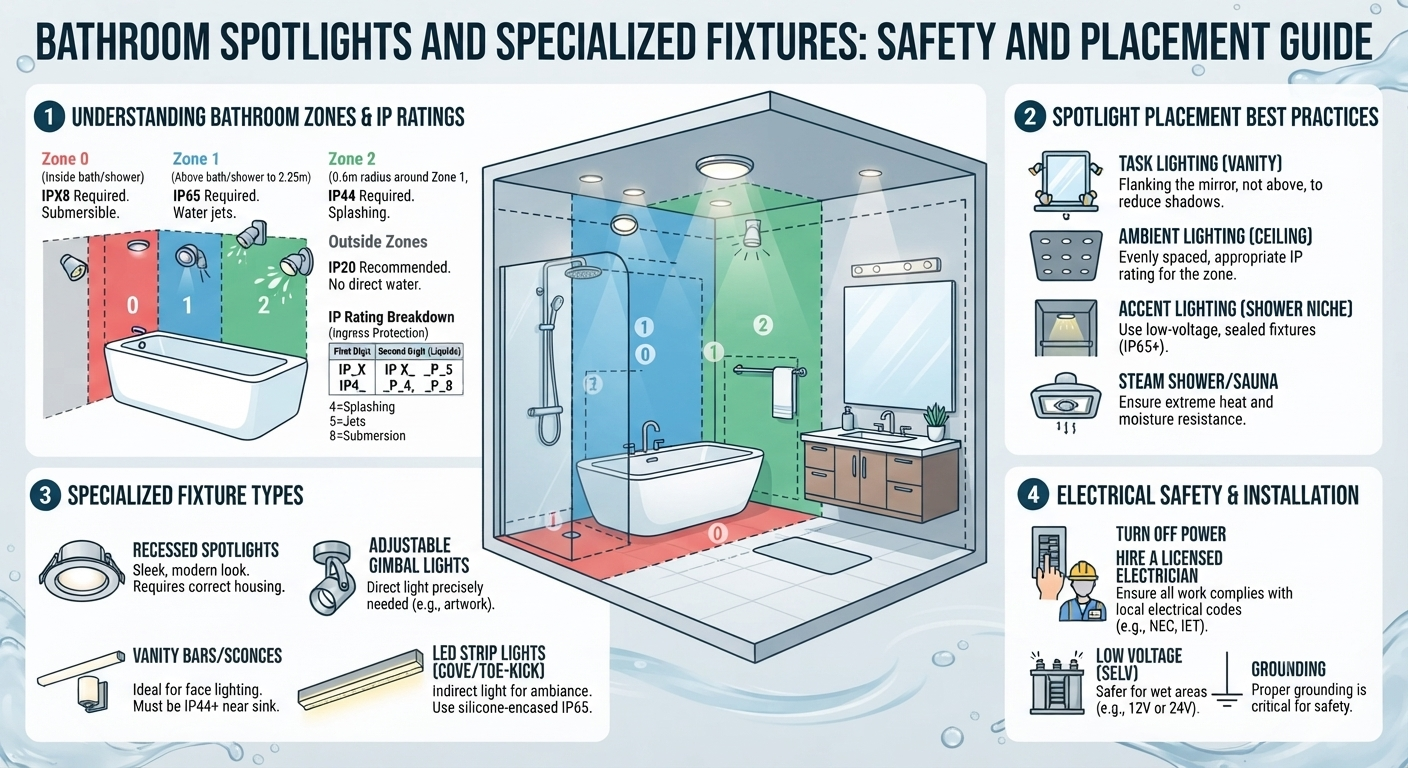
An IP rating—short for Ingress Protection—indicates how effectively an electrical enclosure protects against the entry of solid particles and water. Understanding this rating helps you select lighting fixtures that are appropriate for areas exposed to splashes, spray, humidity, or condensation.
The same principle applies when choosing outdoor lamps for house exteriors. Outdoor lighting also faces rain, dust, humidity, and weather exposure, so the appropriate IP rating is just as important.
In this guide, we'll explain how IP ratings work, what common ratings such as IP44, IP54, IP65, and IP67 actually mean, how bathroom zones affect fixture selection, and how to choose LED spotlights that provide safe, comfortable, and reliable illumination.
Why Bathroom Lighting Requires Special Attention
Bathrooms have several characteristics that make electrical installations more challenging.
They may contain
- Running water
- Showers and bathtubs
- High humidity
- Steam
- Condensation
- Wet floors
- Frequent temperature fluctuations
Even when a light fixture is installed on the ceiling, moisture can still affect its electrical components over time.
The risk is particularly significant near
- Showers
- Bathtubs
- Wet rooms
- Sinks
- Areas exposed to direct water spray
This doesn't mean every bathroom requires the same type of fixture.
The correct specification depends on where the fixture is installed and the conditions it will experience.
What Does an IP Rating Mean?
- An IP rating is usually written as
- IPXY
The first digit describes protection against solid objects and particles.
The second digit describes protection against water.
For example
- IP44
The first 4 relates to protection against solid objects of a certain size.
The second 4 indicates protection against water splashes from various directions.
The two digits have different meanings.
Understanding both is important when selecting bathroom spotlights.
Understanding the First IP Digit
The first digit generally indicates protection against solid foreign objects.
First Digit
- General Meaning
- IP0X
- No protection
- IP1X
- Protection against large objects
- IP2X
- Protection against fingers or similar objects
- IP3X
- Protection against tools and larger objects
- IP4X
- Protection against smaller solid objects
- IP5X
- Dust-protected
- IP6X
- Dust-tight
For most residential bathroom lighting decisions, the second digit—the water protection rating—is often the more immediately relevant factor.
However, dust protection becomes important in environments where airborne particles may accumulate.
Understanding the Second IP Digit
The second digit indicates resistance to water ingress.
Water Rating
- General Protection
- IPX0
- No water protection
- IPX1
- Protection against vertically falling water drops
- IPX2
- Protection against dripping water when tilted
- IPX3
- Protection against spraying water
- IPX4
- Protection against water splashes
- IPX5
- Protection against water jets
- IPX6
- Protection against powerful water jets
- IPX7
- Protection against temporary immersion
- IPX8
- Protection against continuous or extended immersion under specified conditions
The higher number isn't automatically "better" for every installation.
What matters is whether the rating is appropriate for the environment.
A fixture rated IP67 may provide excellent protection, but installing it where IP44 is sufficient could add unnecessary cost.
On the other hand, using a fixture with insufficient water protection in a wet location can create serious safety and reliability concerns.
IP44 Bathroom Spotlights
IP44 is one of the most commonly encountered ratings for bathroom lighting.
The "4" in the second position indicates protection against water splashes.
Depending on the specific installation location and local electrical regulations, IP44 fixtures may be suitable for certain bathroom areas where the light is not exposed to direct water jets.
Common examples may include
- General bathroom ceiling areas
- Areas away from showers
- Areas away from direct spray
However, don't treat IP44 as a universal bathroom rating.
The suitability depends on
- Fixture location
- Bathroom layout
- Presence of a shower
- Local electrical regulations
- Installation zone classification
Always follow the manufacturer's installation instructions and local electrical codes.
IP54 Bathroom Lighting
- IP54 provides
- Protection against dust ingress to a limited degree
- Protection against water splashes
This can be useful in environments where the fixture may experience both airborne particles and moisture.
However, IP54 should not automatically be considered suitable for every wet location.
The specific installation environment still matters.
IP65 Bathroom Spotlights
IP65 is a popular choice for applications exposed to stronger water exposure.
The rating indicates
- 6: Dust-tight
- 5: Protected against water jets
This makes IP65 fixtures suitable for many demanding environments.
In bathrooms, they may be considered for areas where greater water protection is required, subject to local regulations and the manufacturer's installation instructions.
IP65 is also commonly used in
- Outdoor lighting
- Garden lighting
- Exterior walls
- Covered outdoor areas
- Outdoor lamps for house applications
However, an IP65 fixture is not automatically suitable for immersion.
That's where higher water protection ratings become relevant.
IP67 Bathroom Spotlights
- IP67 provides
- Dust-tight protection
- Protection against temporary immersion under specified test conditions
This is a higher level of water protection than IP65.
It can be appropriate for specialized applications where a fixture could potentially experience temporary immersion.
However, choosing IP67 simply because it has a higher number isn't always necessary.
The correct fixture is the one whose rating matches the actual environmental exposure and installation requirements.
Bathroom Zones and Why They Matter
Bathroom electrical installations are often divided into different zones based on proximity to water sources.
The exact zone definitions and permitted equipment can vary by country and electrical code.
Generally, the areas closest to
- Bathtubs
- Shower trays
- Shower heads
- Water outlets
are subject to stricter requirements.
As you move farther away from direct water exposure, the requirements may become less restrictive.
This means you shouldn't select bathroom spotlights solely by asking
- "Is the light IP-rated?"
- Instead, ask
- "Is this specific fixture permitted in this exact location?"
That's a much better question.
Why IP Ratings Are Important for Ceiling Spotlights
Ceiling-mounted bathroom spotlights often appear to be protected simply because they're above eye level.
But ceiling height doesn't automatically eliminate moisture exposure.
Warm air rises.
During a hot shower, steam can accumulate near the ceiling before condensing on cooler surfaces.
Over time, moisture can affect
- LED drivers
- Electrical connections
- Metal components
- Internal electronics
A suitable IP rating helps reduce the risk of moisture entering the fixture enclosure.
However, IP protection doesn't replace proper installation.
A fixture with an excellent IP rating can still fail if
- Wiring connections are poorly made
- The fixture is incorrectly installed
- Seals are damaged
- The wrong driver is used
- The product is modified
- Choosing the Right Bathroom Spotlight
When shopping for bathroom spotlights, consider more than IP rating.
Look at the complete specification.
IP Rating
Confirm that the fixture is approved for the intended location.
Lumen Output
Choose enough light for the bathroom's size and purpose.
Color Temperature
Select a color temperature that suits the room.
CRI
Good color rendering is especially useful around mirrors.
Beam Angle
A wider beam may provide more uniform general lighting.
Glare
Avoid fixtures that create uncomfortable brightness when viewed from the mirror or bathtub.
Dimming
If you want adjustable brightness, confirm that the fixture and driver are dimmable.
Driver Location
Check whether the driver is integrated or external and whether its location is suitable for the installation.
Cutout Size
For recessed spotlights, verify the required ceiling cutout.
Maintenance
Consider whether the LED module is replaceable or whether the entire fixture must be replaced.
Warm White or Cool White for Bathrooms?
Color temperature significantly changes the atmosphere of a bathroom.
2700K–3000K: Warm White
Creates a relaxing, spa-like environment.
Good for
- Residential bathrooms
- Evening use
- Warm interior designs
- 3500K–4000K: Neutral White
A practical middle ground.
Good for
- General bathroom lighting
- Vanity areas
- Modern interiors
- 5000K–6500K: Cool White
Creates a crisp, daylight-like appearance.
Often used in
- Utility spaces
- Commercial environments
- High-visibility applications
For many homes, 3000K–4000K is a comfortable range.
The best choice also depends on the bathroom finishes.
Warm lighting can complement wood and warm tiles.
Neutral lighting often works well with white and gray contemporary interiors.
Bathroom Mirror Lighting
A ceiling spotlight directly above the mirror may not be enough.
In fact, it can create unwanted shadows across the face.
This is particularly noticeable when
- Shaving
- Applying makeup
- Styling hair
- Grooming
- For better facial illumination, consider
- Vertical lights on both sides of the mirror
- A diffused light above the mirror
- An illuminated LED mirror
The goal is balanced lighting from the front rather than a single harsh source from above.
Pro Tip
If you can see a strong shadow under your eyes or chin while standing at the mirror, your lighting is probably too top-heavy.
Adding side illumination can dramatically improve the result.
Beam Angle for Bathroom Spotlights
Beam angle controls how widely the light spreads.
Narrow Beam
Creates focused illumination.
Suitable for
- Accent features
- Decorative walls
- Specific architectural details
- Medium Beam
Provides more concentrated general illumination.
Wide Beam
Creates broader and more uniform coverage.
For general bathroom lighting, wide or medium beam angles often work well.
For a small bathroom with multiple downlights, a moderate beam can provide good coverage without creating excessive overlap.
How Many Bathroom Spotlights Do You Need?
There's no universal number.
The answer depends on
- Bathroom size
- Ceiling height
- Fixture lumen output
- Beam angle
- Wall reflectance
- Desired brightness
- Layout
For example, a compact bathroom may only need a few carefully positioned LED downlights.
A large bathroom with a separate shower, bathtub, vanity, and toilet area may benefit from multiple lighting zones.
The best approach is to design around functional areas.
Consider separate lighting for
- Shower
- Vanity
- General room
- Bathtub
- Storage
This allows you to provide light where it's needed without making every part of the bathroom equally bright.
Combining Spotlights With Other Bathroom Lighting
A sophisticated bathroom doesn't need to rely entirely on ceiling spotlights.
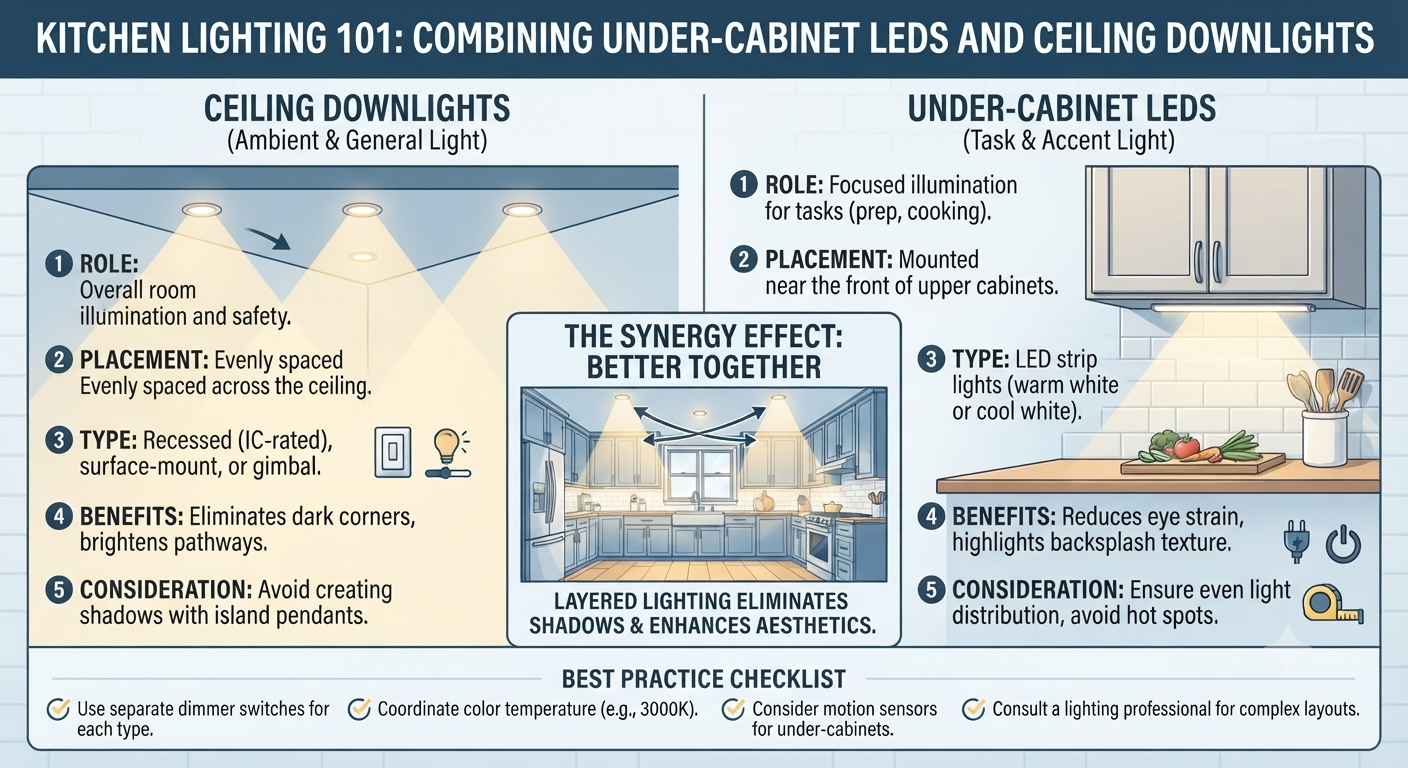
Consider layering
- Ambient
Recessed LED downlights.
Task
Mirror or vanity lighting.
Accent
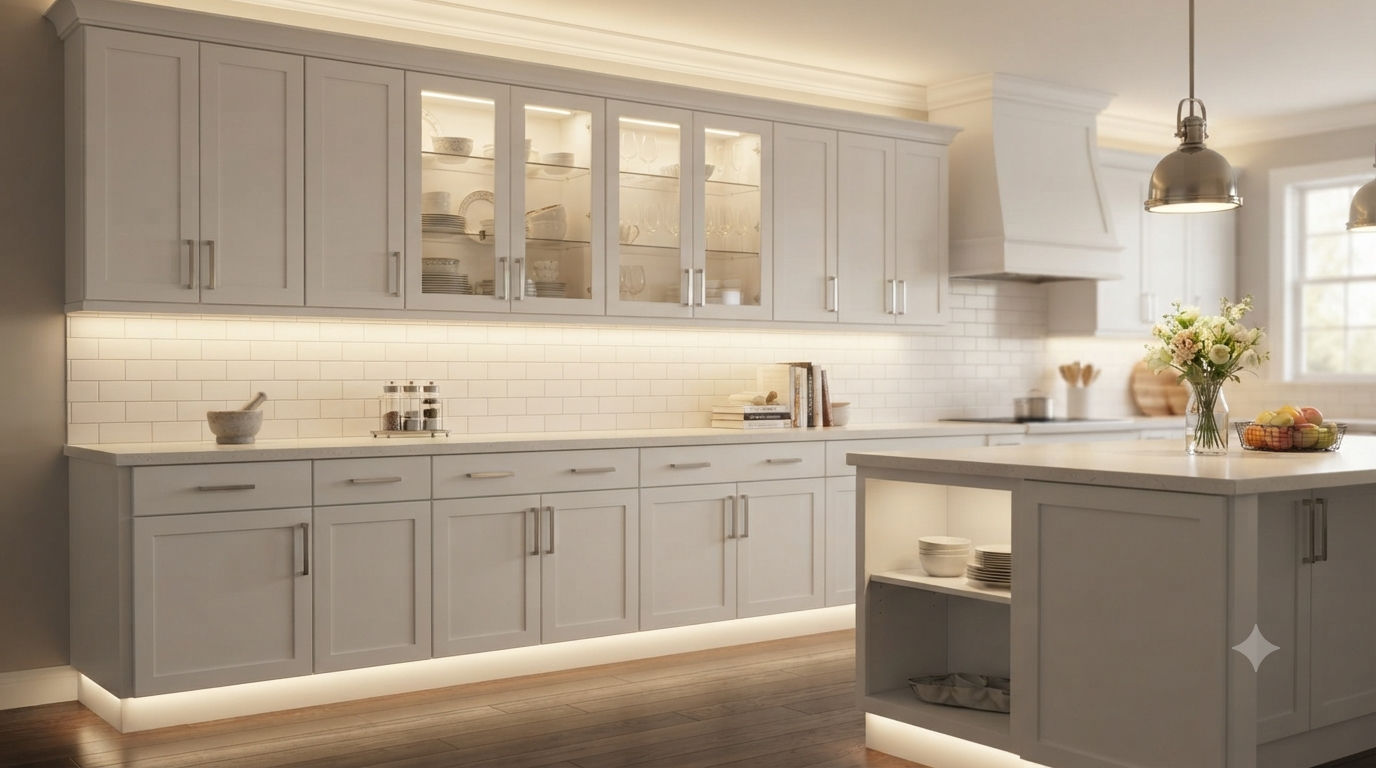
LED strip behind the mirror or beneath floating cabinets.
Decorative
Wall-mounted fixtures where permitted.
This creates depth and flexibility.
For example, you might use
Downlights for morning grooming.
Mirror lighting for shaving or makeup.
Low-level accent lighting for nighttime visits.
The result is more comfortable than turning on every light at full brightness.
Dimmable Bathroom Spotlights
Dimming is especially useful in bathrooms.
Bright light is useful in the morning.
But at night, suddenly switching on powerful overhead lights can be unpleasant.
A dimmable system allows you to reduce brightness when appropriate.
You can create
- Bright daytime lighting
- Moderate evening lighting
- Low nighttime illumination
Make sure the LED fixture, driver, and dimmer are compatible.
Some LED products may flicker or have a limited dimming range when paired with unsuitable dimmers.
Recessed vs. Surface-Mounted Bathroom Spotlights
Both types have advantages.
Feature
- Recessed LED Spotlights
- Surface-Mounted Fixtures
- Appearance
- Minimalist
- More visible
- Ceiling Space
- Requires sufficient cavity
- Suitable for shallow ceilings
- Installation
- More complex
- Generally simpler
- Maintenance
- Depends on design
- Often easier access
- Best For
- Modern ceiling designs
- Renovations and low ceilings
Recessed fixtures can create a clean, architectural appearance.
Surface-mounted fixtures can be more practical when there isn't enough ceiling depth for recessed installation.
Bathroom Lighting and Electrical Safety
Bathroom electrical work should be treated seriously.
Water and electricity are a dangerous combination.
Installation should comply with applicable local electrical regulations and be performed by a qualified electrician where required.
Pay attention to
- Bathroom electrical zones
- IP rating requirements
- RCD/GFCI protection
- Earthing requirements
- Driver location
- Cable routing
- Manufacturer instructions
Never assume that an IP-rated light can be installed anywhere in a bathroom.
The fixture must be suitable for its specific location.
What About Outdoor Lamps for House Exteriors?
The same principles apply to outdoor lamps for house exteriors.
Outdoor lighting can be exposed to
- Rain
- Dust
- Humidity
- Wind
- Temperature fluctuations
- Water spray
The appropriate IP rating depends on the location.
For example, a fixture under a covered porch may experience less direct water exposure than one installed on an exposed garden wall.
Common outdoor applications include
- Porch lighting
- Driveway lighting
- Garden lights
- Wall lights
- Security floodlights
- Gate lighting
- Pathway lighting
For outdoor applications, consider both IP protection and construction quality.
A durable aluminum housing, corrosion-resistant finish, and quality seals can contribute to long-term performance.
Bathroom Spotlights vs. Outdoor Lamps: Are They Interchangeable?
Not necessarily.
Although both may use IP-rated enclosures, their designs and certifications can differ.
A bathroom spotlight may be designed for a particular indoor zone.
An outdoor lamp may be designed for
- Rain exposure
- UV radiation
- Temperature changes
- Outdoor mounting conditions
The fact that two fixtures have the same IP rating doesn't mean they are interchangeable.
Always verify
- Intended application
- Installation location
- Electrical specifications
- Manufacturer approval
- Applicable safety standards
- Common Mistakes When Choosing Bathroom Spotlights
- Mistake 1: Assuming IP44 Works Everywhere
Bathroom requirements depend on location and local regulations.
Mistake 2: Choosing the Highest IP Rating Without Reason
More protection isn't always necessary if the fixture is installed in a dry area.
Mistake 3: Ignoring the Driver
The LED fixture may be IP-rated while the driver is not suitable for the same environment.
Mistake 4: Installing Only Ceiling Lights
The mirror may still have poor facial illumination.
Mistake 5: Ignoring Glare
Bright downlights can be uncomfortable when reflected in mirrors or glossy tiles.
Mistake 6: Choosing Color Temperature Based Only on Brightness
A cooler light may appear visually brighter but isn't necessarily producing more lumens.
Mistake 7: Installing Fixtures Without Checking Bathroom Zones
Always consider the exact installation position.
Mistake 8: Treating Outdoor Lamps as Automatically Suitable for Bathrooms
Outdoor and bathroom requirements are not identical.
Expert Bathroom Spotlight Buying Checklist
- Before purchasing bathroom spotlights, check
- IP rating
- Bathroom zone suitability
- Lumen output
- Beam angle
- Color temperature
- CRI
- Glare control
- Dimming compatibility
- Driver specifications
- Ceiling cutout
- Recessed depth
- Warranty
- Manufacturer installation instructions
- For outdoor lamps for house, also consider
- Direct rain exposure
- UV resistance
- Corrosion resistance
- Mounting surface
- Cable entry points
- Temperature range
- IP rating
- Frequently Asked Questions
- What IP rating is best for bathroom spotlights?
There is no single IP rating that is correct for every bathroom location. The appropriate rating depends on the fixture's position, proximity to water, bathroom zone classification, and local electrical regulations. IP44 may be suitable for some areas, while locations exposed to stronger water spray may require higher protection.
Is IP65 better than IP44 for a bathroom?
IP65 provides greater protection against dust and water jets than IP44. However, "better" does not necessarily mean "required." The fixture should have the IP rating appropriate for its specific installation location and exposure to water.
Can I use outdoor lamps in a bathroom?
Not automatically. Even if an outdoor fixture has a suitable IP rating, it must also be approved and appropriate for the intended bathroom installation location. Always check the manufacturer's specifications and applicable electrical regulations.
Are LED bathroom spotlights energy efficient?
Yes. Modern LED spotlights generally consume less electricity than equivalent halogen fixtures and can provide long service life. Their actual efficiency depends on LED quality, driver efficiency, lumen output, and thermal management.
Final Takeaway: Choose the IP Rating for the Location, Not Just the Room
Choosing bathroom spotlights isn't simply about finding an attractive LED downlight and checking whether it says "waterproof."
The critical question is where the fixture will be installed and what conditions it will experience.
Understand the IP rating.
Check the bathroom zone.
Consider water exposure.
Verify the driver's suitability.
Follow local electrical regulations.
Then look at the lighting qualities that determine comfort and performance: lumens, beam angle, color temperature, CRI, glare control, and dimming compatibility.
The same disciplined approach applies when selecting outdoor lamps for house exteriors. Match the fixture's IP protection and construction to the real environmental conditions rather than choosing based on appearance or price alone.
A well-selected LED spotlight should do more than survive moisture. It should provide reliable illumination, comfortable visual performance, and dependable operation for years.
The best bathroom lighting is safe first, suitable for its location second, and aesthetically pleasing third. When all three are addressed during the design stage, you get a bathroom that is not only brighter and more attractive but also properly equipped for the environment in which it operates.