bolt Quick Answer (As of 2026)
Bathrooms are among the most demanding spaces to light correctly. They combine water, humidity, steam, reflective surfaces, electrical equipment, and often limited natural light. A fixture that works perfectly in a dry bedroom may be completely un...
Bathrooms are among the most demanding spaces to light correctly. They combine water, humidity, steam, reflective surfaces, electrical equipment, and often limited natural light. A fixture that works perfectly in a dry bedroom may be completely unsuitable for installation above a shower or beside a bathtub.
That's why choosing bathroom spotlights isn't simply a matter of finding the brightest LED fixture that fits the ceiling.
You need to consider electrical safety zones, IP ratings, voltage, fixture placement, beam angle, color temperature, glare, and the specific location of the fitting. The same principles apply when selecting specialized fixtures for exterior areas, including outdoor lamps for house applications where rain, dust, condensation, and temperature changes can affect performance.
This guide explains how to choose and position bathroom spotlights safely, how IP ratings work, where different fixtures should be installed, and how to select suitable outdoor lighting for your home's exterior. It also covers common installation mistakes and practical advice for achieving attractive illumination without compromising electrical safety.
Bathroom Lighting at a Glance
- Bathroom Location
- Recommended Lighting Approach
- Key Considerations
- General ceiling
- LED downlights or spotlights
- IP rating, beam angle, glare
- Shower area
- Moisture-rated recessed fixture
- Appropriate IP protection
- Above bathtub
- Suitable moisture-resistant fixture
- Local electrical regulations
- Vanity
- Vertical or balanced face lighting
- Minimize shadows
- Mirror
- Dedicated mirror lighting
- High CRI, low glare
- Ceiling outside wet areas
- Standard or moisture-rated fixture as required
- Environmental conditions
- Small bathroom
- Wide-beam recessed LEDs
- Even illumination
- Large bathroom
- Layered lighting
- Ambient, task, and accent lighting
Always follow local electrical codes and have electrical work performed by a qualified professional where required. Bathroom electrical requirements vary by jurisdiction, and the exact permissible fixture type depends on the installation location.
Why Bathroom Lighting Requires Special Attention
Water and electricity are a dangerous combination.
Bathrooms also experience rapid changes in humidity and temperature. Steam from hot showers can condense on cooler surfaces, potentially affecting unsuitable electrical equipment.
The primary concerns when selecting bathroom lighting are
- Moisture exposure
- Water splashes
- Condensation
- Electrical shock risk
- Corrosion
- Heat accumulation
- Glare from reflective surfaces
This is why bathroom fixtures are often specified according to an IP rating, or Ingress Protection rating.
The IP rating indicates how effectively an enclosure protects internal components against solids and moisture.
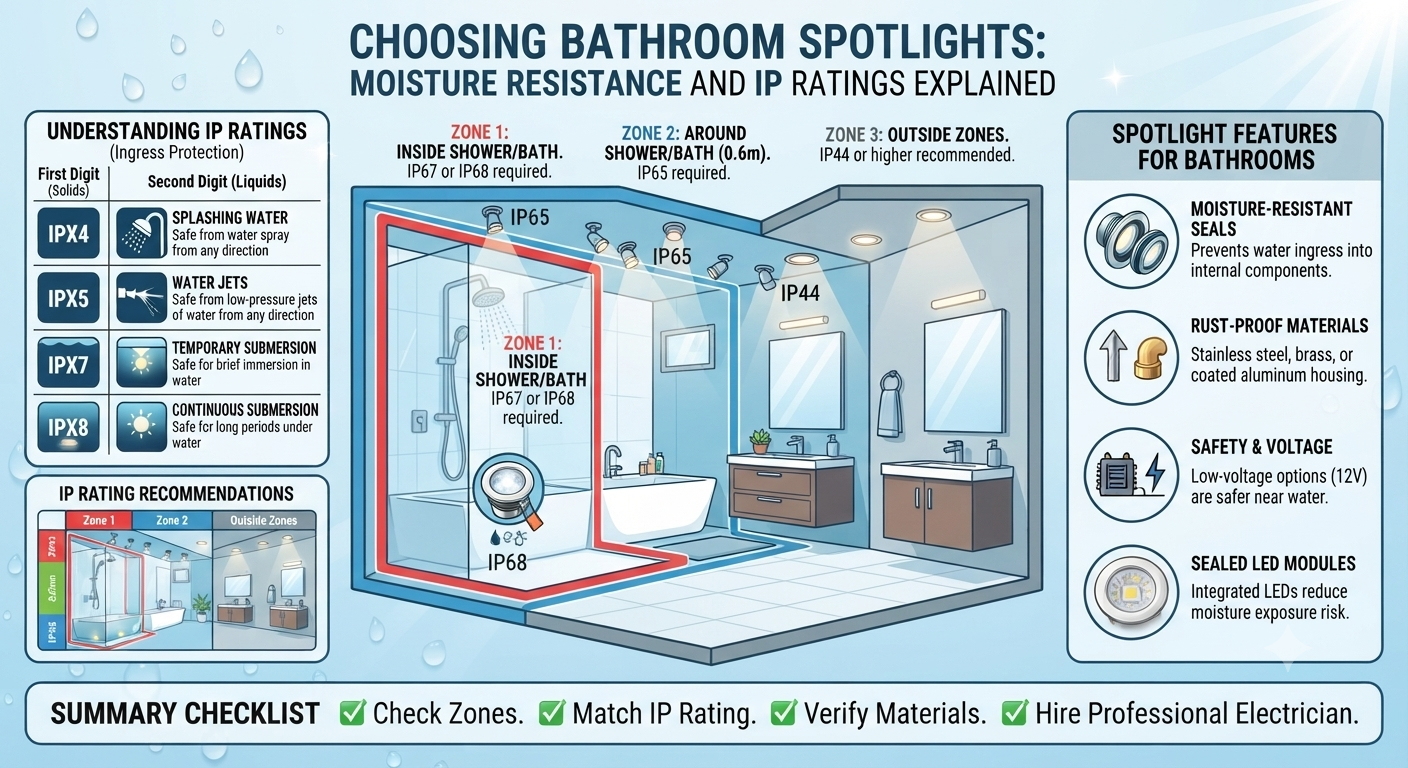
Understanding IP Ratings for Bathroom Spotlights
- An IP rating typically appears as
- IP44
- or
- IP65
The first digit relates to protection against solid particles.
The second digit relates to protection against water.
For bathroom lighting, the second digit is particularly important.
IP44
Provides protection against water splashes from different directions.
This rating may be suitable for certain bathroom locations, depending on local regulations and the fixture's exact position.
IP65
Provides a higher level of protection against water jets.
It is commonly considered for areas with greater exposure to water, but the appropriate rating still depends on the installation zone and local electrical requirements.
IP67
Provides protection against temporary immersion under specified test conditions.
This is generally more protection than is required for most standard bathroom ceiling applications.
Pro Tip
Don't automatically assume that IP65 is always the correct choice.
The correct IP rating depends on
- Distance from water sources
- Installation zone
- Fixture position
- Local electrical code
- Manufacturer specifications
A higher IP rating does not automatically make an incorrectly installed fixture safe.
Bathroom Electrical Zones: Why Placement Matters
Many countries use the concept of bathroom electrical zones to determine which electrical equipment may be installed in areas close to baths and showers.
The exact zone definitions and requirements vary by electrical standard and jurisdiction.
Generally, the closer a fixture is to a water source, the greater the protection requirements.
Typical considerations include areas
- Inside a bathtub or shower
- Directly above a bath or shower
- Immediately adjacent to wet areas
- Outside the immediate splash zones
This is one of the most important reasons you should not choose bathroom spotlights based solely on appearance.
A beautiful recessed LED may be completely inappropriate for a particular location if it lacks the required protection.
Important Safety Advice
Before installing lighting near a bathtub or shower, consult your local electrical regulations and a qualified electrician.
Never assume that a fixture is safe for a wet location simply because it is labeled "bathroom suitable."
Check the manufacturer's installation instructions and the applicable electrical code.
Choosing the Right Bathroom Spotlights
LED spotlights and recessed downlights are popular in modern bathrooms because they provide clean lines and efficient illumination.
However, several specifications matter.
IP Rating
Choose an IP rating appropriate for the installation location.
Lumens
Make sure the fixture provides sufficient brightness for the room.
Beam Angle
A wide beam spreads light more evenly.
A narrow beam creates a more concentrated pool of light.
Color Temperature
Warm white creates a relaxing environment.
Neutral or cool white can provide a cleaner, more functional appearance.
CRI
A high CRI is particularly useful around mirrors and vanities where accurate skin tones and colors matter.
Glare
Choose fixtures with appropriate diffusers, recessed designs, or anti-glare optics.
Dimming
Dimmable fixtures allow you to adjust brightness for different times and activities.
Warm White vs. Cool White in Bathrooms
Color temperature is measured in Kelvin (K).
2700K–3000K: Warm White
Creates a softer, warmer atmosphere.
Suitable for
- Relaxing bathrooms
- Residential master bathrooms
- Evening use
- Spa-inspired interiors
- 3500K–4000K: Neutral White
Provides a balanced appearance.
Suitable for
- General bathroom lighting
- Vanity areas
- Modern interiors
- 5000K–6500K: Cool or Daylight Appearance
Produces a crisp, bright visual effect.
Can be suitable for
- Utility bathrooms
- Some commercial applications
- Task-focused environments
For many residential bathrooms, 3000K–4000K provides a practical balance between comfort and visibility.
The right choice ultimately depends on the room's design and the homeowner's preference.
How Many Bathroom Spotlights Do You Need?
There is no universal number.
The correct quantity depends on
- Bathroom size
- Ceiling height
- Fixture lumen output
- Beam angle
- Wall color
- Reflective surfaces
- Layout
- Task requirements
A common mistake is installing too many small spotlights because each fixture appears inexpensive.
The result can be excessive brightness and harsh shadows.
A better approach is to design the lighting around the room's functional zones.
Think about
- Ambient lighting
- Task lighting
- Accent lighting
Each serves a different purpose.
Ambient Bathroom Lighting
Ambient lighting provides the general illumination required to navigate and use the room.
Recessed LED downlights or bathroom spotlights installed across the ceiling are common solutions.
For even illumination, avoid placing all fixtures in a single straight line down the center of the room.
Instead, consider the actual layout.
For example
- One area for the shower
- One for the central floor area
- One near the vanity
The goal is to distribute light where it is needed.
Vanity and Mirror Lighting
The mirror is one of the most important areas in a bathroom.
A single ceiling spotlight directly above your head can create strong shadows beneath
- Eyes
- Nose
- Chin
This isn't ideal for shaving, makeup application, or grooming.
A better solution is to provide light from the front or both sides.
Options include
- Vertical wall lights
- Side-mounted sconces
- Integrated LED mirrors
- Mirror cabinets with built-in lighting
The ideal arrangement provides relatively even illumination across the face.
Pro Tip
If you use recessed bathroom spotlights above a vanity, don't rely on them as your only mirror lighting.
Add dedicated face lighting where possible.
This can dramatically improve the practical usability of the bathroom.
Shower Lighting
The shower area requires careful fixture selection.
A recessed LED spotlight can provide excellent illumination, but the fixture must be appropriate for the location and exposure to water.
Consider
- IP rating
- Electrical zone requirements
- Ceiling height
- Steam exposure
- Beam angle
- Glare
A wide beam can provide more even illumination inside the shower.
A narrow beam may create a concentrated bright spot that feels harsh against glossy tiles.
If the ceiling is low, glare can become particularly noticeable.
A diffused or anti-glare fixture may be preferable.
Bathtub Lighting
The bathtub is another location where lighting placement requires careful planning.
A spotlight positioned directly above the tub can create attractive illumination, but its suitability depends on:
Fixture design
- IP rating
- Electrical zone
- Ceiling height
- Local regulations
- For a freestanding bathtub, consider using a combination of
- Recessed ceiling lighting
- Wall lighting
- Decorative lighting
The goal is to create a relaxing environment while maintaining safe and compliant installation.
Bathroom Lighting and Glare
- Bathrooms contain many reflective surfaces
- Mirrors
- Glass shower panels
- Glossy tiles
- Chrome fixtures
- Polished countertops
A poorly positioned spotlight can reflect directly into your eyes.
This can make an otherwise attractive bathroom uncomfortable.
To control glare
- Use diffused fixtures
- Choose appropriate beam angles
- Avoid placing spotlights directly in front of mirrors
- Consider anti-glare recessed fittings
- Use layered lighting instead of excessive overhead brightness
Lighting design is not simply about adding more lumens.
The direction and quality of light matter just as much as quantity.
Bathroom Spotlights and Color Rendering
CRI, or Color Rendering Index, measures how accurately a light source reveals colors compared with a reference light source.
For general residential lighting, a CRI of 80 or above is commonly acceptable.
For bathrooms where people apply makeup or evaluate skin tones, higher CRI can be beneficial.
A high-quality LED with strong color rendering can make
- Skin tones look more natural
- Makeup colors appear more accurate
- Towels and décor look more realistic
If accurate color perception matters, consider a higher-CRI product rather than focusing only on wattage.
Dimmable Bathroom Spotlights
Dimming is particularly useful in bathrooms.
Bright lighting is useful when
- Cleaning
- Shaving
- Applying makeup
- Grooming
- Lower light levels can be more comfortable
- Early in the morning
- Late at night
- During relaxing baths
- If you choose dimmable bathroom spotlights, make sure the
- LED fixture + driver + dimmer
are compatible.
Poor compatibility can cause
- Flickering
- Buzzing
- Limited dimming range
For the best performance, use products that have been tested together or are specifically recommended by the manufacturer.
Integrated LED vs. Replaceable LED Bulbs
Bathroom lighting can use either integrated LED fixtures or replaceable LED lamps.
Integrated LED
The LED light source is built into the fixture.
Advantages
- Slim design
- Clean appearance
- Compact installation
- Excellent optical control
- Disadvantages
- The entire fixture may need replacement if the LED or driver fails
- Driver quality becomes especially important
- Replaceable LED Bulb
The fixture uses a standard replaceable lamp.
Advantages
- Easy replacement
- Simple maintenance
- Flexible bulb selection
- Disadvantages
- May be physically larger
- Optical performance depends on bulb and fixture combination
For long-term maintenance, consider how easily the product can be serviced or replaced.
Specialized Outdoor Lighting for Your Home
The phrase outdoor lamps for house covers a wide range of applications.
Exterior lighting may include
- Wall lights
- Porch lights
- Garden lights
- Pathway lights
- Floodlights
- Security lights
- Driveway lighting
- Step lights
- Decorative lanterns
Outdoor fixtures face environmental conditions that indoor lighting doesn't.
These can include
- Rain
- Dust
- Humidity
- UV exposure
- Wind
- Temperature changes
- Insects
Therefore, outdoor lighting also requires appropriate ingress protection and environmental suitability.
Choosing Outdoor Lamps for House Exteriors
When selecting outdoor lamps for house applications, start with the location.
Covered Porch
A fixture protected by a roof may experience less direct rain.
Exposed Exterior Wall
The fixture may require greater protection from rain and weather.
Garden
Ground-level fixtures can experience water, mud, and irrigation spray.
Driveway
Lighting should provide sufficient visibility without causing glare to drivers.
Security Areas
Floodlights should provide broad coverage and may benefit from motion sensors.
The right fixture depends on the environment.
IP Ratings for Outdoor Lamps
Outdoor lighting should have an IP rating appropriate to its exposure.
For example
- A covered porch may have different requirements from
- An exposed garden fixture, which may have different requirements from
- A ground-level light exposed to standing water
Don't choose an outdoor fixture solely because it looks weatherproof.
Check the manufacturer's stated IP rating and installation instructions.
For ground-level applications, drainage and installation method can be just as important as the fixture's IP rating.
Outdoor Floodlights vs. Decorative Lamps
These serve different purposes.
Floodlights
Designed to provide broad, powerful illumination.
Best for
- Driveways
- Large yards
- Security areas
- Building exteriors
- Wall Lanterns
Designed for both illumination and aesthetics.
Best for
- Entrances
- Porches
- Patios
- Pathway Lights
Designed to guide movement safely.
Best for
- Walkways
- Garden paths
- Driveways
- Accent Lights
Designed to highlight architectural or landscape features.
Best for
- Trees
- Walls
- Decorative structures
A good exterior lighting design combines these different fixture types rather than expecting one fixture to do everything.
Outdoor Lighting and Motion Sensors
Motion sensors can make outdoor lighting more practical and energy efficient.
A sensor-controlled floodlight can activate when movement is detected.
This is useful for
- Driveways
- Entrances
- Side passages
- Backyards
However, sensor placement matters.
A poorly positioned sensor may trigger unnecessarily because of
- Passing vehicles
- Tree movement
- Animals
- Heat sources
Adjust the detection range and sensitivity to suit the location.
Avoiding Light Pollution and Glare
More outdoor light doesn't necessarily mean better security.
A poorly aimed floodlight can
- Blind pedestrians
- Create glare for drivers
- Disturb neighbors
- Waste energy
Instead, aim light where it is needed.
Use
- Shielded fixtures
- Appropriate beam angles
- Motion sensors
- Timers
- Lower-output decorative lighting
Good exterior lighting should improve visibility without turning the entire property into a brightly illuminated zone.
Bathroom Spotlights and Outdoor Lamps: Common Mistakes
- Using Indoor Fixtures in Wet Locations
A standard indoor spotlight may not be suitable for bathrooms or outdoor use.
Ignoring IP Ratings
Always check the fixture's actual protection rating.
Installing Too Many Spotlights
More fixtures can create glare and unnecessary energy consumption.
Relying Only on Ceiling Lighting
Bathrooms benefit from dedicated mirror and task lighting.
Choosing Wattage Instead of Lumens
Brightness should be evaluated by lumen output.
Forgetting Beam Angle
A narrow beam may create harsh pools of light.
Ignoring Driver Quality
Poor drivers can cause flicker, buzzing, or premature failure.
Installing Outdoor Fixtures Without Considering Drainage
Water can accumulate around ground-level fixtures even when the product itself has a suitable IP rating.
Using Non-Dimmable Fixtures With Dimmers
This can cause unstable operation.
Practical Placement Checklist
- Before installing bathroom spotlights, consider
- Is the fixture approved for the location?
- Is the IP rating appropriate?
- Does the installation comply with local electrical regulations?
- Is the fixture positioned correctly relative to water sources?
- Is the beam angle suitable?
- Will the light create glare?
- Is dedicated mirror lighting required?
- Is the color temperature appropriate?
- Is the CRI sufficient?
- Is the fixture dimmable if required?
- For outdoor lamps for house applications, additionally check
- Weather exposure
- IP rating
- Mounting surface
- Drainage
- Cable entry points
- UV resistance where applicable
- Motion sensor coverage
- Light direction
- Maintenance access
- Frequently Asked Questions
- What IP rating should bathroom spotlights have?
There is no single IP rating suitable for every bathroom location. The required rating depends on the fixture's position, proximity to water, electrical zone, and local regulations. Always follow applicable electrical codes and the manufacturer's installation instructions.
Can I install ordinary LED spotlights in a bathroom?
Not necessarily. A standard indoor LED spotlight may not have sufficient protection against moisture or water exposure. Choose a fixture specifically approved for the intended bathroom location and verify its IP rating and electrical suitability.
What are the best outdoor lamps for house entrances?
Wall-mounted LED lanterns, sconces, and suitable exterior-rated fixtures are popular choices for entrances. Select a product with an appropriate IP rating, adequate lumen output, and a beam pattern that illuminates the doorway without creating excessive glare.
Are bathroom spotlights better than ceiling lights?
Not always. Recessed spotlights can provide clean, modern illumination, but the best bathroom lighting usually combines multiple layers. Ceiling lighting provides ambient illumination, while mirror or vanity lighting handles detailed tasks and reduces facial shadows.
Final Takeaway: Safety Comes Before Style
Bathroom spotlights can transform a plain bathroom into a bright, modern, and comfortable space, but they must be selected and installed with electrical safety in mind.
Start with the installation location. Then determine the appropriate IP rating, electrical requirements, lumen output, beam angle, color temperature, and glare control. For mirrors and vanities, add dedicated task lighting rather than relying entirely on ceiling spotlights.
The same principle applies to outdoor lamps for house exteriors.
Choose fixtures according to the environment in which they will operate. Rain, dust, humidity, UV exposure, and standing water all influence the appropriate product specification.
Most importantly, don't treat IP ratings as a substitute for proper installation. A high-rated fixture installed incorrectly can still create problems. Follow local electrical regulations and use a qualified electrician for installations involving bathroom electrical zones or other situations where professional expertise is required.
The best specialized lighting solution is one that combines safe installation, appropriate protection, efficient LED technology, and thoughtful placement. When those elements work together, your bathroom and exterior spaces become brighter, safer, and far more functional—without sacrificing style.