bolt Quick Answer (As of 2026)
A kitchen can have plenty of ceiling lights and still feel poorly illuminated.
A kitchen can have plenty of ceiling lights and still feel poorly illuminated.
The problem is often the work surface. Wall cabinets and overhead cupboards can block light from reaching the countertop, creating shadows exactly where you chop vegetables, prepare food, read recipes, or wash dishes. That's why well-planned lights for kitchen cupboards can make such a noticeable difference.
The right under cabinet LED lighting does more than make a kitchen look modern. It improves visibility, reduces shadows, highlights backsplashes and countertops, and adds a layer of ambient light that can completely change the atmosphere after dark.
There are several ways to illuminate kitchen cupboards, from discreet LED strips and puck lights to linear LED bars and recessed fixtures. The best solution depends on your cabinet design, countertop depth, electrical access, color temperature, brightness requirements, and whether you want simple on/off control or a fully integrated smart lighting system.
This guide explores the best lights under cupboards, explains how to choose under counter lighting, and covers practical installation considerations so you can create a kitchen that is both attractive and genuinely functional.
Why Kitchen Cupboard Lighting Matters
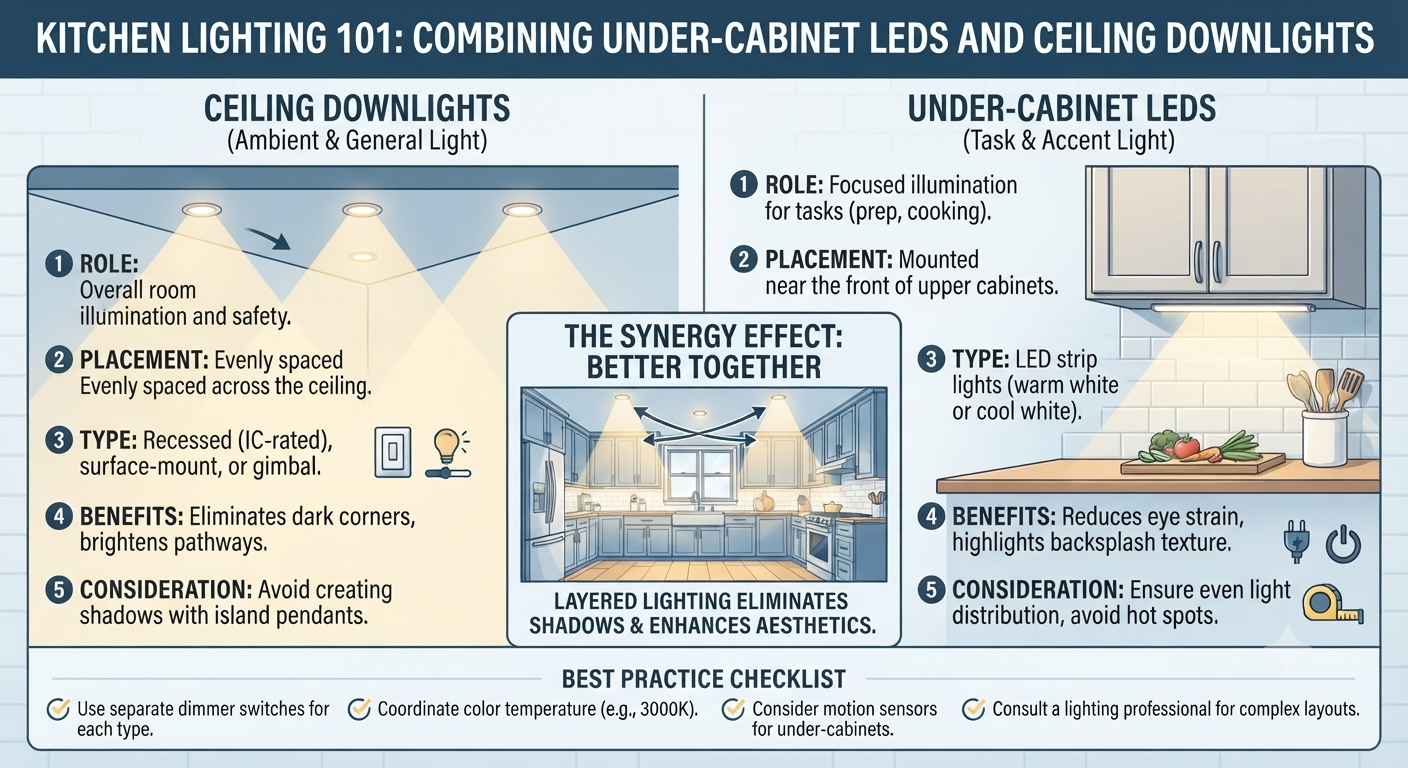
Kitchen lighting works best when it is designed in layers.
A typical lighting plan includes
Ambient lighting – General illumination for the entire kitchen.
Task lighting – Focused light for food preparation and other activities.
Accent lighting – Decorative light that highlights architectural features.
Cabinet lighting – Illumination inside or beneath cupboards.
Ceiling fixtures provide general lighting, but they don't always illuminate countertops effectively.
Imagine standing at your kitchen counter with a ceiling light directly behind you. Your body blocks some of the light, and the upper cabinets prevent it from reaching the work surface.
The result is a shadow exactly where you need clear visibility.
Installing lights under cupboards moves the light source closer to the countertop. Instead of relying entirely on ceiling-mounted fixtures, you're putting illumination where the work actually happens.
This is the fundamental reason under-cabinet lighting is so effective.
The Best Types of Lights for Kitchen Cupboards
There isn't one universal type of cupboard lighting.
The most common options include
- LED strip lights
- LED puck lights
- Linear LED bars
- Recessed LED fixtures
- Motion-activated cabinet lights
- Rechargeable battery-powered LEDs
- Smart LED lighting
Each has different strengths.
Lighting Type
- Best For
- Main Advantage
- Potential Limitation
- LED Strip
- Continuous countertop lighting
- Even illumination
- Requires careful installation
- LED Puck
- Individual cabinet sections
- Easy to position
- Can create bright spots
- LED Bar
- Long countertops
- Uniform light distribution
- Less discreet than strips
- Recessed LED
- Custom cabinetry
- Clean appearance
- Requires precise installation
- Motion Sensor
- Pantry and cabinets
- Automatic operation
- Sensor placement matters
- Rechargeable LED
- Rental or retrofit
- No wiring required
- Requires recharging
- Smart LED
- Connected kitchens
- Remote control and automation
- Higher cost and complexity
For most permanent kitchen installations, under cabinet LED lighting is one of the most versatile choices.
Under Cabinet LED Strip Lighting
LED strip lighting is one of the most popular solutions for modern kitchens.
The strip consists of small LEDs mounted along a flexible circuit board. It can be installed beneath cabinets, inside shelves, or along cabinet edges.
The biggest advantage is continuity.
Instead of individual points of light, a properly installed LED strip can create a long, even line of illumination across the entire countertop.
This is particularly useful for
- Long countertops
- Kitchens with multiple cabinets
- Open shelving
- Modern minimalist designs
- Large work surfaces
- Advantages
- Even light distribution
- Low-profile design
- Flexible installation
- Available in different color temperatures
- Dimmable options available
- Easy to customize to different lengths
- Potential Drawbacks
- Requires a suitable power supply
- Exposed strips may look unfinished
- Poor-quality strips can develop uneven brightness
- Adhesive backing may fail over time
For the best appearance, install the strip inside an aluminum LED profile with a diffuser.
The profile provides
- Better heat dissipation
- Physical protection
- A cleaner appearance
- More consistent light distribution
It also helps prevent the individual LED points from being visible.
LED Puck Lights
Puck lights are small, round fixtures that resemble hockey pucks.
They are commonly installed underneath cabinets to provide localized illumination.
Puck lights work particularly well when you want
- Individual lighting zones
- Accent illumination
- A decorative appearance
- Easy installation
However, spacing is important.
If puck lights are installed too far apart, the countertop may have bright circles separated by darker areas.
For general task lighting, continuous LED strips or linear fixtures often provide more uniform results.
Puck lights can still be excellent for highlighting specific areas, such as
- A sink
- A coffee station
- A breakfast counter
- A display shelf
- Linear LED Bars
Linear LED bars are rigid fixtures designed to provide continuous illumination beneath cabinets.
They combine some of the advantages of LED strips with the physical durability of a traditional fixture.
They are often a good option when you want
- Easy installation
- Consistent light output
- A professional appearance
- Simple replacement
- Long, straight runs
Unlike flexible strips, rigid LED bars maintain their shape and are less likely to sag or peel away from the cabinet.
They are particularly useful for kitchens where you want a straightforward retrofit without cutting or modifying cabinetry.
Recessed Under-Cabinet Lighting
For custom kitchens, recessed LED fixtures can provide an extremely clean appearance.
The light source can be integrated into the underside of the cabinet, reducing the visible profile.
This works especially well in
- High-end kitchens
- Custom cabinetry
- New construction
- Complete kitchen renovations
The downside is installation complexity.
You may need
- Precise cutouts
- Concealed wiring
- Access to the cabinet structure
- Professional electrical installation
If you're renovating the kitchen, this is an ideal time to plan recessed under counter lighting.
Motion-Activated Cabinet Lighting
Motion sensors can make cupboard lighting extremely convenient.
Open a cabinet door, walk into a pantry, or approach a countertop, and the light turns on automatically.
This is particularly useful for
- Pantry cabinets
- Deep storage
- Utility cupboards
- Kitchens used frequently at night
- There are two main approaches
- Door-Activated
The light turns on when the cabinet door opens.
Motion-Activated
The light responds when movement is detected.
For under-cabinet lighting, motion sensors can be useful when you want low-level nighttime illumination without switching on the entire kitchen.
Rechargeable Under-Cabinet Lights
Rechargeable LED lights are useful when installing permanent wiring isn't practical.
They can be installed without opening walls or cabinets, making them suitable for
- Rental properties
- Temporary installations
- Small kitchen upgrades
- Areas without nearby electrical access
The trade-off is maintenance.
Rechargeable batteries eventually need to be recharged, and battery-powered fixtures may not provide the same continuous output as a mains-powered LED system.
For a permanent kitchen renovation, hardwired or properly concealed low-voltage systems are generally the better long-term solution.
Choosing the Right Brightness
Brightness is one of the most important considerations when choosing lights for kitchen cupboards.
Don't select fixtures based solely on wattage.
Instead, look at
- Lumens
Lumens measure the total amount of visible light produced by a light source.
For under-cabinet task lighting, the required brightness depends on
- Countertop color
- Countertop material
- Kitchen size
- Cabinet depth
- Distance between light and work surface
- Ambient lighting
- Personal preference
Dark countertops often absorb more light, while light-colored surfaces reflect it.
A practical approach is to use dimmable lighting.
Start with enough output for food preparation and other tasks, then reduce the brightness when you want a softer evening atmosphere.
How Many Lumens Do You Need for Under-Cabinet Lighting?
There is no single lumen value that works for every kitchen.
As a general starting point, many residential under-cabinet applications work well with approximately 200–500 lumens per linear meter, depending on the fixture efficiency, mounting position, countertop finish, and desired illumination level.
For a kitchen that requires strong task lighting, you may want a higher-output system.
For decorative or ambient lighting, less may be sufficient.
The important factor is the light reaching the countertop, not simply the total lumen rating printed on the packaging.
Pro Tip
If you are comparing two LED strips, don't automatically choose the one with the highest wattage.
Check
- Lumens per meter
- LED density
- Color rendering
- Power consumption
- Heat management
- Diffuser compatibility
A high-quality, efficient strip can deliver excellent countertop illumination without excessive energy consumption.
Color Temperature: Warm White or Neutral White?
The color temperature of your kitchen lighting can dramatically affect its appearance.
For most kitchens, a practical range is
- 3000K–4000K
- 2700K–3000K: Warm White
Creates a cozy atmosphere.
Best for
- Traditional kitchens
- Wooden cabinets
- Evening lighting
- Decorative applications
Warm light can make wood tones and warm-colored surfaces look richer.
3500K–4000K: Neutral White
A popular choice for task lighting.
It provides a cleaner appearance while avoiding the distinctly blue appearance associated with high-Kelvin daylight lighting.
Suitable for
- Modern kitchens
- Food preparation
- Countertops
- General task lighting
- 5000K–6500K: Daylight
Creates a crisp, cool appearance.
It may be suitable for specific commercial or task-oriented environments but can feel overly harsh in some residential kitchens.
For most homes, 3000K or 4000K is a strong starting point.
Don't Forget CRI
CRI, or Color Rendering Index, is particularly important in kitchens.
Why?
Because kitchens contain food, vegetables, meat, fruit, wood, stone, and other materials where accurate color appearance matters.
A low-quality LED may make colors appear dull or unnatural.
For kitchen under cabinet LED lighting, consider
- CRI 80+ for general use
- CRI 90+ for premium color rendering
- High-CRI lighting can make
- Fresh vegetables look more natural
- Meat appear more accurate
- Countertop colors look closer to reality
- Cabinet finishes appear richer
If you've invested heavily in attractive countertops or cabinetry, good CRI is worth considering.
Avoid Glare on Countertops
More light isn't always better.
A poorly positioned LED strip can create uncomfortable glare, particularly when the countertop is made from:
Polished granite
- Quartz
- Glossy marble
- Glass
- High-gloss laminate
The reflected image of the LED source can become distracting.
To reduce glare
- Use a diffuser
- Position the light toward the front of the cabinet
- Choose a wider beam distribution
- Avoid directly exposing bare LED points
- Use dimming when appropriate
A professional installation should illuminate the work surface without making the light source itself visually uncomfortable.
Where Should Under-Cabinet Lights Be Installed?
Positioning makes a significant difference.
If the light is installed too far toward the wall, the front edge of the countertop may remain relatively dark.
If it's installed too far forward, you may see the light source directly.
For many kitchens, positioning the light approximately 50–75% of the way from the wall toward the front edge of the cabinet can provide a good starting point.
However, the ideal position depends on the cabinet depth, fixture optics, and countertop design.
The goal is to illuminate the entire work surface evenly.
Under Cabinet Lighting for Different Kitchen Areas
- Countertops
Use continuous LED strips or linear LED bars.
Prioritize
- Uniformity
- Good CRI
- Appropriate brightness
- Low glare
- Sink Area
Use brighter task lighting if the sink is positioned under cabinets.
Make sure the fixture is appropriately protected if exposed to moisture.
Kitchen Island
- The island may not have overhead cupboards, so consider
- Pendant lighting
- Recessed ceiling fixtures
- Linear suspended LEDs
- Under-counter LED strips
The island should be treated as its own lighting zone.
Pantry
Motion-activated lighting can be extremely useful.
A door switch or sensor can automatically illuminate the interior when the pantry is opened.
Glass-Front Cabinets
- LED strips or small linear fixtures can highlight
- Glassware
- Decorative dishes
- Collectibles
In this case, the lighting is primarily accent lighting rather than task lighting.
Under-Counter Lighting for Kitchen Islands
The term under counter lighting can refer to several different applications.
For a kitchen island, you may want to install LED lighting beneath the countertop overhang.
This can create a subtle floating effect.
It works particularly well with
- Stone countertops
- Quartz
- Waterfall islands
- Modern cabinetry
Low-level LED strips installed beneath the overhang can provide a soft architectural glow.
This is not a replacement for task lighting, but it can add another layer to the overall lighting design.
For the best result, use a separate dimming circuit so you can control task lighting and decorative lighting independently.
Dimmable Under Cabinet LED Lighting
Dimming is one of the most valuable features you can add to kitchen lighting.
During food preparation, you might want
- 100% brightness
- During dinner
- 50–70% brightness
- Late at night
- 10–20% brightness
This flexibility means the same lighting system can serve multiple purposes.
However, dimming compatibility must be checked carefully.
For mains-powered systems, the LED driver must be compatible with the dimmer.
For low-voltage LED strips, the power supply and controller must support the selected dimming method.
Possible control methods include
- TRIAC
- 0–10V
- PWM
- DALI
- Smart wireless control
The correct system depends on the electrical architecture of the project.
12V vs. 24V LED Strip Lighting
Low-voltage LED strips commonly operate at 12V or 24V.
12V Systems
- Advantages
- Widely available
- Suitable for shorter runs
- Easy to source
- Potential limitation
Voltage drop can become noticeable over longer distances.
24V Systems
- Advantages
- Better suited to longer continuous runs
- Lower current for the same power
- Often improved voltage-drop performance
For larger kitchens with long cabinet runs, 24V systems can be an excellent choice.
However, the power supply must be correctly sized.
Calculating the LED Power Supply
- Suppose you have an LED strip rated at
- 10W per meter
- And you need
- 6 meters
- The theoretical load is
- 10W × 6 = 60W
You should not select a 60W power supply and run it continuously at its absolute maximum rating.
A practical approach is to provide a reasonable operating margin.
For example, a supply around 75W–80W could be considered, depending on the manufacturer's recommendations and actual operating conditions.
The exact margin should follow the LED strip and power-supply manufacturer's specifications.
The power supply should also be installed in a location with adequate ventilation and accessible for maintenance.
Voltage Drop in Long LED Strip Runs
Voltage drop is a common problem in under-cabinet LED installations.
If a long LED strip is powered from only one end, the voltage can decrease along the length of the strip.
You may notice
- The far end becoming dimmer
- Uneven brightness
- Color variation
- This is more likely with
- Long runs
- High-power strips
- Lower-voltage systems
- Thin conductors
- Possible solutions include
- Using 24V LED strips
- Shortening individual runs
- Powering from multiple points
- Using appropriately sized wiring
- Installing separate power feeds
A professional installer should design the wiring based on the total load and run length.
Aluminum Profiles: A Small Upgrade With a Big Impact
If you're installing permanent under cabinet LED lighting, aluminum profiles are worth considering.
The profile serves two purposes.
Thermal Management
LED strips generate heat.
Aluminum helps transfer heat away from the LEDs.
This can support better long-term performance and reduce thermal stress.
Better Appearance
A diffuser can soften the light and hide individual LED points.
This creates a continuous, professional appearance.
For high-end kitchens, the combination of
- LED strip + aluminum profile + diffuser
is one of the best ways to achieve a clean result.
How to Hide the Wiring
Good lighting can be ruined by visible cables.
During a kitchen renovation, plan the wiring before cabinets are installed.
Options include
- Concealed low-voltage cables
- Channels inside cabinets
- Cable management tracks
- Recessed power supplies
- Junction boxes in accessible locations
Avoid permanently burying inaccessible power supplies behind finished cabinetry.
Drivers and power supplies can eventually fail, and future maintenance should be possible without dismantling the kitchen.
Hardwired vs. Plug-In Under-Cabinet Lighting
- Hardwired
- Best for
- New kitchens
- Major renovations
- Permanent installations
- Advantages
- Clean appearance
- No visible plugs
- Integrated control
- Disadvantages
- More complex installation
- Usually requires qualified electrical work
- Plug-In
- Best for
- Retrofit projects
- Rental properties
- Simple installations
- Advantages
- Easy installation
- Lower initial complexity
- Disadvantages
- Visible cables
- Less integrated appearance
- Low-Voltage Plug-In
A useful middle ground.
The mains connection is located at the power supply, while low-voltage wiring runs to the LED fixtures.
This can provide a clean installation without requiring mains voltage wiring throughout the cabinetry.
Smart Kitchen Cupboard Lighting
Smart lighting systems can make your kitchen more flexible.
Depending on the system, you may be able to
- Turn lights on remotely
- Dim them
- Schedule operation
- Change color temperature
- Integrate with voice assistants
- Create automatic scenes
- A practical setup might include
- Morning: 4000K, bright
- Dinner: 3000K, medium brightness
- Late night: Warm, low-level illumination
This is particularly useful when combined with tunable-white LED strips.
For many kitchens, adjustable white light is more practical than RGB color-changing LEDs.
Best Lighting Approach for Different Kitchen Styles
- Modern Minimalist Kitchen
- Consider
- 4000K neutral white
- Recessed LED strips
- Aluminum profiles
- Diffusers
- Hidden wiring
- Traditional Kitchen
- Consider
- 2700K–3000K warm white
- Puck lights
- Warm LED strips
- High CRI
- Luxury Kitchen
- Consider
- CRI 90+
- Continuous LED strips
- Recessed profiles
- Multiple lighting zones
- Smart dimming
- Rental Kitchen
- Consider
- Rechargeable LED bars
- Adhesive LED strips
- Plug-in fixtures
Choose products that can be removed without damaging cabinets.
Common Under-Cabinet Lighting Mistakes
- Using Only Ceiling Lights
This creates shadows on countertops.
Installing Lights Too Far Back
The front edge of the work surface remains dark.
Choosing Excessively Cool Light
6500K may feel harsh in a warm residential kitchen.
Ignoring CRI
Low-quality LEDs can make food and surfaces look unnatural.
Using Bare LED Strips
Visible LED points can look unfinished.
Oversizing the Power Supply Without Proper Planning
The power supply must be correctly matched to the LED system.
Forgetting Voltage Drop
Long LED strips may experience uneven brightness.
Hiding Drivers Permanently
Leave access for future maintenance.
Using Too Much Light
Overly bright countertop lighting can create glare, particularly on polished surfaces.
A Practical Kitchen Lighting Plan
- For a typical kitchen renovation, consider combining several layers
- Layer 1: General Lighting
Use ceiling downlights or a central fixture for overall illumination.
Layer 2: Under-Cabinet Task Lighting
Install continuous under cabinet LED lighting above work surfaces.
Layer 3: Island Lighting
Use pendants or recessed fixtures above the island.
Layer 4: Accent Lighting
Illuminate glass cabinets, shelves, or architectural details.
Layer 5: Toe-Kick Lighting
Add low-level LEDs beneath cabinets for a subtle nighttime effect.
The key is independent control.
If every light turns on simultaneously, you lose much of the flexibility that layered lighting provides.
Frequently Asked Questions
- What are the best lights for kitchen cupboards?
For most kitchens, continuous LED strips or linear LED bars are excellent choices for under-cabinet task lighting. They provide even illumination across the countertop and can be installed in aluminum profiles with diffusers for a professional appearance. Puck lights are useful when localized or decorative lighting is preferred.
What color temperature is best for under-cabinet LED lighting?
For most residential kitchens, 3000K–4000K is a practical range. 3000K provides a warmer appearance, while 4000K offers a cleaner, more neutral look. Choose based on your kitchen's existing lighting, cabinet colors, and personal preference.
How bright should lights under cupboards be?
The ideal brightness depends on countertop material, cabinet design, and the purpose of the lighting. As a general starting point, approximately 200–500 lumens per linear meter can work for many residential applications, with higher outputs used when stronger task lighting is needed. Dimmable fixtures provide the greatest flexibility.
Are LED strips good for under-counter lighting?
Yes. LED strips are among the most versatile options for under counter lighting. They can provide continuous illumination, fit into narrow spaces, and work well with dimmers and smart controls. For the best long-term performance and appearance, consider installing them in an aluminum profile with a diffuser.
Final Takeaway: Put the Light Where You Work
The best kitchen lighting isn't necessarily the lighting with the highest wattage or the greatest number of fixtures.
It's the lighting that puts useful illumination exactly where you need it.
For most kitchens, under cabinet LED lighting is one of the most effective upgrades you can make. Continuous LED strips or linear fixtures can eliminate countertop shadows, improve visibility, and create a polished modern appearance. Warm 3000K lighting can make traditional kitchens feel welcoming, while 4000K neutral white provides a crisp, practical environment for food preparation.
For a professional installation, pay attention to lumens, CRI, color temperature, beam distribution, dimming compatibility, voltage drop, driver quality, and heat dissipation.
And don't forget the details that separate a basic installation from a great one: hide the wiring, use aluminum profiles where appropriate, provide access to drivers, and position the lights toward the working area rather than simply sticking them at the back of the cabinet.
The result should be more than a brighter kitchen.
It should be a kitchen where every countertop, cupboard, and work surface is illuminated exactly where it matters.