bolt Quick Answer (As of 2026)
When shopping for LED lighting, one of the first numbers people look at is wattage. A bulb labeled 9W, 12W, or 15W seems to offer an easy way to compare products. But there is a common problem: wattage tells you how much electricity a bulb uses—no...
When shopping for LED lighting, one of the first numbers people look at is wattage. A bulb labeled 9W, 12W, or 15W seems to offer an easy way to compare products. But there is a common problem: wattage tells you how much electricity a bulb uses—not how much light it produces.
This distinction matters.
A modern 9W LED bulb can potentially produce as much light as an older 60W incandescent bulb, depending on its efficiency and design. Meanwhile, two LED bulbs with exactly the same LED bulb wattage can produce noticeably different amounts of light.
That's why choosing the right LED light bulb wattage starts with understanding lumens, not simply watts.
In this guide, we'll explain how LED wattage works, how it relates to brightness, how many watts you may need for different rooms, and why factors such as lumens, room size, ceiling height, color temperature, beam angle, fixture design, and LED efficiency all matter. We'll also look at practical examples to help you select the right LED wattage without wasting energy—or ending up with a room that feels too dim.
What Does LED Bulb Wattage Actually Mean?
Wattage is a measure of electrical power consumption.
In simple terms, a 10W LED bulb consumes approximately 10 watts of electrical power when operating at its rated conditions.
The wattage does not directly tell you how bright the bulb is.
Brightness is measured in lumens (lm).
This creates an important distinction
- Watts = energy consumption
- Lumens = light output
- Lux = light falling on a surface
- Kelvin (K) = color appearance
- CRI = color rendering quality
Think of it like a car.
Wattage is somewhat like the amount of fuel or energy the system uses. Lumens are closer to the useful output you actually receive. A more efficient system can produce more useful output while consuming less energy.
The same principle applies to LED lighting.
LED Wattage vs. Lumens: The Difference You Need to Know
The most important number to check when buying an LED bulb is generally the lumen rating.
Consider these examples
- LED Bulb Wattage
- Approximate Light Output
- Typical Traditional Equivalent
- 4W–5W
- 350–500 lumens
- 25W–40W incandescent
- 7W–8W
- 600–800 lumens
- 40W–60W incandescent
- 9W–10W
- 800–1,100 lumens
- 60W–75W incandescent
- 12W–13W
- 1,000–1,500 lumens
- 75W–100W incandescent
- 15W–17W
- 1,400–2,000 lumens
- 100W–125W incandescent
- 20W
- 1,800–2,500+ lumens
- 125W–150W+ incandescent
These figures are approximate. Actual performance depends on LED efficiency, driver losses, optical design, diffuser material, and the quality of the LED bulb.
The key point is simple
Do not assume that every 10W LED bulb produces the same amount of light.
One 10W product might produce 800 lumens. Another might produce 1,100 lumens.
That's a significant difference.
Why the Same LED Wattage Can Produce Different Brightness
The efficiency of an LED bulb is generally expressed as lumens per watt (lm/W).
For example
- Bulb A: 10W × 80 lm/W = 800 lumens
- Bulb B: 10W × 100 lm/W = 1,000 lumens
- Bulb C: 10W × 120 lm/W = 1,200 lumens
All three use 10W of electrical power, but Bulb C produces 50% more light than Bulb A in this simplified comparison.
Real-world lamp efficacy is affected by several factors, including
- LED chip efficiency
- Driver efficiency
- Thermal management
- Optical losses
- Diffuser transmission
- Operating temperature
This is why LED light watts should never be considered in isolation.
When comparing two products, look at both
- Wattage + Lumens
- Then calculate the approximate efficacy
- Lumens ÷ Watts = Lumens per Watt
The higher the result, the more light the bulb produces for each watt of electrical power consumed.
How Many LED Watts Do You Need?
There is no single correct answer.
The right LED bulb wattage depends on
- Room size
- Ceiling height
- Wall and ceiling colors
- Fixture design
- Number of bulbs
- Desired brightness
- Type of activity
- Natural daylight
- Beam angle
- Light distribution
- Personal preference
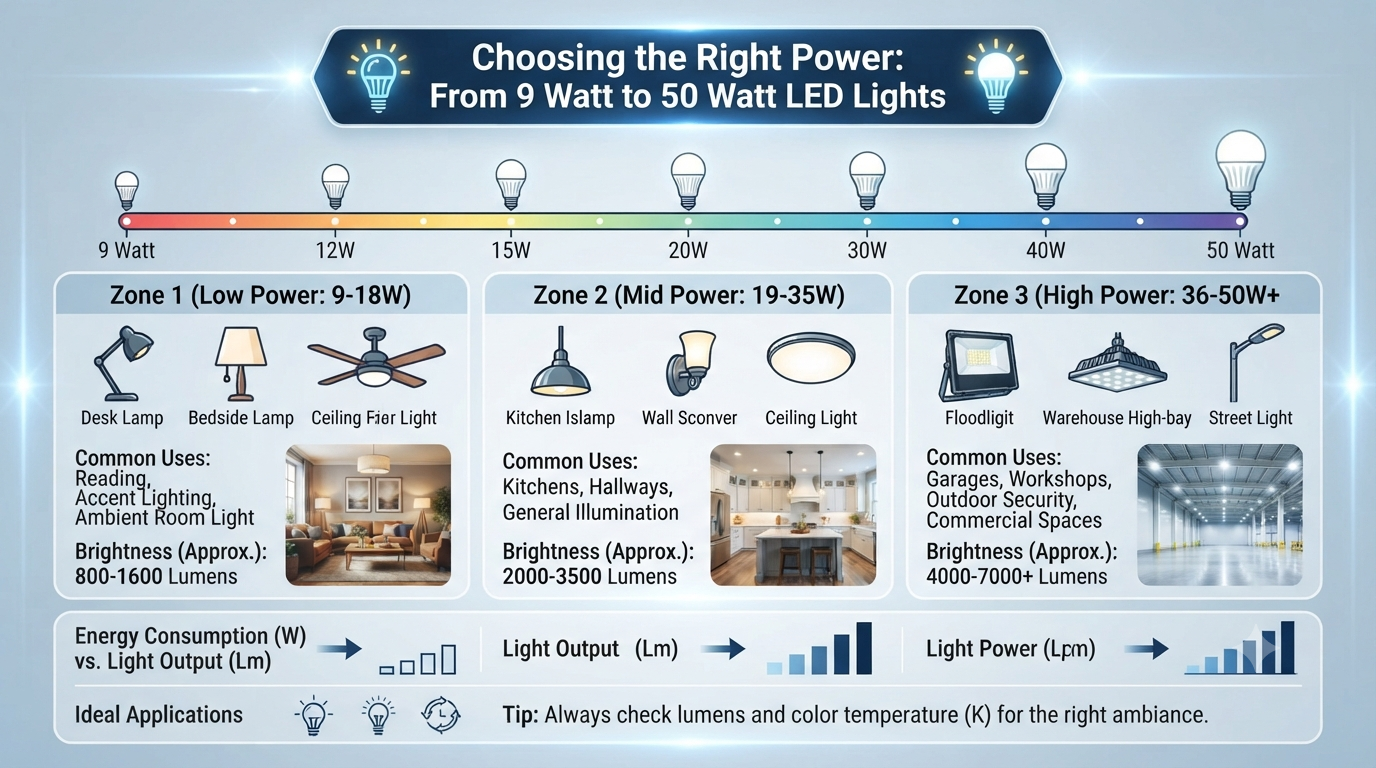
A 9W bulb may be perfect for a bedside lamp but insufficient as the only light source in a large living room.
Similarly, a 20W bulb might be excellent for a workshop but unnecessarily bright for a small bedroom.
The better approach is to determine how many lumens you need and then select an LED wattage that provides those lumens efficiently.
Recommended LED Wattage by Room
The following examples provide a practical starting point for common residential applications.
Bedroom
Bedrooms generally require softer, comfortable lighting rather than extremely high illumination.
For a small or medium bedroom, consider
- 9W–12W LED bulb: General lighting
- 12W–15W: Larger bedroom or brighter preference
- 4W–7W: Bedside or accent lighting
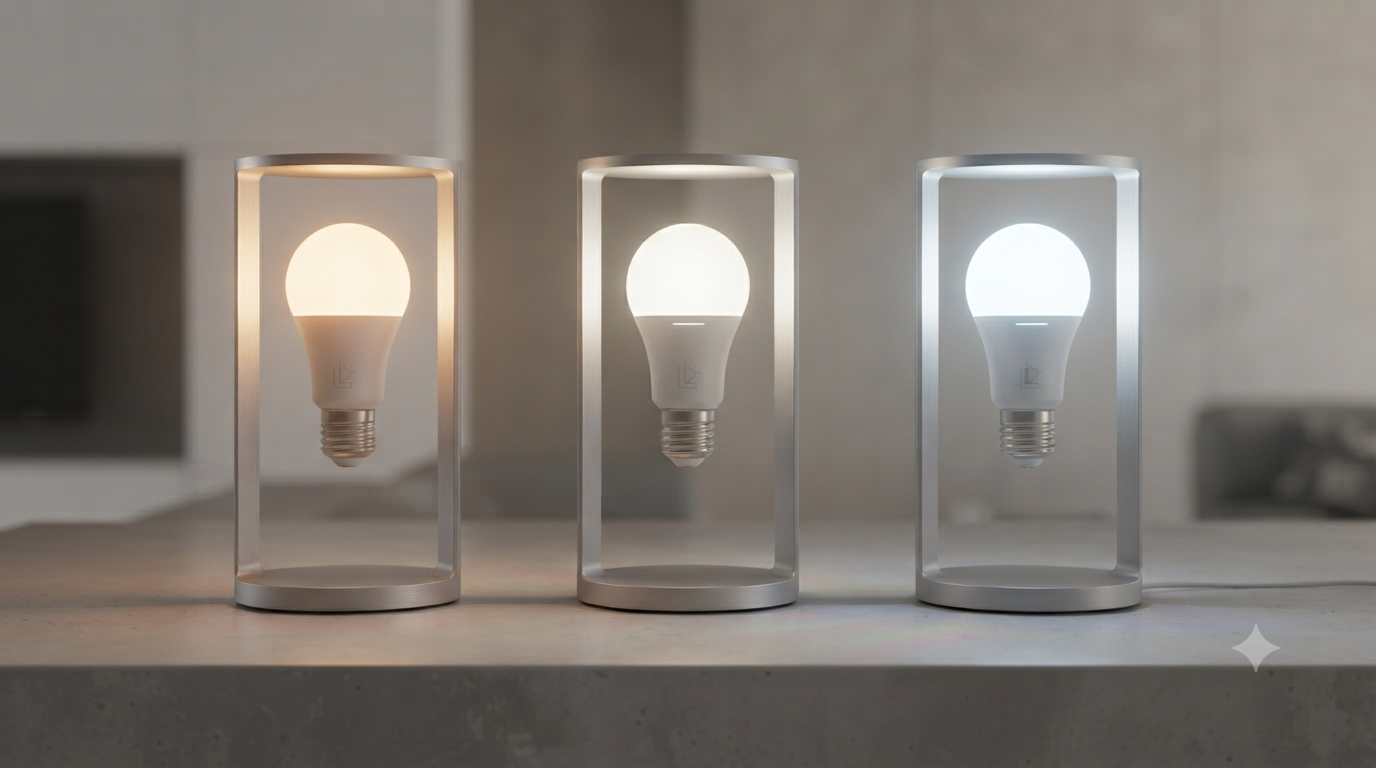
For a typical bedroom, warm white light around 2700K–3000K can create a more relaxed environment.
If the room is large, using multiple lower-wattage bulbs may provide better light distribution than one extremely powerful bulb.
Living Room
Living rooms often require flexible lighting because they are used for multiple activities.
A practical starting point might be
- 9W–12W per bulb: General ambient lighting
- 12W–15W: Higher brightness requirements
- Multiple bulbs for larger rooms
For example, instead of using a single high-output bulb in a large room, a ceiling fixture with three or four appropriately sized LED bulbs may distribute light more evenly.
This can also reduce harsh shadows.
Neutral white around 3500K–4000K can work well for general-purpose living spaces, while warmer light may be preferred for evening use.
Kitchen
Kitchens require more functional lighting because people prepare food, read labels, and work with knives and other tools.
A typical setup might use
- 10W–15W LED bulbs for general lighting
- Additional task lighting under cabinets
- Higher lumen output over work surfaces
For kitchens, 4000K–5000K is often preferred when a clean, crisp appearance is desired.
However, wattage alone isn't enough. The position of the light source matters.
A 12W bulb mounted in the wrong location can leave a countertop in shadow, while several lower-wattage fixtures positioned correctly can provide much better task illumination.
Bathroom
Bathrooms often benefit from bright, even illumination.
A practical starting point is
- 9W–12W: Small bathroom
- 12W–15W: Medium or larger bathroom
- Dedicated mirror lighting for grooming
Neutral white light around 4000K is a popular choice.
For mirror lighting, CRI becomes particularly relevant because accurate color rendering helps with makeup, shaving, and personal grooming.
Always select fixtures and bulbs appropriate for the installation location and local electrical safety requirements, especially in areas exposed to moisture.
Study Room or Home Office
A study or office requires comfortable lighting that supports reading and computer work.
Consider
- 9W–12W: General ambient lighting
- 7W–10W: Desk lamp
- Higher total lumen output for larger workspaces
Neutral white light around 4000K–5000K is commonly selected for work-oriented environments.
Avoid excessive glare. A high-wattage bulb placed directly in the user's field of view can be uncomfortable even if the room technically has enough light.
Garage or Workshop
Workshops and garages generally require higher illumination than bedrooms.
Depending on the size and task
- 15W–20W: General lighting
- 20W–30W+: Larger or high-activity areas
- Multiple fixtures for uniform coverage
For detailed mechanical, electrical, or woodworking tasks, dedicated task lighting may be more effective than simply increasing the LED light bulb wattage.
A Better Way to Choose: Think in Lumens
- Instead of asking
- "How many LED watts do I need?"
- Ask
- "How many lumens do I need?"
- A rough residential guide might look like this
- Room
- Approximate Target Illuminance
- Typical Lighting Character
- Bedroom
- 100–200 lux
- Soft to moderate
- Living Room
- 100–300 lux
- Comfortable, flexible
- Kitchen
- 300–500 lux
- Bright task-oriented
- Bathroom
- 200–500 lux
- Bright and even
- Home Office
- 300–500 lux
- Clear working light
- Workshop
- 500+ lux
- High task illumination
These are broad guidelines rather than universal design requirements. Professional lighting design should consider room dimensions, reflectance, fixture distribution, maintenance factors, and the specific task being performed.
The key concept is that lux measures illumination at a surface, while lumens measure the total light output of the source.
Room Size Matters
Suppose you have a 10 × 12 ft room.
That's 120 square feet of floor area.
If you install one 9W LED bulb producing 800 lumens, the room may feel adequately lit in some circumstances but too dim for tasks requiring focused visibility.
Now consider four 7W bulbs producing 600 lumens each.
Total output
- 4 × 600 = 2,400 lumens
Even though each individual bulb has a relatively modest wattage, the combined system produces significantly more light and distributes it across the room.
Total electrical consumption
- 4 × 7W = 28W
This demonstrates why room lighting should be designed around the total light requirement rather than selecting a single bulb based solely on wattage.
Ceiling Height Changes the Equation
Ceiling height is often overlooked.
A bulb installed on a standard 8–10 ft ceiling will deliver a very different visual result from the same bulb installed on a 15–20 ft ceiling.
As the distance between the light source and the working plane increases
- Light spreads over a larger area
- Illuminance decreases
- Shadows may become more noticeable
- High-ceiling spaces may require
- Higher lumen output
- Narrower beam angles
- More fixtures
- Dedicated high-bay or low-bay lighting
Simply increasing LED wattage is not always the best solution.
The optical design and mounting height must be considered together.
Beam Angle: The Hidden Factor in Brightness
Imagine two 12W LED bulbs, both producing 1,200 lumens.
One has a very wide beam angle.
The other concentrates more of its light into a narrower area.
The total lumen output is the same, but the light distribution is different.
This can change how bright a surface appears.
For general room lighting, wide beam angles can help create uniform illumination.
For accent lighting or high-ceiling applications, narrower beams can concentrate light where it is needed.
This is why professional lighting design considers lumens + beam angle + mounting height, not just LED wattage.
Color Temperature Can Change How Bright a Room Feels
The human eye does not perceive every type of light in exactly the same way.
A cool 6000K light can appear visually brighter and more energetic than a warm 2700K light at similar lumen levels.
However, that does not mean the cool light necessarily provides more measured illumination.
The choice depends on the application.
Warm White: 2700K–3000K
- Best suited to
- Bedrooms
- Restaurants
- Hospitality
- Relaxed living areas
- Neutral White: 3500K–4500K
- Suitable for
- Offices
- Kitchens
- Retail
- General commercial environments
- Cool White / Daylight: 5000K–6500K
- Often used for
- Workshops
- Warehouses
- Garages
- Utility areas
Choose color temperature based on the environment—not simply because a higher Kelvin number sounds brighter.
CRI Matters When Choosing LED Bulbs
Two LED bulbs can produce the same number of lumens and still make a room look different.
The reason is Color Rendering Index (CRI).
CRI describes how accurately a light source reveals colors compared with a reference light source.
For general lighting, CRI 80+ is often adequate.
Higher CRI can be valuable in
- Clothing stores
- Art galleries
- Photography
- Healthcare
- Food displays
- High-end residential interiors
If color appearance matters, don't focus solely on LED light watts.
Check
- Lumens + CRI + Color Temperature
Together, these specifications provide a much better picture of lighting quality.
How to Replace an Old Incandescent Bulb With an LED
Many people still think in terms of traditional wattage.
For example
- 60W incandescent → approximately 800 lumens
A modern LED bulb producing around 800 lumens may consume only about 8W–10W, depending on efficiency.
This means you can achieve a similar amount of light while consuming substantially less electricity.
A simplified comparison
- Traditional Bulb
- Approx. LED Replacement
- Approx. Light Output
- 25W Incandescent
- 3W–5W LED
- 200–450 lm
- 40W Incandescent
- 5W–7W LED
- 400–700 lm
- 60W Incandescent
- 8W–10W LED
- 700–1,100 lm
- 75W Incandescent
- 10W–12W LED
- 1,000–1,400 lm
- 100W Incandescent
- 13W–17W LED
- 1,400–2,000 lm
The exact replacement depends on the actual lumen output of the LED bulb.
This is why it is better to think
- "I need approximately 800 lumens."
- rather than
- "I need a 60W replacement."
- Does Higher LED Wattage Mean Better Quality?
No.
A 20W LED bulb is not automatically better than a 10W bulb.
Higher wattage simply means the product consumes more electrical power.
Quality depends on factors such as
- Luminous efficacy
- LED chip quality
- Driver reliability
- Thermal management
- Power factor
- Surge protection
- CRI
- Color consistency
- Construction quality
A high-quality 10W bulb can be a better product than a poorly engineered 20W bulb.
When purchasing, compare the complete specification rather than assuming that more LED wattage equals better performance.
How Much Electricity Does LED Wattage Use?
One of the biggest advantages of LED lighting is reduced energy consumption.
Suppose you replace a 60W incandescent bulb with a 10W LED bulb.
The power saving per bulb is
- 60W − 10W = 50W
- If the bulb operates for 5 hours every day
- 50W × 5 hours = 250Wh per day
- That's
- 25 kWh per day
- Over one year
- 25 × 365 = 91.25 kWh
Multiply that by 10 bulbs and the energy savings become significantly larger.
This is why choosing the correct LED light bulb wattage can reduce energy consumption without sacrificing useful light output.
Common LED Wattage Mistakes to Avoid
- Mistake 1: Choosing Based Only on Watts
A 12W bulb is not necessarily brighter than a 10W bulb.
Check lumens.
Mistake 2: Using One Very Powerful Bulb
One high-wattage bulb may create harsh shadows.
Multiple lower-wattage bulbs can distribute light more evenly.
Mistake 3: Ignoring Beam Angle
The same lumen output can produce different results depending on how the light is distributed.
Mistake 4: Forgetting the Fixture
An enclosed fixture can trap heat and affect LED performance.
Always verify that the bulb is suitable for the fixture.
Mistake 5: Ignoring Color Temperature
A room may technically have enough light but still feel uncomfortable because the color temperature isn't appropriate.
Mistake 6: Overlooking CRI
For spaces where color matters, brightness alone is not enough.
Practical LED Bulb Wattage Selection Guide
- If you're replacing conventional bulbs, this is a useful starting point
- For a bedside lamp
Choose approximately 4W–7W LED, depending on desired brightness.
For a bedroom ceiling fixture
Consider 9W–12W LED for a typical room, or use multiple bulbs for larger spaces.
For a living room
Consider 9W–15W per bulb, depending on the number of fixtures and room size.
For a kitchen
Consider 10W–15W per bulb, supplemented with dedicated task lighting where needed.
For a home office
Consider 9W–12W for ambient lighting, with additional desk lighting if required.
For a garage
Consider 15W–20W or more, depending heavily on ceiling height, room size, and required illumination.
These figures are starting points, not strict rules. The lumen output and lighting layout ultimately determine the result.
Frequently Asked Questions
- Is a higher LED bulb wattage always brighter?
No. Wattage measures electrical power consumption, not brightness. A 10W LED bulb with high luminous efficacy can produce more light than a 12W bulb with poor efficiency. Always compare lumen output when determining brightness.
What LED wattage replaces a 60W incandescent bulb?
An LED bulb producing approximately 800 lumens is generally considered a comparable replacement for a traditional 60W incandescent bulb. Depending on efficiency, this may require approximately 8W–10W of LED power.
How many LED watts do I need for a bedroom?
For a typical bedroom, a 9W–12W LED bulb may provide suitable general lighting, depending on the bulb's lumen output and the size of the room. Larger rooms may require multiple bulbs or higher total lumen output.
Should I choose LED bulbs by watts or lumens?
Choose primarily by lumens when determining how much light you need, then use wattage to evaluate energy consumption. The ideal bulb provides the required lumen output while using as little electrical power as practical.
Final Takeaway: Choose Light Output First, Wattage Second
Understanding LED bulb wattage changes the way you shop for lighting.
Instead of asking, "How many watts do I need?" start by asking, "How much light does this space actually require?"
Then look at the bulb's lumen output, efficacy, beam angle, color temperature, CRI, and installation environment. Once you know the required light level, select an LED bulb wattage that can deliver those lumens efficiently.
For most applications, the winning formula is simple
Determine the required lumens → choose the right beam distribution → select the appropriate color temperature → verify CRI → then compare LED wattage and energy efficiency.
That approach produces better lighting, avoids unnecessary energy consumption, and helps ensure that your LED bulbs deliver the right amount of light where you actually need it.