bolt Quick Answer (As of 2026)
LED downlights have become one of the most popular ways to create clean, modern, and energy-efficient interior lighting. Unlike traditional ceiling fixtures that hang below the ceiling, recessed lighting sits inside the ceiling structure, creating...
LED downlights have become one of the most popular ways to create clean, modern, and energy-efficient interior lighting. Unlike traditional ceiling fixtures that hang below the ceiling, recessed lighting sits inside the ceiling structure, creating a streamlined appearance with minimal visual clutter.
But choosing the right downlight is more complicated than picking a wattage and cutting a hole in the ceiling.
A successful installation depends on several factors: lumens, beam angle, color temperature, CRI, cutout size, ceiling depth, driver quality, insulation compatibility, dimming performance, and thermal management. Get these details right, and recessed lighting can transform an ordinary room into a comfortable, well-lit space. Get them wrong, and you may end up with glare, dark corners, uneven illumination, flickering, or expensive ceiling repairs.
This guide explains everything you need to know about LED recessed lighting, from choosing the right type of downlight to planning spacing, selecting color temperature, understanding IC-rated fixtures, and avoiding common installation mistakes.
What Are LED Downlights?
LED downlights are ceiling-mounted or recessed LED fixtures designed to direct light downward into a room.
Unlike conventional pendant lights or chandeliers, a recessed downlight is installed within the ceiling, so the visible portion is usually limited to the trim and diffuser.
Depending on the design, a downlight may be
- Fully recessed
- Surface-mounted
- Adjustable or gimbal-style
- Fixed
- Trimless
- Fire-rated
- Dimmable
- Smart-enabled
The term downlights is often used broadly, but technically, different products can have very different installation requirements.
A small 5W recessed spotlight for a hallway is a completely different product from a 20W wide-beam LED downlight used for general room illumination.
Why Choose LED Recessed Lighting?
LED technology has several advantages over older halogen and incandescent recessed fixtures.
Lower Energy Consumption
LEDs can produce significantly more light per watt than traditional incandescent and halogen lamps.
A conventional 50W halogen spotlight, for example, can often be replaced with a substantially lower-wattage LED that provides comparable or better illumination.
Long Operating Life
Quality LED fixtures can operate for tens of thousands of hours under appropriate conditions.
This reduces the frequency of lamp replacement, particularly in locations where changing bulbs is difficult.
Lower Heat Output
LEDs produce much less heat per lumen than incandescent and halogen technology.
However, this does not mean LEDs are completely cool. High-power LEDs still generate heat, and that heat must be managed effectively.
Compact Design
LED technology allows manufacturers to create thin, low-profile fixtures that work well in modern interiors.
Better Control
- LED downlights are available with
- Dimming
- Tunable white
- Color-changing options
- Smart controls
- Motion sensors
- Wireless connectivity
This flexibility makes them suitable for both residential and commercial lighting.
Recessed Lighting vs. Surface-Mounted Downlights
Not every ceiling can accommodate a traditional recessed fixture.
Before choosing down lights LED products, determine whether the ceiling has enough cavity depth.
Feature
- Recessed LED Downlight
- Surface-Mounted LED
- Installation
- Inside ceiling
- On ceiling surface
- Appearance
- Minimal and streamlined
- More visible
- Ceiling Cavity
- Usually required
- Not required
- Suitable for Concrete Ceiling
- Often difficult
- Usually easier
- Visual Impact
- Very low
- Moderate
- Maintenance Access
- Depends on design
- Generally easier
- Best For
- False ceilings, suitable joist spaces
- Concrete or shallow ceilings
If you're installing lighting in a concrete slab ceiling, traditional recessed fixtures may require extensive structural work.
In such cases, surface-mounted LED fixtures or ultra-thin recessed systems may be more practical.
Understanding LED Downlight Wattage
Wattage is one of the first specifications people look at, but it shouldn't be the only one.
A typical residential downlight might consume
- 5W
- 7W
- 9W
- 12W
- 15W
- 18W
- 20W
The correct choice depends on the required lumen output.
For example
- LED Power
- Approx. Output at 100 lm/W
- Possible Application
- 5W
- 500 lumens
- Hallways, accent lighting
- 7W
- 700 lumens
- Small rooms
- 9W
- 900 lumens
- General residential lighting
- 12W
- 1,200 lumens
- Medium rooms
- 15W
- 1,500 lumens
- Larger rooms
- 18W
- 1,800 lumens
- Large rooms or commercial spaces
- 20W
- 2,000 lumens
- High-output applications
These are simplified examples. Actual fixture output can vary depending on LED efficiency, driver losses, diffuser performance, thermal conditions, and optical design.
Pro Tip
When comparing two LED downlights, don't assume that a 12W fixture is automatically better than a 9W fixture.
Check the delivered lumen output.
A high-efficiency 9W downlight may provide similar light to a poorly designed 12W model while consuming less electricity.
Lumens Matter More Than Watts
If you're replacing old halogen downlights, you may be tempted to buy an LED based on wattage equivalence.
That's not always the best approach.
Instead, ask
- How many lumens does the existing fixture provide?
Then select an LED downlight that delivers the required light output.
For example, if an old 50W halogen produces approximately 500–700 lumens, a modern 7W–9W LED may provide similar or better useful light, depending on the fixture design.
The actual comparison should consider the entire fixture, not just the LED chip.
Beam Angle: The Specification That Changes Everything
Two LED downlights with identical wattage and lumen output can produce completely different lighting results because of beam angle.
Narrow Beam
- Typically used for
- Accent lighting
- Artwork
- Retail displays
- Feature walls
The light is concentrated into a smaller area.
Medium Beam
- Suitable for
- General residential lighting
- Kitchens
- Offices
- Corridors
- Wide Beam
- Useful for
- General ambient illumination
- Large rooms
- Low ceilings
- Even light distribution
A common mistake is installing narrow-beam downlights too far apart.
The result?
Bright circles on the floor with dark areas between them.
For general room lighting, wider beam angles often provide better uniformity.
How Far Apart Should LED Downlights Be?
- There is no universal spacing rule because the correct distance depends on
- Ceiling height
- Beam angle
- Fixture lumen output
- Room dimensions
- Wall reflectance
- Desired illuminance
- Type of activity
A practical starting point for many residential installations is to space downlights approximately 1.2–2 meters apart, but this should be treated as a planning guideline rather than a fixed engineering rule.
The distance from the wall also matters.
If downlights are installed too close to walls, you may create excessive brightness or "scalloping."
If they're too far away, the walls may appear dark and the center of the room may become disproportionately bright.
Professional Approach
For commercial and high-quality residential projects, use a lighting calculation or photometric simulation.
The goal is not simply to install an equal number of fixtures.
The goal is to achieve appropriate
- Average illuminance
- Uniformity
- Glare control
- Visual comfort
- How Many LED Downlights Do You Need?
A simple planning method is to estimate the total lumen requirement.
For example
- Room area × Target illuminance = Approximate lumens required
- Suppose a room is
- 5m × 4m = 20m²
- If you target approximately 150 lux
- 20 × 150 = 3,000 lumens
- If each downlight delivers 750 lumens
- 3,000 ÷ 750 = 4 downlights
This is only a simplified calculation.
Real installations require consideration of
- Light loss
- Room surface reflectance
- Ceiling height
- Fixture distribution
- Maintenance factors
- Uniformity
In practice, you might install five or six lower-output fixtures rather than four high-output fixtures to achieve better distribution.
Color Temperature: Warm White, Neutral, or Daylight?
The color temperature of your LED recessed lighting dramatically affects the atmosphere of a room.
2700K–3000K: Warm White
- Best for
- Bedrooms
- Living rooms
- Dining rooms
- Hospitality environments
Creates a warm, relaxed atmosphere.
3500K–4500K: Neutral White
- Best for
- Kitchens
- Bathrooms
- Offices
- General commercial areas
Provides a balanced appearance.
5000K–6500K: Daylight
- Best for
- Workshops
- Garages
- Utility spaces
- Certain industrial environments
Creates a crisp, cool appearance.
For most homes, 2700K–3000K is popular in living areas, while 3500K–4000K is often practical for kitchens and functional spaces.
CRI: Don't Overlook Color Rendering
CRI, or Color Rendering Index, describes how accurately a light source reveals colors compared with a reference light source.
For general residential applications, CRI 80+ is commonly acceptable.
For areas where color accuracy matters, consider
- CRI 90+
- High-CRI downlights can be especially useful in
- Kitchens
- Art studios
- Clothing stores
- Makeup areas
- Galleries
- Retail displays
A high-CRI light can make fabrics, food, wood, and skin tones appear more natural.
Pro Tip
If you are designing a kitchen with expensive countertops and cabinets, don't focus only on wattage and Kelvin.
Ask about CRI and R9 performance.
Strong R9 performance is particularly relevant for rendering saturated red tones, which can affect the appearance of skin, food, and certain materials.
Fixed vs. Adjustable LED Downlights
The right type depends on your lighting objective.
Fixed Downlights
The light points directly downward.
Best for
- General ambient lighting
- Hallways
- Bedrooms
- Living rooms
- Adjustable Downlights
The light direction can be tilted.
Best for
- Artwork
- Feature walls
- Retail displays
- Architectural elements
Adjustable fixtures provide flexibility, but they can create more glare if poorly positioned.
If the fixture is visible from common viewing angles, consider a low-glare design.
Glare: The Hidden Problem With Recessed Lighting
A room can have enough light and still be uncomfortable.
That's because glare matters.
A bright LED source directly visible from a normal viewing position can cause
- Eye discomfort
- Visual fatigue
- Reflections on screens
- Reduced visual performance
- This is particularly important in
- Offices
- Kitchens
- Living rooms with TVs
- Computer workstations
- Look for features such as
- Deep-set LEDs
- Anti-glare reflectors
- Diffusers
- Low UGR designs for commercial applications
The brightest fixture isn't always the best fixture.
LED Downlight Driver Quality
The LED driver converts and regulates electrical power for the LED.
It is one of the most important components in the entire fixture.
A poor-quality driver can cause
- Flickering
- Audible buzzing
- Early failure
- Poor dimming
- Voltage instability
- Reduced LED lifespan
- When purchasing LED recessed lighting, check whether the driver is
- Replaceable
- External or integrated
- Dimmable
- Compatible with your supply voltage
- Properly rated for the fixture
For higher-quality installations, a replaceable external driver can simplify future maintenance.
Dimmable LED Downlights
Dimming can make a lighting system significantly more versatile.
You might want
- Bright lighting while cleaning
- Medium lighting for entertaining
- Low lighting for relaxing
However, not every LED downlight is compatible with every dimmer.
Potential problems include
- Flickering
- Buzzing
- Limited dimming range
- Dropout at low brightness
- Uneven dimming
- Always verify compatibility between
- LED driver + downlight + dimmer
If you are installing a new system, choose the dimming technology first and ensure all components support it.
IC-Rated LED Downlights and Insulation
If the ceiling contains insulation, the fixture's thermal rating becomes critical.
An IC-rated (Insulation Contact-rated) fixture is designed for specific installation conditions where insulation may be in contact with the fixture.
Non-IC-rated fixtures may require clearance from insulation to prevent overheating.
Always follow the manufacturer's installation instructions and local electrical codes.
This is not an area for guesswork.
If you're replacing an existing fixture, inspect the ceiling cavity and determine
- Whether insulation is present
- Whether the fixture is IC-rated
- Whether the driver is accessible
- Whether adequate ventilation is available
- Fire-Rated LED Downlights
In some buildings, recessed fixtures may need to maintain the fire resistance of the ceiling assembly.
A fire-rated downlight is designed to help preserve the required fire-resistance performance when installed according to its certification and instructions.
This can be especially relevant in
- Multi-story buildings
- Apartments
- Commercial properties
- Buildings with fire-rated ceilings
Always check local building regulations and use appropriately certified products where required.
Fire rating, IC rating, and IP rating are not interchangeable.
Each addresses a different performance requirement.
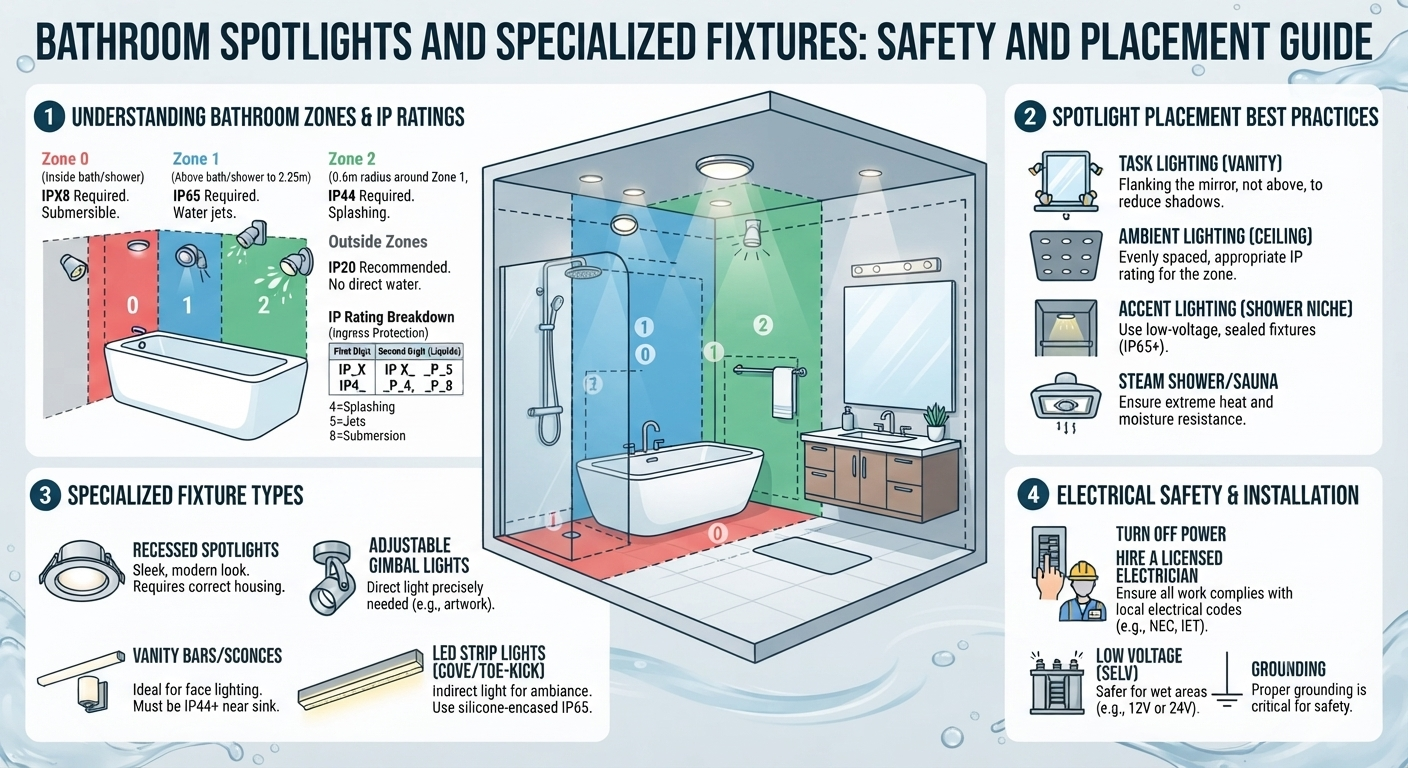
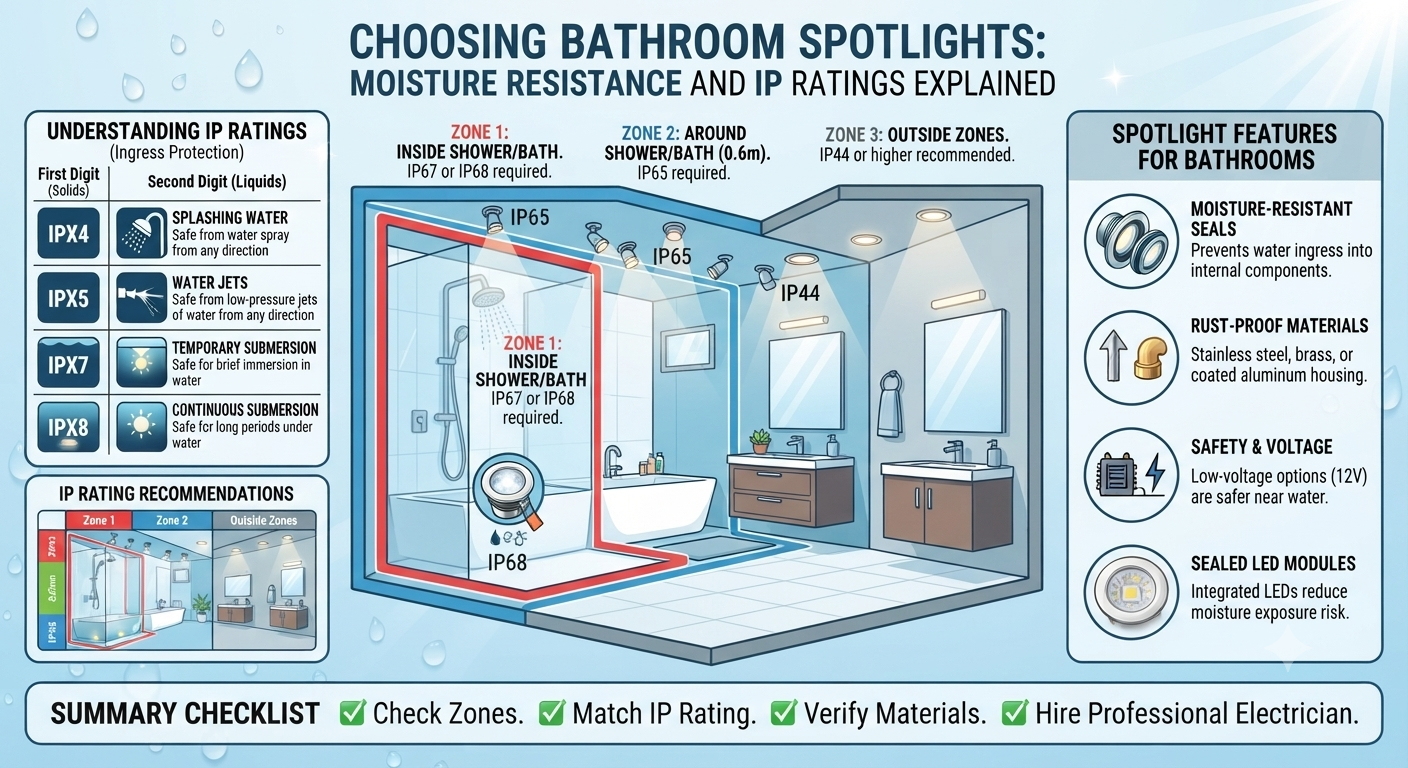
IP Ratings for Bathrooms and Wet Areas
Bathrooms require special consideration.
An IP rating indicates protection against ingress of solids and water.
The correct rating depends on the installation location and local electrical regulations.
Areas directly exposed to water may require higher protection than areas outside splash zones.
Before installing a downlight in a bathroom
Identify the installation zone.
Check local electrical requirements.
Select a fixture with the appropriate IP rating.
Ensure the product is certified for the intended application.
Don't assume that every "water-resistant" downlight is suitable for direct exposure to water.
Can LED Downlights Be Installed in Concrete Ceilings?
Traditional recessed lighting generally requires access to a ceiling cavity.
Concrete ceilings present a different challenge.
Options may include
- Surface-mounted downlights
- Ultra-thin recessed fixtures
- False ceilings
- Specially engineered recessed systems
Cutting into structural concrete is not a routine lighting installation and should not be attempted without proper engineering and authorization.
If you're renovating a concrete-ceiling building, a suspended or false ceiling can provide the cavity needed for recessed lighting without modifying the structural slab.
LED Downlights for False Ceilings
False ceilings are one of the easiest environments for recessed lighting.
They typically provide
- Installation space
- Easy cable routing
- Flexible fixture positioning
- Access to drivers
However, the ceiling material must still be considered.
For example
- Gypsum board
- PVC panels
- Acoustic tiles
- Metal ceiling systems
Each may require different mounting hardware.
Always verify the manufacturer's specified cutout diameter.
Cutout Size vs. Fixture Size
This is one of the most common installation mistakes.
A downlight may have
- Overall diameter: 150mm
- Cutout diameter: 125mm
The ceiling opening must match the specified cutout, not the external diameter.
Never assume that a 6-inch downlight requires a 6-inch hole.
Manufacturers may use different naming conventions.
Before cutting
Measure the fixture.
Confirm the official cutout size.
Check the ceiling cavity depth.
Verify driver clearance.
Mark the position carefully.
A hole that is too large can make the fixture impossible to secure properly.
Integrated vs. Replaceable LED Downlights
There are two common approaches.
Integrated LED
The LEDs are built directly into the fixture.
Advantages
- Compact
- Slim design
- Optimized optical performance
- Easy installation
- Disadvantages
- LED or driver replacement may be more difficult
- Entire fixture may eventually require replacement
- Replaceable LED Lamps
The fixture uses a replaceable LED lamp.
Advantages
- Easy lamp replacement
- Familiar maintenance
- Flexible lamp selection
- Disadvantages
- Larger fixture
- Potentially less compact
- Optical performance depends on lamp and housing combination
For new construction and modern residential projects, integrated LED downlights are increasingly common.
Choosing Between 9W, 12W, 15W, and 18W Downlights
- For many residential projects, wattage selection can be simplified as follows
- 5W–7W
- Good for
- Hallways
- Accent lighting
- Small spaces
- 9W
- Good for
- Bedrooms
- Small rooms
- General lighting
- 12W
- Good for
- Medium rooms
- Kitchens
- Living areas
- 15W–18W
- Good for
- Larger rooms
- Higher ceilings
- Commercial applications
- 20W+
- Good for
- High-output applications
- Commercial spaces
- Large areas
Again, use lumens rather than wattage as your primary performance metric.
Smart LED Recessed Lighting
Modern LED recessed lighting can be integrated with smart-home systems.
Features may include
- Smartphone control
- Voice control
- Scheduling
- Dimming
- Tunable white
- Color changing
- Occupancy sensing
For many homes, tunable white lighting can be more useful than RGB color-changing lighting.
You can adjust from
- Warm 2700K → Neutral 4000K → Cool 6500K
depending on the time and activity.
This provides more practical value for everyday illumination.
How to Plan a Professional Downlight Installation
Before buying fixtures, create a basic lighting plan.
Measure the Room
- Record
- Length
- Width
- Ceiling height
- Identify Activities
- Determine where people
- Sit
- Work
- Cook
- Read
- Walk
- Select Target Illuminance
Different spaces require different light levels.
Calculate Approximate Lumens
- Use
- Area × Target Lux = Required Lumens
- Select Fixture Output
Determine the lumen output of each downlight.
Plan Spacing
Consider beam angle and ceiling height.
Check Ceiling Construction
- Verify
- Cavity depth
- Joist locations
- Insulation
- Fire requirements
- Select Color Temperature
Choose warm, neutral, or daylight based on the application.
Confirm Driver and Dimming Compatibility
Especially important for dimmable installations.
Verify Cutout Dimensions
Do this before cutting the ceiling.
This planning process prevents many expensive installation problems.
Common LED Downlight Installation Mistakes
- Installing Too Many Fixtures
More fixtures don't automatically mean better lighting.
Excessive fixture density can cause glare and unnecessary energy consumption.
Using High-Wattage Fixtures Everywhere
Select the correct lumen output for the space.
Ignoring Beam Angle
A narrow beam can create harsh pools of light.
Installing Fixtures Too Close to Walls
This can create distracting scalloping.
Mixing Color Temperatures
Keep the lighting visually consistent.
Ignoring Driver Quality
A cheap driver can undermine an otherwise excellent LED fixture.
Forgetting Maintenance Access
Think about what happens when the driver eventually fails.
Cutting the Ceiling Before Checking the Cutout
Always confirm dimensions first.
Are LED Downlights Energy Efficient?
Yes, when properly selected and designed.
The efficiency advantage comes from the ability of LEDs to produce substantial light output with relatively low electrical consumption.
But system efficiency depends on the complete fixture.
Consider
- LED chip efficiency + driver efficiency + optical efficiency + thermal performance
- A product with an efficient LED chip can still perform poorly if
The driver wastes excessive energy.
The fixture overheats.
The diffuser absorbs too much light.
This is why reputable manufacturers should publish complete fixture specifications rather than only LED chip performance.
Frequently Asked Questions
- What are LED downlights used for?
LED downlights are used for general ambient lighting, task lighting, accent lighting, and architectural illumination. They are commonly installed in homes, offices, retail stores, hotels, restaurants, and commercial buildings.
How many LED downlights do I need for a room?
The number depends on room size, ceiling height, fixture lumen output, beam angle, and target illuminance. A basic calculation is room area × target lux = required lumens, followed by dividing the required lumens by the output of each fixture. Final layouts should also consider uniformity and glare.
Are LED recessed lights better than traditional downlights?
Modern LED recessed lighting generally offers better energy efficiency, longer operating life, lower maintenance, and greater control options than older halogen and incandescent technologies. However, fixture quality, driver reliability, thermal management, and correct installation still matter.
What color temperature is best for LED downlights?
For living rooms and bedrooms, 2700K–3000K warm white is commonly preferred. Kitchens and offices often work well with 3500K–4500K neutral white. Garages and workshops may benefit from 5000K–6500K daylight. The best choice depends on the space and intended activity.
Final Takeaway: Design the Lighting, Don't Just Install the Fixtures
The best LED downlights are not necessarily the most powerful or the cheapest. A successful recessed lighting system is the result of matching the right fixture to the right application.
Start with the lighting requirement. Then consider lumens, wattage, beam angle, color temperature, CRI, glare, ceiling construction, driver quality, thermal management, and installation requirements.
For residential spaces, warm 2700K–3000K lighting often creates a comfortable atmosphere. Kitchens and offices may benefit from neutral white. Workshops and utility spaces can take advantage of cooler daylight color temperatures.
Above all, plan the layout before cutting the ceiling.
A well-designed LED recessed lighting system should provide consistent illumination, comfortable brightness, controlled glare, and efficient energy use—while blending naturally into the architecture.
The goal isn't to see the downlights.
The goal is to see the space beautifully illuminated.