bolt Quick Answer (As of 2026)
The LED bulb price you see on a retail shelf is the final result of a long chain of costs. Raw materials, LED chips, drivers, housing materials, assembly, testing, packaging, shipping, import duties, distribution margins, and retailer markups all ...
The LED bulb price you see on a retail shelf is the final result of a long chain of costs. Raw materials, LED chips, drivers, housing materials, assembly, testing, packaging, shipping, import duties, distribution margins, and retailer markups all contribute to the amount a customer eventually pays.
That is why two bulbs with the same wattage can have dramatically different prices. A 9W LED bulb selling for a low price may use a basic driver, lower-cost components, a lighter housing, and minimal quality control. Another 9W bulb may cost significantly more because it delivers higher lumen output, uses a better driver, has improved thermal management, offers higher CRI, and carries a longer warranty.
For consumers, understanding these factors makes it easier to judge whether an LED light bulb price represents genuine value. For distributors, retailers, contractors, and lighting brands, it provides a framework for understanding margins and predicting market movements.
This guide examines what actually drives LED bulb prices, how manufacturing costs influence market rates, why prices change over time, and what buyers should consider when comparing products. The goal is simple: to help you distinguish between a genuinely economical LED bulb and a cheap product that may cost more over its lifetime.
What Determines the Price of an LED Bulb?
At a basic level, the final selling price of an LED bulb can be viewed as a combination of several cost layers.
LED Bulb Price = Manufacturing Cost + Logistics + Taxes/Duties + Distribution Margin + Retail Margin
The exact proportions vary by country, product quality, order volume, and brand positioning.
A simplified cost structure may look like this
- Cost Factor
- What It Includes
- Impact on Price
- LED Components
- LED chips, PCB, phosphor
- Medium to High
- Driver
- IC, capacitors, resistors, protection components
- High
- Housing
- Plastic, aluminum, diffuser
- Low to Medium
- Thermal Management
- Heat sink and thermal materials
- Medium
- Manufacturing
- Assembly, testing, labor
- Medium
- Packaging
- Box, printing, labels
- Low to Medium
- Quality Control
- Testing and inspection
- Low to Medium
- Logistics
- Freight, warehousing, delivery
- Variable
- Taxes & Duties
- Import taxes and local charges
- Market-dependent
- Distribution
- Wholesaler and distributor margins
- Variable
- Retail
- Store or e-commerce margin
- Variable
The interesting part is that the visible bulb represents only one stage of the pricing process.
A manufacturer may sell a bulb at one price, a distributor at another, and a retailer at a significantly higher price. The customer therefore needs to understand the difference between factory price, wholesale price, distributor price, and retail price.
LED Chip Costs and Their Effect on LED Bulb Price
The LED chip is a critical component, but buyers should avoid assuming that the most expensive chip automatically produces the best bulb.
What matters is the complete system.
Higher-quality LED packages can provide
- Better luminous efficacy
- Improved color consistency
- Higher color rendering
- Better lumen maintenance
- More predictable performance
- Improved long-term reliability
However, the LED chip is only one part of the equation.
A premium LED chip combined with a poor-quality driver and inadequate thermal management can still result in a disappointing product.
This is why two bulbs with similar LED chip specifications can have different real-world performance and different LED light bulb prices.
What buyers should compare
- When comparing manufacturers, look at
- Lumens per watt
- Total lumen output
- CRI
- Color temperature consistency
- LED package quality
- Rated operating temperature
- Expected lumen maintenance
A 10W bulb producing 1,000 lumens is fundamentally different from a 10W bulb producing 700 lumens, even though both consume the same nominal amount of electricity.
The LED Driver Can Change the Price Significantly
One of the most overlooked factors affecting the LED bulb price is the driver.
The driver regulates electrical power supplied to the LED circuit. Its design influences reliability, flicker, power factor, surge resistance, and overall lifespan.
A basic low-cost bulb may use a simplified driver design to minimize production costs.
A higher-quality bulb may include
- Better-quality capacitors
- Integrated driver ICs
- Surge protection
- Over-voltage protection
- Over-temperature protection
- Improved power factor
- Better electrical isolation
- More robust PCB design
The difference may not be visible from outside the bulb. Yet it can have a major impact on service life.
This is one reason a very cheap LED bulb can appear attractive at the point of purchase but perform poorly over time.
Pro Tip: If you are sourcing LED bulbs in bulk, ask for the driver specification. A manufacturer that discusses only wattage and brightness but cannot explain its driver design may not be offering a product suitable for demanding applications.
Housing Materials and Heat Dissipation
LEDs are more energy-efficient than traditional incandescent lamps, but they still generate heat. That heat must be managed effectively.
The housing can influence
- Thermal performance
- Component lifespan
- Mechanical durability
- Appearance
- Weight
- Manufacturing cost
A basic plastic housing is generally cheaper to manufacture.
An LED bulb with a more advanced aluminum heat sink or thermally optimized structure can cost more, but the additional material may help maintain lower operating temperatures.
This becomes especially relevant in
- Enclosed fixtures
- High-temperature environments
- Commercial installations
- Industrial facilities
- Outdoor applications
If a manufacturer cuts costs by reducing the thermal design, the product may initially look competitive. However, excessive heat can accelerate LED lumen depreciation and driver failure.
So when comparing LED bulb prices, don't ask only, "How much does the bulb cost?"
- Ask
- "What engineering is included in that price?"
- Why LED Bulb Prices Change Over Time
The LED lighting industry has experienced substantial price changes over the years.
Several forces influence these trends.
Manufacturing Scale
As LED lighting became mainstream, production volumes increased dramatically.
Large-scale manufacturing allows factories to
- Automate assembly
- Purchase components in bulk
- Reduce labor costs per unit
- Improve production efficiency
- Spread tooling costs across larger volumes
As manufacturing scale increases, the average production cost can decline.
This is one reason mainstream LED bulbs have become much more affordable compared with their early market years.
Component Prices
- LED bulbs contain multiple electronic components, including
- LED packages
- Driver ICs
- Capacitors
- Resistors
- PCBs
- Connectors
- Plastic housings
- Aluminum components
If the price of electronic components increases, manufacturers may face higher production costs.
However, component pricing does not always move in the same direction. One component may become cheaper while another becomes more expensive.
The final impact depends on the product's bill of materials.
Energy and Labor Costs
Manufacturing facilities consume electricity and require skilled and semi-skilled labor.
Changes in
- Electricity prices
- Wages
- Factory overhead
- Automation
- Production efficiency
can influence manufacturing costs.
Energy-intensive manufacturing is particularly sensitive to electricity price increases, while automation can reduce the labor component of unit costs.
Shipping and Freight
International logistics can have a surprisingly large effect on the final LED light bulb price.
A bulb manufactured overseas may pass through several cost stages before reaching a customer:
Factory → Export Warehouse → International Freight → Port → Customs → Local Warehouse → Distributor → Retailer
Changes in freight rates, fuel prices, container availability, and port congestion can all affect landed costs.
For low-value products such as standard LED bulbs, shipping costs can represent a meaningful percentage of the final product value.
Why Two Identical-Wattage Bulbs Have Different Prices
Consider two 12W LED bulbs.
Product A
- 12W rated power
- 850 lumens
- Basic driver
- CRI 70+
- Minimal surge protection
- Shorter warranty
- Basic thermal design
- Product B
- 12W rated power
- 1,200 lumens
- Higher-quality driver
- CRI 80+
- Better surge protection
- Improved heat dissipation
- Longer warranty
- Both products are labeled "12W LED bulb."
But technically, they are not equivalent.
Product B may have a higher manufacturing cost, and therefore a higher selling price. The buyer is paying for more than electricity consumption. They are paying for performance, reliability, optical quality, thermal engineering, and risk reduction.
This is why comparing LED bulbs only by wattage can be misleading.
Retail vs Wholesale vs Factory LED Bulb Price
Understanding the supply chain is essential when analyzing market rates.
Pricing Level
- Typical Buyer
- Main Cost Consideration
- Factory Price
- Importer / Large Buyer
- Manufacturing and production volume
- Wholesale Price
- Distributor
- Factory cost + logistics + margin
- Distributor Price
- Retailer / Contractor
- Distribution + handling margin
- Retail Price
- Consumer
- Full supply chain + retail margin
- Premium Retail
- Brand-conscious Buyer
- Brand + warranty + support + packaging
The difference between factory and retail pricing can be substantial.
A large importer purchasing 100,000 units may receive a significantly lower per-unit price than a retailer buying 100 pieces.
This is primarily an economy-of-scale effect.
The manufacturer also has lower packaging, handling, and sales costs per unit when fulfilling a large order.
How Wattage Affects LED Bulb Price
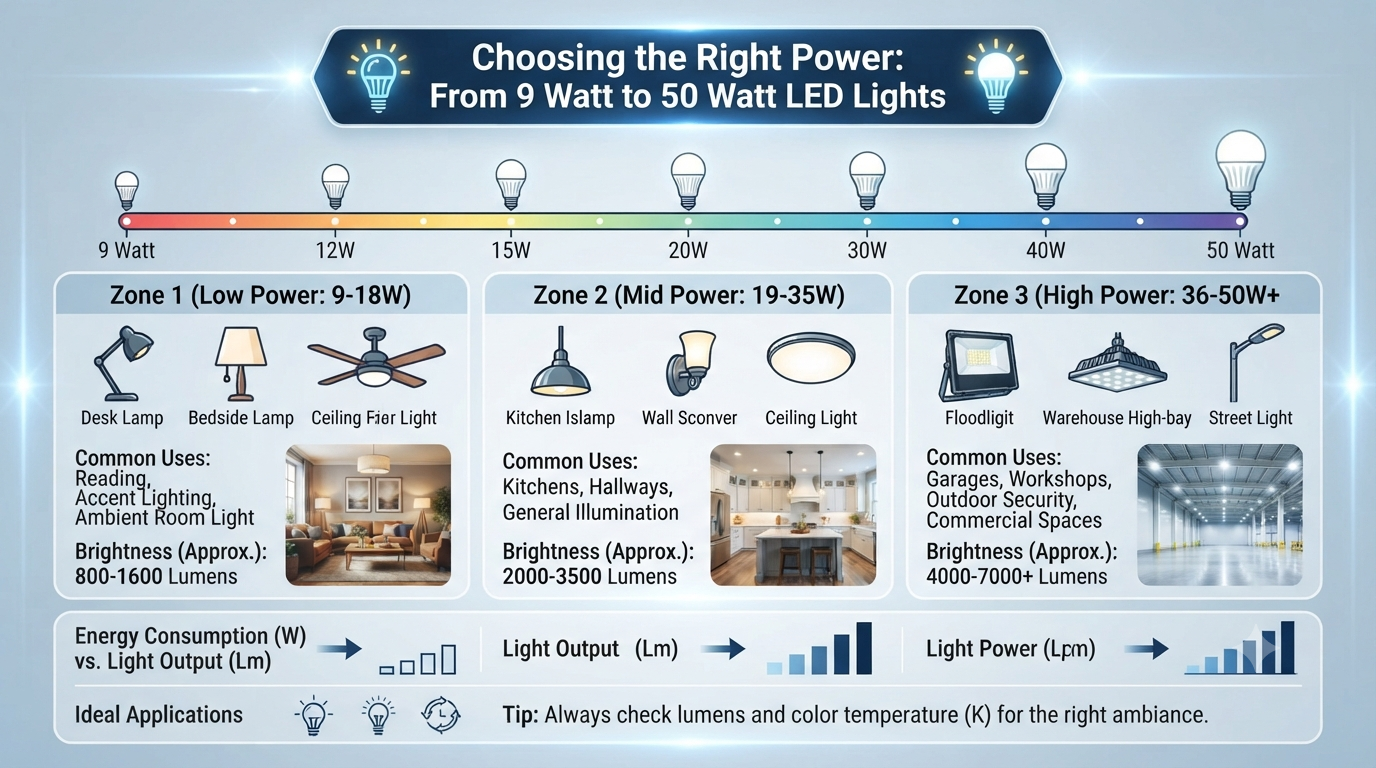
Generally, higher-wattage bulbs require more LED packages, a larger driver, and potentially improved thermal management.
For example
- 5W bulb
- 7W bulb
- 9W bulb
- 12W bulb
- 15W bulb
- 20W bulb
The price generally increases with wattage, but not necessarily in a perfectly linear manner.
A 15W bulb does not always cost exactly 50% more to manufacture than a 10W bulb.
Why?
Because many components are shared.
The packaging, assembly process, testing, and some housing components may remain similar. The main differences may involve the LED board, driver capacity, and thermal design.
This creates opportunities for manufacturers to achieve economies of scale in higher-volume product ranges.
Energy Efficiency Should Be Part of the Price Calculation
The cheapest bulb at the time of purchase may not be the cheapest bulb to operate.
Suppose two LED bulbs produce similar light
- Bulb A: 10W
- Bulb B: 12W
If both operate for 8 hours per day, the 10W product consumes less energy.
Over thousands of bulbs and several years, that difference can become significant.
For commercial buyers, energy efficiency should therefore be evaluated alongside the purchase price.
A useful metric is
- Cost per useful lumen over the product's operating life
This considers not only what the bulb costs to buy, but also how much light it produces and how efficiently it uses electricity.
How to Compare LED Bulb Prices Like a Professional Buyer
When evaluating suppliers, build a comparison table.
Factor
- Supplier A
- Supplier B
- Supplier C
- Wattage
- 10W
- 10W
- 10W
- Lumens
- 800 lm
- 1,000 lm
- 1,100 lm
- Efficacy
- 80 lm/W
- 100 lm/W
- 110 lm/W
- CRI
- 70+
- 80+
- 80+
- Power Factor
- 50
- 90
- 95
- Driver Quality
- Basic
- Standard
- Premium
- Surge Protection
- Limited
- Yes
- Yes
- Warranty
- 1 Year
- 2 Years
- 3 Years
- Unit Price
- Low
- Medium
- High
The objective is not necessarily to choose the lowest price.
The objective is to identify the best price-to-performance ratio.
A commercial buyer might reasonably pay more for a product that delivers
- Higher lumen output
- Better energy efficiency
- Longer service life
- Lower failure rates
- Better warranty support
- Why Brand Positioning Affects LED Light Bulb Price
Not all price differences come from technical specifications.
Brand reputation also influences pricing.
An established lighting brand may invest heavily in
- Product development
- Laboratory testing
- Certification
- Warranty reserves
- Distribution networks
- Customer service
- Marketing
- Packaging
These expenses are reflected in the final product price.
A lesser-known manufacturer may offer a similar specification at a lower price because it has lower overhead.
This does not automatically mean the established brand is better—or that the cheaper product is worse.
The key is to verify actual technical performance.
Pro Tip: Treat brand reputation as one purchasing factor, not the entire purchasing decision. A documented 100 lm/W product with verified testing is more useful than an impressive marketing claim without technical evidence.
Why the Cheapest LED Bulb May Be a False Economy
Ultra-low-priced LED bulbs often achieve their price through cost reductions somewhere in the bill of materials.
Potential compromises include
- Lower-quality capacitors
- Undersized drivers
- Lower-grade LED packages
- Reduced heat dissipation
- Minimal surge protection
- Lightweight housings
- Limited testing
- Shorter warranties
Not every inexpensive bulb has these problems, but unusually low pricing deserves investigation.
A low purchase price becomes less attractive if the bulb fails prematurely.
For businesses, the hidden costs may include
- Product returns
- Replacement shipments
- Technician visits
- Customer complaints
- Lost sales
- Warranty administration
- Brand reputation damage
The real economic comparison should therefore be based on total cost of ownership, not just invoice price.
What to Ask an LED Bulb Supplier Before Buying
- Before placing a significant order, request
- Technical Information
- Rated wattage
- Actual lumen output
- Luminous efficacy
- CRI
- Color temperature
- Beam angle
- Power factor
- Input voltage range
- Reliability Information
- Expected lifespan
- Driver specifications
- Surge protection
- Thermal testing
- Warranty period
- Commercial Information
- MOQ
- Bulk pricing
- Lead time
- Shipping terms
- Packaging options
- OEM/private-label availability
- Quality Documentation
- Product datasheet
- Test reports
- Relevant certifications
- Sample evaluation
A serious supplier should be able to provide clear answers.
What Is a Good LED Bulb Price?
There is no universal answer.
A reasonable LED bulb price depends on
- Wattage
- Lumen output
- LED efficiency
- Driver quality
- Housing design
- CRI
- Brand
- Certification
- Warranty
- Purchase volume
- Country
- Taxes and import duties
- Instead of asking, "What is the cheapest 12W LED bulb?" ask
- "What is the best 12W LED bulb for my required performance and budget?"
That small change in thinking can prevent expensive mistakes.
For a household buyer, a basic 7W or 9W bulb may be perfectly adequate.
For a factory operating thousands of lamps every day, efficiency, surge protection, thermal performance, and service life may matter far more than saving a small amount on each bulb.
Frequently Asked Questions
- Why do LED bulb prices vary so much?
LED bulb prices vary because products use different LED chips, drivers, housing materials, thermal designs, quality-control procedures, warranties, and certifications. Supply-chain costs, brand positioning, order quantities, taxes, and distribution margins also influence the final price.
Does a higher LED light bulb price mean better quality?
Not always. A higher price can reflect better components and engineering, but it can also reflect branding, packaging, or higher distribution margins. Compare technical specifications such as lumens, efficacy, CRI, driver quality, power factor, warranty, and testing before deciding.
Why has the price of LED bulbs decreased over the years?
Greater manufacturing scale, improved automation, increased competition, better LED technology, and more efficient supply chains have helped reduce production costs for many mainstream LED products. However, premium products with advanced drivers, high CRI, smart controls, or specialized thermal designs can still command higher prices.
How can I get the best LED bulb price for bulk orders?
Request quotations from multiple manufacturers, provide a precise product specification, and compare landed costs rather than unit prices alone. Larger quantities can reduce production and packaging costs, but you should also evaluate warranty terms, quality consistency, shipping, and payment conditions.
Final Takeaway: Look Beyond the Sticker Price
The LED bulb price is the result of much more than the number printed on a supplier's quotation. LED chips, drivers, thermal management, manufacturing processes, testing, logistics, taxes, distribution, and retail margins all contribute to the final amount.
For consumers, the smartest approach is to compare price against actual light output, energy efficiency, reliability, and expected service life.
For businesses, the calculation should go further. Evaluate the landed cost, warranty exposure, failure rates, energy consumption, and long-term supplier reliability.
A low-priced LED bulb can be an excellent purchase when the manufacturer has optimized production without sacrificing quality. But when a low price comes from cutting essential components, the savings may disappear quickly.
The best buying decision is therefore not simply to find the lowest LED light bulb price. It is to find the best combination of performance, reliability, efficiency, and total lifetime cost for the application.