bolt Quick Answer (As of 2026)
Choosing the right LED bulbs manufacturer is not simply a matter of comparing prices or finding a supplier with the largest catalog. The manufacturer you select can directly affect product performance, energy efficiency, warranty claims, customer ...
Choosing the right LED bulbs manufacturer is not simply a matter of comparing prices or finding a supplier with the largest catalog. The manufacturer you select can directly affect product performance, energy efficiency, warranty claims, customer satisfaction, and your long-term operating costs.
A cheap LED bulb that flickers, overheats, loses brightness quickly, or fails within months is rarely a bargain. For distributors, retailers, contractors, importers, and commercial buyers, poor-quality lighting can also create a chain reaction: product returns increase, installation costs rise, and customer trust takes a hit.
The challenge is that LED bulbs often look similar from the outside. Two 12W bulbs may have completely different internal components, thermal designs, LED chips, and drivers. Their actual performance can vary dramatically.
This LED bulbs manufacturer and supplier guide explains what to evaluate before placing an order. We will look at LED chip quality, driver design, lumen output, color temperature, CRI, heat management, certifications, testing, warranty policies, customization, production capacity, and total cost of ownership. Whether you are sourcing LED bulbs for resale or specifying lighting for a large project, these criteria will help you separate a genuine manufacturer from a basic trading company—and a reliable lighting partner from a risky supplier.
Start by Defining What You Actually Need
Before contacting an LED bulbs manufacturer, define your application. A residential retailer has very different requirements from a contractor supplying a hospital, factory, office building, or housing project.
Consider the following
- Bulb type: A60, A65, candle, globe, reflector, PAR, MR16, or other form factor
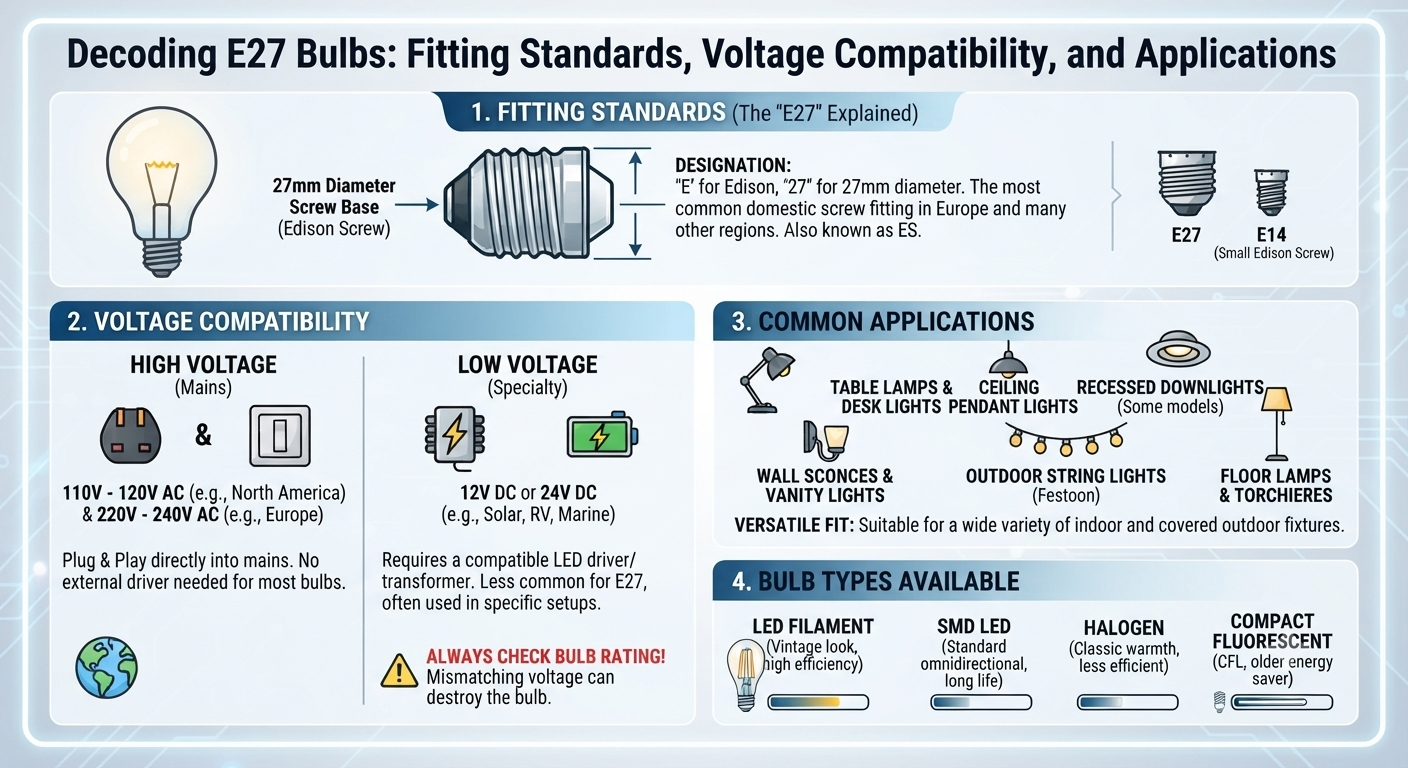
- Base: B22, E27, E14, GU10, or another socket type
- Power: For example, 5W, 7W, 9W, 12W, 15W, or higher
- Voltage: 220–240V, 110–120V, or a wide-voltage input
- Color temperature: Warm white, neutral white, or cool daylight
- CRI: Standard CRI 80+ or higher CRI for applications requiring better color accuracy
- Dimming: Non-dimmable or compatible with specific dimmers
- Beam angle: Narrow, medium, or wide distribution
- Operating environment: Indoor, outdoor, humid, dusty, or high-temperature locations
- Expected lifespan: Residential use versus demanding commercial operation
This specification becomes your technical baseline.
A professional manufacturer should be able to discuss these parameters with you in detail rather than simply asking, "How many pieces do you need?"
Manufacturer or Trading Company? Know the Difference
One of the first questions buyers should ask is whether they are dealing directly with a manufacturer, an OEM/ODM producer, or a trading company.
A manufacturer typically controls production processes and can provide detailed information about LED chips, drivers, PCB design, thermal management, testing, assembly, and quality control.
An OEM manufacturer may produce bulbs according to your brand specifications. This can be useful if you want custom packaging, branding, product dimensions, or electrical specifications.
An ODM supplier may already have an established product design that can be modified or branded for your business.
A trading company, on the other hand, may source products from several factories. That is not automatically bad, but it can make technical consistency and quality control more difficult to verify.
What should you ask?
- Ask the supplier
- Where is the product manufactured?
- Who manufactures the LED PCB and driver?
- What LED chips are used?
- What driver topology is used?
- Where is the final assembly performed?
- What testing is performed before shipment?
- Can the supplier provide technical datasheets?
- Can they provide samples from the actual production line?
- Can they maintain consistent specifications for repeat orders?
Pro Tip: Don't judge a manufacturer by the sophistication of its website alone. A supplier with excellent marketing but vague technical answers deserves more scrutiny than a technically transparent factory with a modest online presence.
Examine the LED Chip Quality
The LED chip is one of the most important components in a bulb, but it is not the only factor determining performance.
Quality LED manufacturers pay attention to
- Luminous efficacy
- Color consistency
- Color binning
- Junction temperature
- Forward voltage
- Long-term lumen maintenance
- Chip reliability
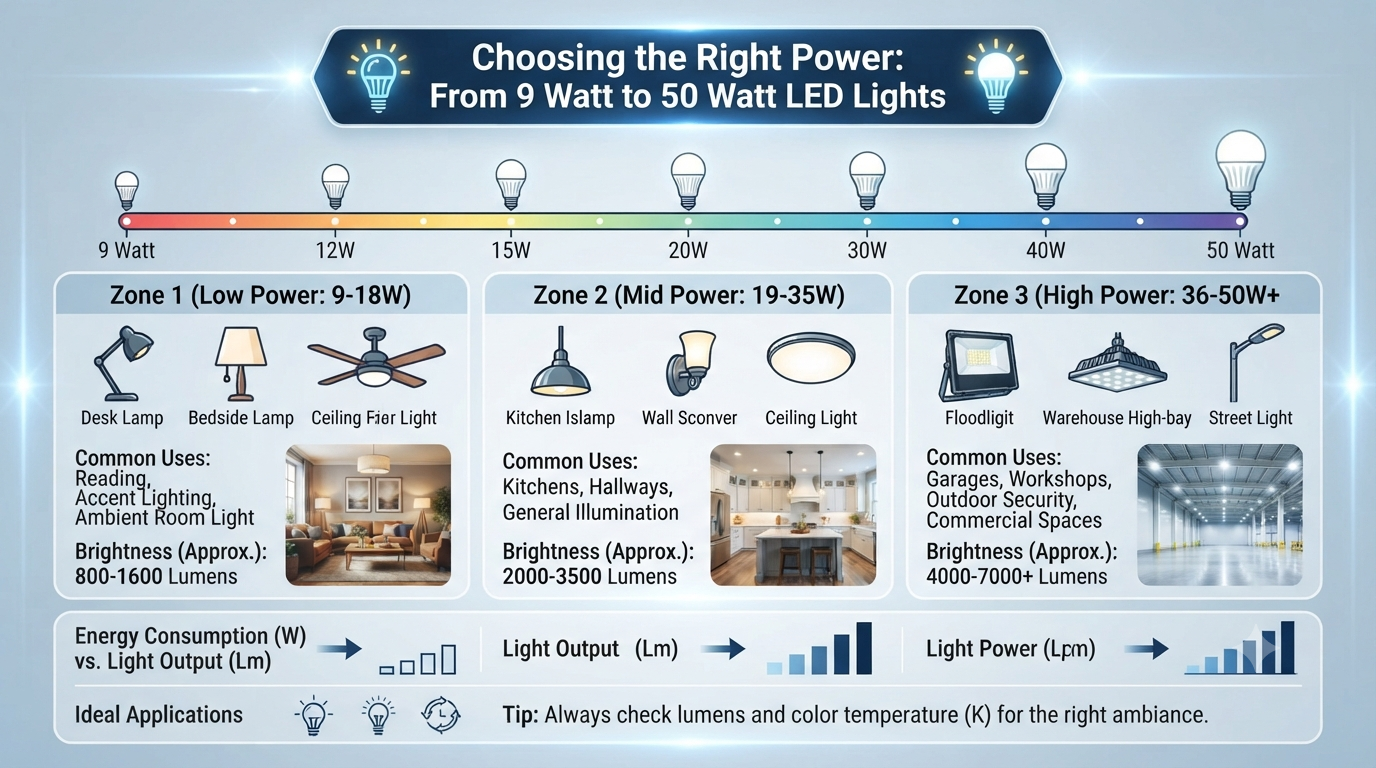
A bulb may advertise a high wattage while producing relatively few lumens. This is where lumens versus watts becomes critical.
Watts measure electrical power consumption. Lumens measure visible light output.
For example, a modern 10W LED bulb producing 1,000 lumens delivers approximately 100 lumens per watt. Another 10W bulb producing only 700 lumens is considerably less efficient, even though both consume the same nominal electrical power.
Look beyond the wattage
- Ask the manufacturer for
- Rated wattage
- Initial lumen output
- Luminous efficacy
- Lumen maintenance data
- LED chip brand or specification
- Color consistency information
A reputable manufacturer should be comfortable discussing these figures.
The LED Driver Is Just as Important as the LED Chip
Many buyers focus heavily on the LED chip and overlook the driver. That is a mistake.
The LED driver converts and regulates electrical power so the LED module can operate correctly. In simple terms, the driver is the power-management system that controls the relationship between the incoming mains supply and the LEDs.
A poor driver can cause
- Flickering
- Excessive heat
- Short lifespan
- Poor power factor
- High electrical stress
- Audible buzzing
- Inconsistent brightness
- Premature failure
A high-quality LED bulb can still perform poorly if it is paired with an undersized or poorly designed driver.
Ask about driver specifications
- For commercial or professional sourcing, ask about
- Input voltage range
- Power factor
- Driver efficiency
- Surge protection
- Over-voltage protection
- Over-temperature protection
- Flicker performance
- Electrolytic capacitor quality
- Driver operating temperature
The manufacturer should also be able to explain how the driver is matched to the LED load.
Pro Tip: If a supplier cannot provide meaningful information about the driver, do not assume the bulb is high quality simply because the housing looks premium.
Compare Manufacturers Using Technical Specifications
When evaluating multiple suppliers, create a standardized comparison sheet. Never compare products using price alone.
Specification
- Manufacturer A
- Manufacturer B
- Manufacturer C
- Rated Power
- 10W
- 10W
- 10W
- Lumen Output
- 1,000 lm
- 850 lm
- 1,100 lm
- Efficacy
- 100 lm/W
- 85 lm/W
- 110 lm/W
- Power Factor
- 90
- 50
- 95
- CRI
- 80+
- 70+
- 80+
- Color Temperature
- 6500K
- 6500K
- 6500K
- Input Voltage
- 220–240V
- 200–240V
- 165–265V
- Driver Type
- IC Driver
- Basic Driver
- IC Driver
- Surge Protection
- Yes
- No
- Yes
- Warranty
- 2 Years
- 1 Year
- 3 Years
- Testing
- Documented
- Limited
- Documented
The lowest price is not necessarily the lowest-cost solution.
If Manufacturer B's bulb fails twice as frequently as Manufacturer C's product, the apparent purchase savings can quickly disappear through returns, replacement stock, logistics, and customer complaints.
Evaluate Lumen Output, Not Just Wattage
A common sourcing mistake is to purchase LED bulbs based solely on wattage.
For example
- Supplier A: 9W = 900 lumens
- Supplier B: 9W = 700 lumens
- Supplier C: 9W = 1,000 lumens
All three products are marketed as 9W bulbs, but their lighting performance is different.
This is why a professional LED bulbs manufacturer should provide verified lumen data.
Also consider whether the stated lumen figure refers to
- LED chip output
- LED module output
- Complete lamp output
The last measurement is generally more useful to the end user because it represents the light actually delivered by the finished product.
For commercial projects, ask whether measurements come from laboratory testing or internal estimates.
Check Color Temperature and CRI
Lighting quality isn't just about brightness.
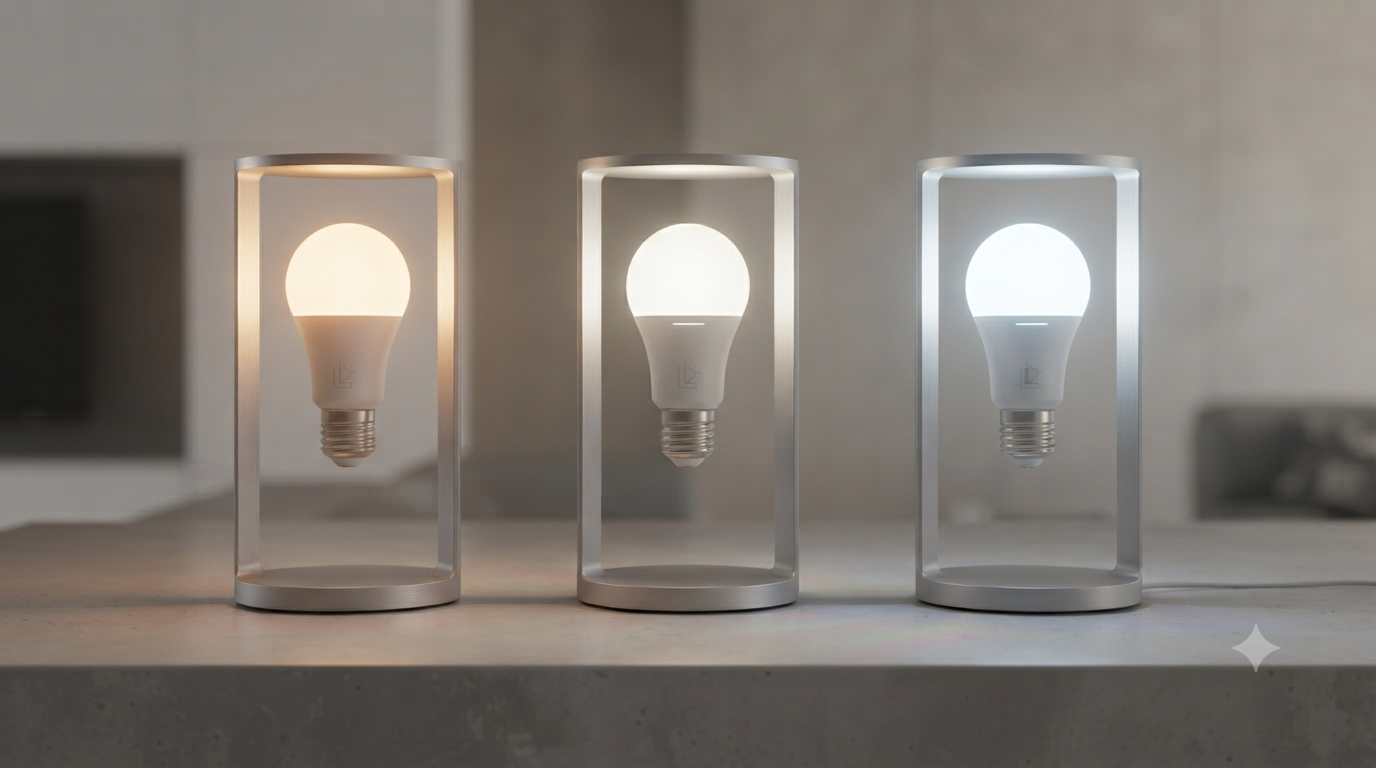
Color temperature, measured in Kelvin (K), determines the visual appearance of white light.
Color Temperature
- Appearance
- Typical Application
- 2700K–3000K
- Warm white
- Bedrooms, restaurants, hospitality
- 3500K–4000K
- Neutral white
- Offices, shops, kitchens
- 5000K–6500K
- Cool/daylight
- Workshops, warehouses, outdoor areas
The right LED bulbs manufacturer should be able to maintain consistent color temperature across production batches.
This is particularly important for retailers and large projects. If a customer buys ten bulbs today and five more six months later, significant color differences can be visually obvious.
What about CRI?
The Color Rendering Index (CRI) indicates how accurately a light source reveals colors compared with a reference light source.
For general residential and commercial lighting, CRI 80+ is commonly suitable. Applications such as retail displays, art spaces, photography, healthcare, and certain industrial environments may benefit from higher CRI products.
Do not accept a vague statement such as "excellent color quality." Ask for the actual CRI specification.
Heat Dissipation Is a Major Quality Indicator
LEDs are highly efficient, but they are not completely free of heat. A portion of the electrical energy consumed by the system becomes heat, and that heat must be managed.
Poor thermal management can accelerate
- LED lumen depreciation
- Driver failure
- Component aging
- Color shift
- Reduced operating life
- The manufacturer's thermal design may include
- Aluminum heat sinks
- Thermally conductive materials
- Ventilation pathways
- Efficient internal component placement
- Thermal interface materials
The housing itself can provide clues, but visual inspection is not enough.
Ask whether the manufacturer conducts temperature testing and whether the bulb has been evaluated under realistic operating conditions.
A bulb designed for a cool laboratory environment may behave very differently inside an enclosed fixture in a hot room.
Pro Tip: If the bulb will be installed in an enclosed ceiling fixture, warehouse, or outdoor fitting exposed to high ambient temperatures, tell the manufacturer. The correct product may require a different driver or thermal design.
Verify Certifications and Compliance
Certifications and compliance documentation are essential, particularly for commercial buyers and importers.
Depending on your market, relevant requirements may include
- Electrical safety testing
- EMC compliance
- RoHS compliance
- Photobiological safety
- Surge immunity
- Energy-efficiency requirements
The exact certifications required depend on the destination market and product category.
Do not rely solely on logos printed on a brochure. Ask for actual documentation and verify that it applies to the specific model being purchased.
A manufacturer may have certification for one bulb family while selling another product under the same brand.
Investigate Quality Control and Production Testing
A serious manufacturer should have a documented quality-control process.
A typical LED bulb production workflow may include
- Incoming component inspection
- LED PCB inspection
- Driver testing
- Assembly inspection
- Electrical safety testing
- Lumen or photometric verification
- Aging or burn-in testing
- Final visual inspection
- Packaging inspection
- Batch traceability
Ask how the manufacturer handles defective units.
More importantly, ask how they prevent defects from reaching the customer in the first place.
Questions worth asking
- What is your acceptable defect rate?
- Do you conduct 100% electrical testing?
- Are products batch-coded?
- How are failed samples recorded?
- Do you perform aging tests?
- Can you provide inspection reports?
- How do you manage component changes?
A supplier that suddenly changes the LED chip, driver, capacitor, or PCB without notifying customers can create serious consistency problems.
Warranty: Read the Fine Print
- A three-year warranty sounds attractive. But what exactly does it cover?
- Ask
- Is the warranty replacement-only?
- Does it cover labor?
- Who pays shipping?
- What constitutes product failure?
- Are there installation restrictions?
- Is the warranty valid in enclosed fixtures?
- Is there a minimum or maximum operating temperature?
- Is there a claim procedure?
A warranty is only valuable if the manufacturer has a practical process for honoring it.
For distributors and retailers, also consider the supplier's after-sales support. Fast technical responses can be more valuable than a slightly longer warranty period.
Consider Customization and Private Label Support
If you are building your own lighting brand, look for a manufacturer that supports OEM and private-label production.
Potential customization options include
- Brand logo
- Packaging design
- Product labels
- Color temperature
- Wattage
- Beam angle
- Housing design
- Driver specifications
- Warranty period
However, customization should not mean compromising technical quality.
A good OEM partner should help you define a product specification that is stable and repeatable. Your next production batch should perform like the previous one.
This is particularly important when building a long-term lighting brand.
Assess Production Capacity and Supply Reliability
A supplier may deliver 5,000 bulbs perfectly but struggle with a 100,000-unit order.
Ask about
- Monthly production capacity
- Current production schedule
- Minimum order quantity (MOQ)
- Lead times
- Component availability
- Packaging capacity
- Export experience
- Backup component sourcing
Supply reliability matters just as much as product quality for businesses selling LED lighting at scale.
Imagine a distributor has a successful retail product but the manufacturer suddenly cannot supply the driver or LED PCB for three months. The business may lose shelf space and customers.
A strong supplier should have a realistic production plan and communicate supply risks early.
Don't Ignore Power Quality and Local Grid Conditions
LED bulbs operate on electrical systems that are not always perfect.
Voltage fluctuations, electrical surges, poor wiring, and unstable power can affect LED lighting performance.
If your products are intended for markets with challenging grid conditions, ask the manufacturer about:
Wide input voltage
- Surge protection
- Driver robustness
- Power factor
- Voltage tolerance
A bulb designed only for ideal laboratory conditions may not perform well in a real-world electrical environment.
This is one reason a manufacturer should understand the market where its products will be installed.
Calculate Total Cost of Ownership
Purchase price is only one part of the equation.
Consider
Total Cost of Ownership = Purchase Price + Energy Cost + Maintenance + Replacement + Logistics + Warranty Handling
For example, a commercial customer may choose between two 12W LED bulbs. One costs less but has lower efficiency and a higher failure rate. The other costs slightly more but delivers better lumen output, has a stronger driver, and lasts longer.
The second product may be the better financial decision.
For large installations, even small efficiency differences can become significant.
A 2W difference across 10,000 bulbs operating for several hours every day can represent substantial energy savings over the operating life of the installation.
This is why professional buyers should evaluate lumens per watt, expected lifespan, driver quality, and warranty performance alongside unit price.
Questions to Ask an LED Bulb Manufacturer Before Ordering
- Use this checklist before finalizing a supplier
- Product
- What is the actual lumen output?
- What LED chip is used?
- What driver is installed?
- What is the power factor?
- What is the CRI?
- What color temperature options are available?
- What is the beam angle?
- Is the bulb dimmable?
- Reliability
- What is the expected operating life?
- What thermal testing has been performed?
- Is surge protection included?
- Is burn-in testing performed?
- Quality
- What certifications are available?
- Can you provide test reports?
- How is batch consistency controlled?
- Can you provide samples from current production?
- Commercial
- What is the MOQ?
- What is the lead time?
- What is the warranty?
- What is the replacement process?
- Can you provide OEM/private-label packaging?
If a supplier gives clear, specific answers backed by documentation, that is a positive sign.
Frequently Asked Questions
- What should I look for in an LED bulbs manufacturer?
Look for a manufacturer with strong quality control, reliable LED chips and drivers, documented testing, consistent lumen output, effective thermal management, appropriate certifications, transparent warranties, and stable production capacity. The right manufacturer should also understand your market's voltage, environmental, and regulatory requirements.
How can I tell if an LED bulb manufacturer is reliable?
Request product samples, technical datasheets, test reports, certification documents, warranty terms, and factory or production information. Compare samples against the manufacturer's stated specifications. Consistency between documentation, samples, and mass production is a strong indicator of reliability.
Is a higher-wattage LED bulb always brighter?
No. Wattage measures energy consumption, not brightness. Lumens are the more relevant measurement for light output. A highly efficient 10W LED bulb can produce more light than a poorly designed 12W bulb.
Should I choose the cheapest LED bulb supplier?
Not necessarily. The lowest purchase price can lead to higher total costs if the bulbs have poor efficiency, short service life, inconsistent performance, or high failure rates. Compare the total cost of ownership, not just the initial unit price.
Final Takeaway: Choose a Lighting Partner, Not Just a Supplier
Selecting the right LED bulbs manufacturer requires more than comparing quotations. Look inside the product. Examine the LED chip, driver, thermal design, lumen output, CRI, power factor, surge protection, and testing procedures.
Then look beyond the bulb itself. Evaluate warranty support, production consistency, supply capacity, documentation, and the manufacturer's ability to maintain the same specifications across future batches.
For distributors, retailers, contractors, and project buyers, the best supplier is rarely the one with the lowest price on the first order. It is the manufacturer that consistently delivers reliable performance, documented quality, predictable supply, and genuine long-term value.
If you are building a lighting brand, sourcing products for resale, or purchasing thousands of bulbs for a commercial project, treat the manufacturer's technical transparency as a buying criterion. The right decision at the sourcing stage can prevent years of product failures, returns, and unnecessary operating costs.